
Case study. Adapted from an actual engagement. All identifying details removed; all figures are the real figures.
The savings
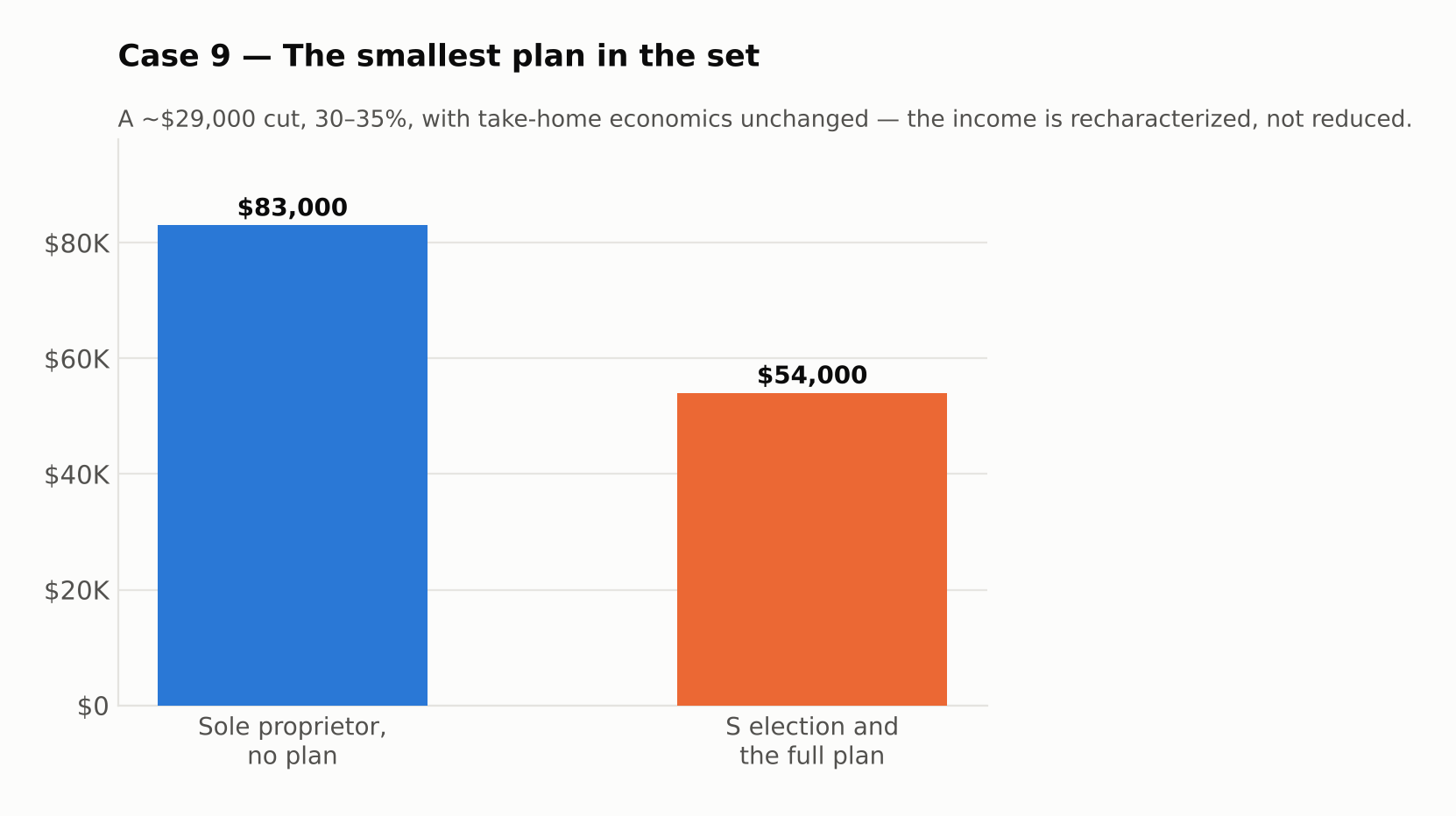
About $29,000, a 30–35% cut, with take-home economics unchanged. The owner still receives the full $300,000 of practice earnings; it is recharacterized, not reduced. This is the cleanest illustration in the set of what tax planning is and is not.
The Taxpayer
A solo owner of a professional services practice organized as a single-member professional entity in a state that imposes no individual income tax on wage or business income. The practice has no employees other than the owner. Annual net profit is approximately $300,000. The owner files as a single taxpayer with no dependents and owns a home subject to a mortgage. The practice rents outside office space at $1,800 per month and carries professional liability coverage costing approximately $2,500 per year.
As of the planning date (November 2025), the entity was taxed as a sole proprietorship, the default classification for a single-member LLC under Treas. Reg. § 301.7701-3(b)(1)(ii). The owner had contributed only $10,000 to a SEP-IRA for the year, drove a personal sport-utility vehicle informally treated as the “business car” with no formal titling or depreciation schedule, and had been taking a home office deduction on an actual-expense allocation. Books and payroll were informal.
The Situation
This is the classic profile of a successful single-owner professional practice that has outgrown its default tax structure. Every dollar of the $300,000 of net profit was flowing through Schedule C, and therefore every dollar was exposed to self-employment tax under IRC § 1401 at the combined 15.3% rate (subject to the Social Security wage base, with the 2.9% Medicare component and the 0.9% additional Medicare tax under § 3101(b)(2) uncapped). The resulting self-employment tax burden was on the order of $30,000 annually.
At the same time, three sizable deductions available to the practice were being underused or missed entirely:
- Retirement contributions were running at $10,000 against a statutory ceiling of $70,000 for 2025 ($72,000 for 2026), subject to the 25%-of-compensation limitation of § 404(h).
- A vehicle worth approximately $40,000 with an outstanding loan balance of approximately $36,000 was held personally, producing no depreciation deduction and no interest deduction, because interest on a personal automobile loan is nondeductible personal interest under § 163(h).
- The home office was being claimed on the owner’s personal return rather than through an employer accountable plan, a structure that becomes unavailable the moment the entity elects S corporation status, because unreimbursed employee business expenses are disallowed under § 67(g).
The engagement was timed deliberately: the planning window ran from November 2025 so that every structural change could be effective January 1, 2026, and the vehicle could be placed in service on the first day of the first S corporation year.
Issues Presented
- Whether electing S corporation treatment for the single-member professional entity would reduce total employment tax on approximately $300,000 of practice profit, and what level of owner salary is defensible as “reasonable compensation.”
- How the choice of salary level interacts with, and constrains, the maximum SEP-IRA contribution, and whether the trade-off is net favorable.
- Whether contributing a personally owned heavy sport-utility vehicle to the entity permits a full first-year write-off of its fair market value under § 168(k) as restored by the One Big Beautiful Bill Act of 2025, notwithstanding the luxury-automobile limits of § 280F.
- Whether the related automobile loan interest becomes deductible business interest under § 163(a) once the debt is allocable to the trade or business.
- How to preserve the home office deduction after the S election, given § 67(g), and how to avoid the § 280A(c)(6) trap that defeats a direct lease of space from an owner-employee to the entity.
- What bookkeeping, payroll, and estimated-tax compliance infrastructure the plan requires to be defensible.
Analysis
S Corporation Election and the Reasonable Compensation Boundary
A single-member LLC is disregarded by default. It may elect to be classified as an association taxable as a corporation under Treas. Reg. § 301.7701-3(c), and in the same act elect S status by filing Form 2553 under § 1362(a); Rev. Proc. 2004-48 permits a single, timely Form 2553 to accomplish both the entity classification election and the S election. No change to the entity’s legal form under state law is required, the single-member professional entity remains exactly that, with its liability shield and professional-licensing posture intact. Only the federal tax classification changes.
The mechanical consequence is the division of the owner’s economic return into two streams:
- Wages. Compensation paid to the owner-employee is subject to FICA under §§ 3101 and 3111, 6.2% employee and 6.2% employer Social Security to the wage base, plus 1.45% each in Medicare without limit, plus the 0.9% additional Medicare tax on the employee side above the applicable threshold.
- Distributions. The residual S corporation profit passes through on Schedule K-1 and is taxed as ordinary income, but is not subject to FICA or self-employment tax. S corporation distributive share is excluded from net earnings from self-employment under § 1402(a)(2).
The constraint is § 162 reasonableness, enforced through the line of authority holding that an S corporation that distributes profit to a working shareholder without paying adequate wages has made a disguised wage payment. See Rev. Rul. 74-44, 1974-1 C.B. 287; Joseph Radtke, S.C. v. United States, 712 F. Supp. 143 (E.D. Wis. 1989), aff’d, 895 F.2d 1196 (7th Cir. 1990); Spicer Accounting, Inc. v. United States, 918 F.2d 90 (9th Cir. 1990); David E. Watson, P.C. v. United States, 668 F.3d 1008 (8th Cir. 2012). The Service’s position and the case law converge on a facts-and-circumstances inquiry keyed to the value of the services the owner actually performs.
The recommendation set annual salary at $120,000 against $300,000 of profit, leaving approximately $180,000 as distribution. The supporting reasoning:
| Item | Sole proprietorship (current) | S corporation (planned) |
|---|---|---|
| Net profit / economic return | $300,000 | $300,000 |
| Base subject to SE tax or FICA | ~$300,000 | $120,000 |
| Self-employment tax | ~$30,000+ | n/a |
| Combined employer + employee FICA | n/a | ~$18,000 |
| Residual taken as distribution | $0 | ~$180,000 |
| Employment-tax savings | n/a | ~$12,000–$15,000 |
A salary in the $100,000–$150,000 band is defensible for an owner at this profit level, and the file documents the benchmark against published compensation survey data for the owner’s profession, market, and years of experience. The documentation is the deliverable: a contemporaneous reasonable-compensation memorandum in the entity file, refreshed annually, is what converts a favorable split into a defensible one. An unreasonably low salary invites recharacterization of distributions as wages, with FICA, penalties, and interest.
SEP-IRA Funding and the Salary-Dependency Trade-Off
The retirement-plan consequence of the salary decision is the subtlest point in the engagement, and it runs in the opposite direction from the employment-tax saving.
Under § 408(k) and § 404(h), an employer SEP contribution is limited to 25% of the participant’s compensation, subject to the overall § 415(c) ceiling of $70,000 for 2025 and $72,000 for 2026. For an S corporation owner-employee, “compensation” means W-2 wages. A $120,000 salary therefore supports a maximum employer SEP contribution of $30,000.
| Salary level | Maximum SEP (25% of comp) | Employment tax on salary |
|---|---|---|
| $120,000 (recommended) | $30,000 | ~$18,000 |
| $300,000 (salary-only, no split) | capped at $70,000–$72,000 | ~$30,000+ |
Paying a $300,000 salary would have raised the SEP ceiling to the full statutory limit, but at the cost of the entire employment-tax saving, a worse net outcome at these numbers. The engagement accepted the lower SEP ceiling in exchange for the FICA split, while noting that the $30,000 contribution is still three times the $10,000 actually contributed for the prior year.
Mechanically, the SEP contribution is made by the employer. It is deducted on the entity’s Form 1120-S as a pension expense, reducing the profit that passes through on the K-1, rather than being claimed as an above-the-line deduction on the owner’s Form 1040. The economics are equivalent; the reporting is not, and the bookkeeper must be instructed accordingly. Contributions for a tax year may be funded through the extended due date of the entity return, for a 2026 tax year, as late as September 15, 2027 on extension, which preserves cash-flow flexibility and permits the contribution to be sized after the year’s final W-2 figure is known.
The incremental $20,000 of contribution, at an approximate 32% marginal federal rate, yields roughly $6,000 of current-year federal income tax savings, plus tax-deferred compounding.
The memorandum flagged, without recommending for the current year, that a solo 401(k) would permit employee elective deferrals under § 402(g) on top of the employer contribution, raising the achievable total at a $120,000 salary materially above the 25% SEP ceiling. That remains the obvious next-year refinement once payroll infrastructure is running.
Heavy-Vehicle Contribution and 100% Bonus Depreciation Under Sec. 168(k)
The vehicle analysis turns on three separate provisions interlocking.
First, bonus depreciation availability. The One Big Beautiful Bill Act of 2025, enacted July 4, 2025, restored 100% bonus depreciation under § 168(k) and made it permanent for qualified property placed in service after the statutory effective date, eliminating the TCJA phase-down schedule that had been stepping the percentage toward zero. Qualified property includes MACRS property with a recovery period of 20 years or less, which covers a 5-year-class business automobile under Rev. Proc. 87-56.
Second, the luxury-automobile limitation. Section 280F(a) caps annual depreciation on a “passenger automobile.” But § 280F(d)(5)(A) defines that term by reference to a gross vehicle weight rating of 6,000 pounds or less. A sport-utility vehicle with GVWR in excess of 6,000 pounds falls outside the definition entirely and is not subject to the § 280F caps. (Section 179(b)(5) separately caps the elective expensing of such a vehicle, but that limitation does not restrict § 168(k) bonus depreciation, which is why the deduction here is taken under § 168(k) rather than § 179.) The subject vehicle’s GVWR exceeds the 6,000-pound threshold, so the full depreciable basis is eligible for first-year bonus treatment.
Third, acquisition by the entity and placement in service. The owner contributes the vehicle to the single-member professional entity as a capital contribution, with the entity assuming the related debt. Contribution of property to the entity is a § 351 exchange (or, for the pre-election period, a contribution to a disregarded entity); basis carries over under § 362. The file documents the transfer by written consent or bill of sale reciting the $40,000 fair market value and the assumption of the $36,000 note, and the title and insurance are transferred to the entity name. The vehicle is placed in service by the entity on January 1, 2026, property is “placed in service” when it is first ready and available for its assigned function.
Result: a first-year depreciation deduction of approximately $40,000, producing roughly $14,000 of tax savings in that year at the owner’s rates.
Two conditions govern. Business use must exceed 50%; if qualified business use falls to 50% or below in a later year, § 280F(b)(2) requires recapture of the excess depreciation as ordinary income. And substantiation of business use is governed by § 274(d) and Treas. Reg. § 1.274-5T, which require a contemporaneous mileage log. The practical recommendation is to retain a separate personal vehicle so that the entity-owned vehicle can be used almost exclusively for client and office travel, client meetings, and other business driving, making the near-100% business-use position easy to support. Where personal use occurs, it must be handled either by owner reimbursement to the entity or by inclusion of a fringe-benefit value in wages under Treas. Reg. § 1.61-21.
Operating costs, fuel, maintenance, insurance, registration, and personal property taxes, become deductible to the entity to the extent of business use once the vehicle is on the books.
Finally, this is a one-time deduction. The vehicle is fully depreciated in year one, and the memorandum states plainly that no comparable deduction recurs in 2027 or later. The planning value of the figure is front-loaded, and the file notes that a future vehicle replacement, not a repeat of the same deduction, would be required to generate another first-year write-off.
Business Interest on the Vehicle Loan
Section 163(h) disallows personal interest, and consumer automobile loan interest is squarely within that disallowance. But § 163(a) allows a deduction for “all interest paid or accrued on indebtedness,” and interest on debt properly allocable to a trade or business under the tracing rules of Treas. Reg. § 1.163-8T is deductible business interest.
Once the entity assumes the note and services it from the business account, the approximately $1,500 of annual interest (on a $36,000 balance at an assumed 4%–5% rate) becomes a business deduction. The § 163(j) business-interest limitation does not apply: the practice is well under the gross-receipts threshold for the small-business exemption of § 163(j)(3).
The OBBBA’s new limited personal automobile loan interest deduction, up to $10,000 per year, was considered and rejected as inapplicable on these facts. It reaches only new vehicle purchases and phases out for single filers with income above $100,000. The owner’s income is far above that threshold and the vehicle is not a new purchase. Routing the interest through the business side bypasses both limitations.
Home Office: Sec. 280A and the Accountable-Plan Solution
The owner uses a dedicated portion of the home exclusively and regularly for the practice. The existence of an outside rented office does not defeat the deduction: § 280A(c)(1)(A) permits a deduction for a portion of a dwelling unit used exclusively and regularly as a place of business, and the home workspace supports distinct functions, drafting, research, and administrative work outside office hours. The deduction had been computed on an actual-expense allocation rather than the $5 per square foot, 300-square-foot safe harbor, because the actual-expense method produces the larger deduction on this home. At an approximate 10% business-use allocation, annual deductible home office expense is approximately $5,000.
The S election changes the delivery mechanism, not the entitlement. After the election the owner is an employee, and § 67(g) suspends the miscellaneous itemized deduction for unreimbursed employee business expenses through the OBBBA-extended period. An employee cannot deduct home office expense directly.
Two routes exist, and only one is correct:
- A lease of the home office space from the owner to the entity is a trap. Section 280A(c)(6) denies the employee any deduction for expenses attributable to the rental of a dwelling unit to an employer. The entity would deduct the rent; the owner would recognize rental income and be barred from offsetting it with the related expenses. The result is a worse outcome than taking nothing.
- An accountable plan under Treas. Reg. § 1.62-2 is the correct structure. The entity adopts a written accountable plan. The owner submits a periodic expense report substantiating the allocable share of mortgage interest, property tax, insurance, utilities, maintenance, and depreciation together with the square-footage allocation. The entity reimburses, approximately $5,000 annually on these facts. The reimbursement is deductible to the entity, is excluded from the owner’s gross income, and is not reported as wages. Because the reimbursement exactly offsets documented costs, no rental income arises and § 280A(c)(6) is never triggered.
The coordination point on the personal return: amounts of mortgage interest and property tax allocated to the business and reimbursed through the plan are not also deductible on Schedule A. The owner must still test whether the remaining personal-use share of qualified residence interest under § 163(h)(3), remaining real property taxes within the state and local tax cap as raised by OBBBA, and charitable contributions exceed the standard deduction. A single filer with a mortgage will often clear it. Bunching charitable contributions into alternating years is the standard lever for pushing a marginal itemizer decisively over the threshold.
Compliance Infrastructure
The strategies are only worth their projected value if the records support them. The plan requires:
- Form 2553 filed by March 15, 2026 for an S election effective January 1, 2026 (§ 1362(b)(1)).
- Form 1120-S annually, plus a Form W-2 to the owner-employee, plus quarterly Form 941 and annual Form 940 payroll filings. A full-service payroll provider handles withholding, deposit, and filing, the single most common failure point for a first-year S corporation owner is a missed payroll deposit deadline.
- Estimated tax payments on the distribution portion. Salary withholding covers the wage component; the K-1 income does not. Either quarterly estimates under § 6654 or increased wage withholding is required to avoid the underpayment penalty. Increasing withholding on the salary is often the cleaner administrative choice.
- Books segregating every category the plan relies on: salary, employer SEP contribution, home office reimbursements, vehicle depreciation schedule and mileage log, office rent, professional liability premium, supplies, travel, and marketing.
- Documentary record for each structural step: the reasonable-compensation benchmark memorandum, the written consent and bill of sale for the vehicle contribution reciting $40,000 value and $36,000 debt assumption, the written accountable plan, and the depreciation schedule.
- State-level filings. The owner’s state imposes no individual income tax on wage or business income, so neither the salary nor the distribution attracts state income tax, a fact that makes the salary/distribution split cleaner here than in states that tax S corporation distributive share or impose entity-level taxes on the split. The entity may nonetheless owe the state’s entity-level taxes; the engagement flagged that whether the state’s entity-level tax regime offers an exemption for professional service entities required verification before the first entity filing.
The Plan
| Phase | Action | Deadline |
|---|---|---|
| 1 | File Form 2553 electing S status effective January 1, 2026 | March 15, 2026 |
| 1 | Establish payroll; set owner salary at $120,000 annualized | January 2026 |
| 2 | Document reasonable-compensation benchmark in entity file | Q1 2026 |
| 2 | Execute written consent / bill of sale contributing the vehicle at $40,000 FMV with assumption of the $36,000 note; transfer title and insurance; notify lender | January 1, 2026 |
| 2 | Place vehicle in service; open depreciation schedule at $40,000; begin mileage log | January 1, 2026 |
| 2 | Adopt written accountable plan; begin periodic home office reimbursement (~$5,000/yr) | Q1 2026 |
| 3 | Run all practice expenses through business accounts: $1,800/mo rent, ~$2,500/yr professional liability coverage, supplies, travel, marketing | Ongoing 2026 |
| 3 | Mid-year review of salary adequacy, estimated tax posture, and profit trend | Mid-2026 |
| 4 | Fund employer SEP contribution of ~$30,000 (25% of final W-2) | By extended 1120-S due date |
Projected Result
| Component | Annual effect |
|---|---|
| Employment tax savings from salary/distribution split | ~$12,000+ |
| Vehicle bonus depreciation deduction (one-time, 2026) | $40,000 deduction → ~$14,000 tax |
| Incremental SEP contribution ($30,000 vs. $10,000) | $20,000 deduction → ~$6,000+ tax |
| Home office via accountable plan | ~$5,000 deduction |
| Business interest on vehicle loan | ~$1,500 deduction |
| Aggregate reduction in taxable income | ~$60,000+ |
| Federal income tax savings | ~$18,000–$20,000 |
| Scenario | Federal income tax | SE / payroll tax | Total |
|---|---|---|---|
| 2026 as sole proprietor (no plan) | n/a | n/a | ~$83,000 |
| 2026 with S corporation and full plan | n/a | n/a | ~$54,000 |
| Reduction | n/a | n/a | ~$29,000 (30–35%) |
Combined first-year savings are projected at approximately $25,000–$30,000, with take-home economics unchanged, the owner still receives the full approximately $300,000 of practice earnings, recharacterized rather than reduced. In subsequent years the SEP, home office, and interest deductions recur; the $40,000 vehicle depreciation does not.