
Case study. Adapted from an actual engagement. All identifying details removed; all figures are the real figures.
The savings
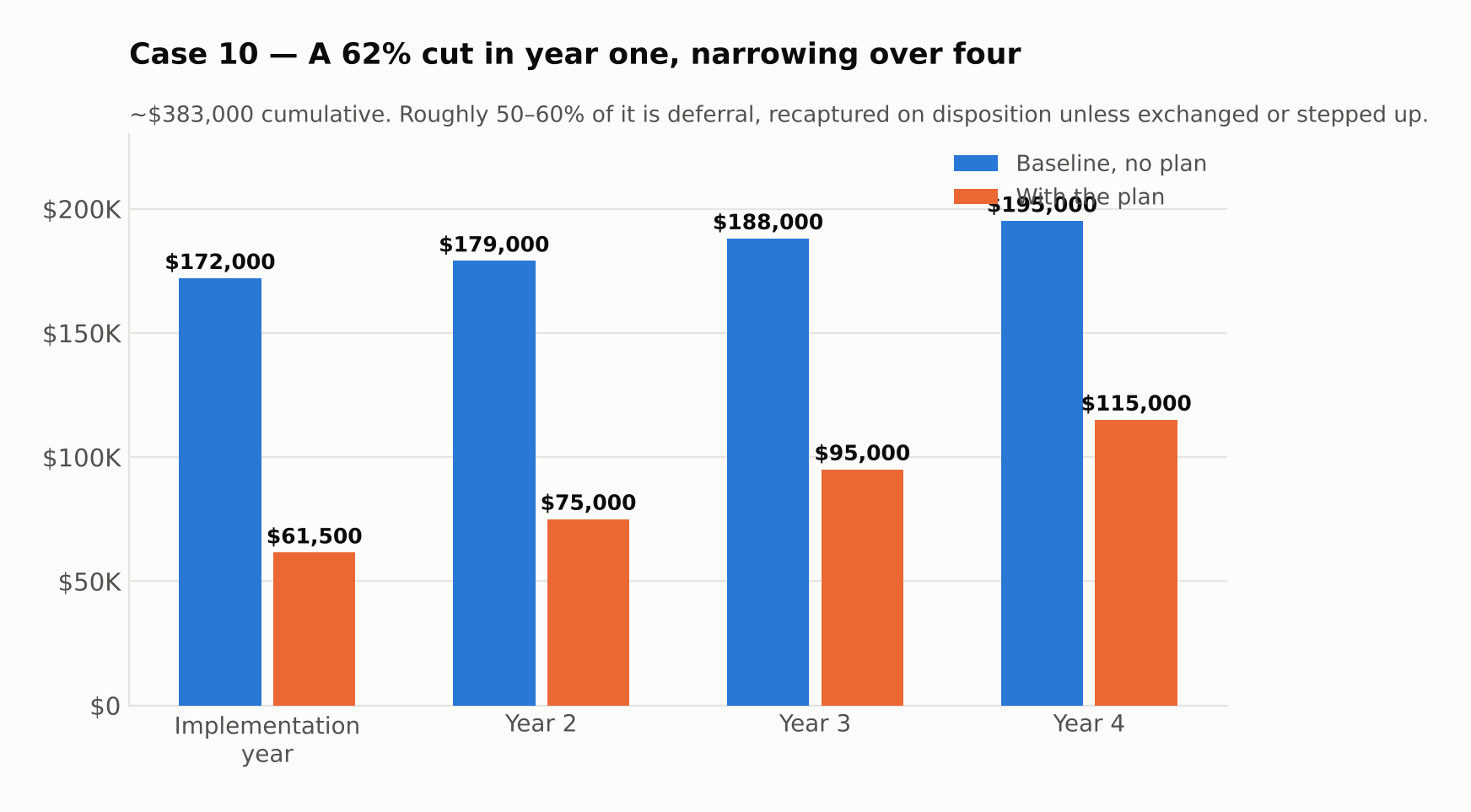
$106,000 to $115,000 in one year, a 62% to 67% reduction, and approximately $383,000 cumulative over four years. One lever is three quarters of it, and that lever only works because of a provision that has nothing to do with depreciation: the spouse qualifying as a real estate professional, which is what makes the losses usable against $1,000,000 of W-2 income.
The Taxpayer
A married couple filing jointly. The husband is a physician and an equity owner in his medical practice, which is assumed to be a C corporation and in which he holds a minority, non-controlling interest. The wife is a homemaker with no wages of her own, a fact of central strategic importance to everything that follows. Four dependents, each claimed for the credit for other dependents.
The couple resides in a state with a flat individual income tax. The engagement date was April 2026, and the planning was calibrated against the couple’s filed joint return for the prior-to-prior year, prepared by an outside CPA firm and signed in September 2025.
Asset profile:
| Category | Approximate balance |
|---|---|
| 401(k) | $1,500,000 |
| Defined benefit plan | $485,000 (contributions ~$8,000/month; stated capacity ~$10,000/month) |
| Roth IRAs (combined) | $300,000 |
| HSA | $100,000 |
| 529 accounts | $161,000 |
| Taxable brokerage (three accounts, passive ETF posture) | $325,000 |
| Direct investment real estate | One family rental partnership; nothing else directly owned |
| Closely held equity | Minority interests in the practice, ambulatory surgical centre interests, a practice real-property affiliate, an industrial-park partnership, and a privately held technology position |
| Personal residence | Mortgaged at approximately 2%; long remaining term; no planned acceleration |
| High-interest consumer debt | ~$30,000, targeted for payoff in the planning year |
Structural posture at engagement: no personal holding company, no operating company, no S corporation, no will, no revocable trust, no financial or health care power of attorney, no HIPAA authorization, no guardianship designation, no irrevocable trust, no asset-protection architecture of any kind.
The Situation
The filed-return baseline
| Line item | Prior year (actual) | Year before (comparative) |
|---|---|---|
| W-2 wages | approximately $512,000 | approximately $462,000 (+10.9%) |
| Schedule E, partnerships / S corps (net) | $87,038 | $160,787 (-45.9%) |
| Form 4797 § 1231 gain | $7,822 | $3,861 |
| Schedule D, net long-term capital gain | $7,668 | ($3,000) limited |
| Schedule C, consulting (net) | $4,000 | $12,000 |
| Interest | $6,965 | $6,019 |
| Ordinary dividends (qualified $3,421) | $6,365 | $5,785 |
| Tax-exempt interest | $1,050 | n/a |
| Total income | approximately $632,000 | approximately $647,000 |
| Adjustments to income (½ SE tax) | ($54) | n/a |
| AGI | approximately $632,000 | approximately $647,000 |
| Itemized deductions | approximately $87,000 | approximately $79,000 |
| QBI deduction (§ 199A) | $43 | $12,128 |
| Taxable income | approximately $544,000 | approximately $556,000 |
| Federal income tax | approximately $129,000 | approximately $138,000 |
| Other federal taxes (SE $107; NIIT $368; additional Medicare $2,597) | $3,072 | $2,627 |
| Total federal tax | approximately $132,000 | approximately $140,000 |
| State individual income tax | approximately $25,000 | approximately $30,000 |
| Combined federal + state tax | approximately $157,000 | approximately $171,000 |
| Effective combined rate on AGI | 24.82% | 26.38% |
Federal withholding was approximately $153,000, estimated payments approximately $3,000, and a $30 foreign tax credit was claimed without Form 1116 under the de minimis election of § 904(j), producing a federal refund of approximately $24,000. State withholding (through the practice’s payroll administrator) ran slightly below total state credits and prepayments, producing a small state refund. State tentative tax was reduced by state credits and prepayments.
Itemized deductions of approximately $87,000 comprised: state and local taxes capped at $10,000 (state and local income taxes paid were approximately $27,000; real property taxes approximately $3,000; approximately $30,000 before cap); home mortgage interest $9,549; investment interest $7,787 (Form 4952, from a K-1 allocation); cash charitable contributions $10,824; and non-cash charitable contributions of $49,313, three tranches of appreciated broad-market index fund shares donated in-kind. Total charitable giving: $60,137.
The structural problem
81% of total income was W-2 wages, up from 71% the prior year, both absolutely (wages up approximately $50,000) and proportionally. Wages cannot be sheltered by passive losses. Meanwhile the household held $120,858 of suspended passive activity losses carried forward on Form 8582, concentrated in a handful of syndication investments with small balances attributable to the family rental partnership and an ambulatory surgical centre affiliate.
Current-year passive losses from these vehicles totaled $17,965. Prior-year unallowed losses were $149,375, of which $44,706 was absorbed by current-year passive income, the trapped-PAL inventory therefore decreased by approximately $34,282 from the comparative year’s $155,140. That absorption is important: it is empirical proof that passive income, when generated, releases stranded losses dollar for dollar under § 469(b).
The marginal rate stack on the next dollar of wage income was approximately 40%, reflecting the federal marginal bracket (taxable income of approximately $544,000 falls in the $487,450–$731,200 married-filing-jointly band), the additional Medicare tax on excess Medicare wages ($2,564 base plus $33 spousal pickup, totaling $2,597), and the state’s flat individual income tax. Against an effective combined rate of 24.82%, the gap between effective and marginal is the entire planning opportunity: every dollar of wage income shielded by an active real-estate loss saves the marginal rate, not the average.
The QBI collapse
The § 199A deduction fell from $12,128 to $43. Form 8995-A produced a $215 wage/UBIA-limited preliminary amount across nine qualifying activities, reduced by loss netting ($19,884 of losses across the loss activities) and a phase-in reduction. Two structural causes: every rental and syndication activity except the practice operated at a QBI net loss, and at approximately $544,000 of pre-QBI taxable income the household sits far above the married-filing-jointly threshold ($383,900 in the filed year), triggering the wage/UBIA limitation of § 199A(b)(2)(B). QBI is not a meaningful lever on these facts absent a change in the active-trade-or-business income mix.
What was already working
Retirement and charitable discipline were sound. Approximately $96,000 of wage deferrals, employer match, and defined-benefit contributions (inferred from the $23,000 spread between Medicare wages of approximately $535,000 and Box 1 wages of approximately $512,000). Both spouses executed clean backdoor Roth contributions of $7,000 each ($14,000 combined, $0 taxable, Forms 8606). A $14,000 distribution from the practice’s defined benefit plan was reported as a nontaxable rollover. The HSA was funded at the full family limit of $8,300 with $4,682 of qualified distributions and no excise tax. The three-tranche appreciated-share donation pattern is a textbook execution of § 170 and Rev. Rul. 78-197, fair market value deduction with no recognition of built-in gain.
The diagnosis is therefore structural, not behavioral: the single largest lever available to a high-wage professional, converting active income into sheltered income through a directly owned, materially participated real estate activity, had never been built.
Issues Presented
- Whether the non-working spouse can qualify as a real estate professional under § 469(c)(7), and whether the working spouse’s full-time medical practice forecloses his own qualification.
- Whether a short-term rental with an average period of customer use of seven days or fewer escapes “rental activity” classification under Treas. Reg. § 1.469-1T(e)(3)(ii)(A), permitting non-passive loss treatment on material participation alone, without REP qualification.
- The magnitude of first-year depreciation obtainable on an approximately $1,000,000 short-term rental acquisition using a cost segregation study and 100% bonus depreciation under § 168(k) as restored by the One Big Beautiful Bill Act of 2025.
- Whether REP qualification retroactively releases the $120,858 of pre-existing suspended passive losses, and if not, what the monetization path is.
- What entity architecture best supports the real estate program, and whether any existing closely held or syndication interest can be contributed to it without triggering tax or breaching governance restrictions.
- How to remedy the complete absence of testamentary, incapacity, and guardianship instruments for a household with four minor dependents.
- When, not whether, to install self-settled asset protection, given voidable-transaction exposure.
- Whether the pending vehicle purchase should be placed in a business entity.
- What refinements to the existing charitable, defined-benefit, Roth, and HSA posture are available.
Analysis
Passive Activity Rules, the Sec. 469 Pathway Analysis
Section 469 disallows deductions attributable to passive activities except to the extent of passive income. A passive activity is any trade or business in which the taxpayer does not materially participate and, with limited exceptions, any rental activity. § 469(c). Material participation means involvement that is regular, continuous, and substantial. § 469(h)(1).
Material participation is established under the seven tests of Treas. Reg. § 1.469-5T(a). The three commonly used are the 500-hour test, the substantially-all test, and the more-than-100-hours-and-more-than-any-other-individual test of Treas. Reg. § 1.469-5T(a)(3). Hours must be substantiated by reasonable means. While Treas. Reg. § 1.469-5T(f)(4) does not strictly require contemporaneous daily logs, the Tax Court has been unforgiving toward uncorroborated post hoc reconstructions. Moss v. Commissioner, 135 T.C. 365 (2010); Hakkak v. Commissioner, T.C. Memo. 2020-46; Pohoski v. Commissioner, T.C. Memo. 1998-17.
REP status under § 469(c)(7)(B) requires both (i) more than 750 hours of services during the year in real property trades or businesses in which the taxpayer materially participates, and (ii) more than half of all personal services performed by the taxpayer during the year in such trades or businesses. For a married couple, each spouse is tested separately on both prongs; the hours of one spouse are not aggregated with the other for qualification purposes. Once one spouse qualifies, the couple may elect to treat all rental real estate interests as a single activity for material-participation testing under § 469(c)(7)(A) and Treas. Reg. § 1.469-9(g).
Applied here, the pathway analysis is dispositive. The physician spouse cannot qualify: a full-time clinical practice generating approximately $512,000 of wages makes the “more than half of personal services” prong impossible. The homemaker spouse, by contrast, reports no wages of her own on the filed return, which makes the 50%-of-personal-services prong essentially automatic. The entire active-loss strategy runs through her.
The Short-Term Rental Exception, the Cleaner 2026 Path
The short-term rental route is faster and structurally safer than REP for the first year, and the memorandum made it the primary recommendation.
Treas. Reg. § 1.469-1T(e)(3)(ii)(A) excludes from “rental activity” any activity in which the average period of customer use is seven days or fewer. An activity meeting the seven-day test is not a rental activity at all; it is a trade or business. If the taxpayer materially participates in that trade or business under any of the seven tests of Treas. Reg. § 1.469-5T(a), the activity is non-passive and its losses, including bonus depreciation, are immediately deductible against ordinary income, including wages. Bailey v. Commissioner, T.C. Summ. Op. 2001-103; CCA 201427016.
The critical consequence: the STR route does not require REP qualification at all. It requires no 750-hour commitment and no 50%-of-services test. It requires only material participation in the specific STR activity, most practically satisfied under the 100-hours-and-more-than-anyone-else test of Treas. Reg. § 1.469-5T(a)(3). That is a far lower and far more documentable bar in the first year of a program.
REP qualification remains the recommended concurrent posture, because it is what permits long-term rentals acquired in later years to generate non-passive losses as well, where the seven-day rule will not be available.
Cost Recovery and Bonus Depreciation, Secs. 167, 168, 168(k), 1245, 1250
Cost segregation reclassifies portions of acquired real property from 27.5-year residential or 39-year nonresidential recovery periods into 5-, 7-, and 15-year property. Hospital Corp. of America v. Commissioner, 109 T.C. 21 (1997); Rev. Proc. 87-56. Reclassified components, having recovery periods of 20 years or less, are qualified property eligible for bonus depreciation under § 168(k).
The One Big Beautiful Bill Act of 2025 restored 100% bonus depreciation and made it permanent for qualified property placed in service after January 19, 2025, eliminating the post-2022 phase-down.
The worked projection on a $1,000,000 acquisition:
| Component | Amount |
|---|---|
| Purchase price | $1,000,000 |
| Land allocation (20%) | ($200,000) |
| Depreciable basis | $800,000 |
| Cost segregation reclassification ratio (28%) | 28% |
| 5-, 7-, and 15-year property eligible for 100% bonus | ~$224,000 |
| Partial-year MACRS on remaining 27.5-year residential basis | ~$10,000–$15,000 |
| First-year deduction | ~$235,000–$245,000 |
| Applied at the approximately 40% marginal stack | ~$94,000–$98,000 of combined federal and state tax savings |
This single item is the largest discrete lever in the plan. A typical reclassification ratio of 25%–30% on a $1,000,000 property produces $250,000–$300,000 of first-year bonus deduction before land allocation, the 28% assumption and 20% land allocation used here are deliberately mid-range.
“Placed in service” means ready and available for its assigned function, listed, advertised, furnished, and either booked or available for booking. Treas. Reg. § 1.167(a)-11(e)(1)(i); Stine, LLC v. United States, 2015 WL 9412700 (W.D. La. 2015). The property need not have hosted a paying guest by December 31; it must be available.
Recapture. The deduction is offset at disposition by § 1245 (full ordinary recapture on the personal property components) and § 1250 (unrecaptured § 1250 gain taxed at 25% on the real property components). Recapture is a deferral, not a permanent giveback, and is mitigated by a § 1031 like-kind exchange (real property only, post-TCJA) or eliminated by holding through death for a § 1014 basis step-up. The plan therefore embeds a hold-or-exchange discipline; any contemplated sale must be modeled on an after-tax basis before execution.
NIIT interaction. Net investment income tax under § 1411 applied in the filed year in the amount of $368, computed on $9,686 of net investment income against approximately $382,000 of MAGI in excess of the $250,000 married-filing-jointly threshold. NIIT does not reach wages. On the rental side, properly classified non-passive trade-or-business rental income (and future gain) is excluded from net investment income under § 1411(c)(2)(A) and Treas. Reg. § 1.1411-5, a secondary benefit of the non-passive characterization.
The Suspended PAL Question, and the Common Misconception
REP qualification does not retroactively unlock pre-existing suspended passive losses. This is the single most frequently misunderstood point in this area, and the memorandum addressed it expressly. REP changes the character of new losses going forward. The $120,858 of pre-REP suspended PALs continue to require their own monetization path, which is one of exactly two things:
- Full disposition of each activity in a fully taxable transaction to an unrelated party, releasing the suspended loss under § 469(g) and recovering the trapped basis-times-marginal-rate benefit; or
- Future passive income against which the suspended losses offset under § 469(b).
The filed return proves route two is live: $44,706 of prior-vintage suspended losses were absorbed by the household’s own current-year passive income across several activities, the family rental partnership, the practice real-property affiliate, the industrial-park partnership, and the ambulatory surgical centre interests, with no structural change whatsoever. The architecture recommended below permits deliberate routing of future passive-character income toward the existing PAL inventory, accelerating an absorption pattern that has already demonstrated itself.
Entity Architecture, Holding LLC Plus Operating LLC
A single-member LLC is disregarded by default under Treas. Reg. § 301.7701-3(b)(1)(ii); a multi-member LLC defaults to partnership classification. Either may elect corporate status under Form 8832, and may then elect S status under Form 2553 if the § 1361 criteria are met.
For real estate holdings, partnership or disregarded classification is strongly preferred over S classification: (i) appreciated property may be distributed from a partnership without the gain that § 311(b) triggers on a corporate distribution; (ii) partnership basis includes the partner’s share of entity-level debt under § 752, a material advantage for leveraged real estate and unavailable in an S corporation; and (iii) special allocations under §§ 704(b) and 704(c) preserve flexibility, the filed return illustrates the point, with the largest ambulatory surgical centre K-1 carrying specially allocated § 734 and § 704(c) depreciation and amortization adjustments totaling $3,023.
S elections are properly reserved for active service businesses where employment-tax savings on a salary/distribution split outweigh the structural rigidity. The household has no qualifying active service business outside the practice, so no S election was recommended for the implementation year; the question is deferred until the management company has documented operations.
The recommended structure:
| Entity | Jurisdiction criterion | Role | Tax classification |
|---|---|---|---|
| Holding LLC | A state providing charging-order exclusivity, ownership anonymity, and no state income tax | Holds equity in operating subsidiaries and in each property-level LLC | Partnership (multi-member, husband and wife, later the revocable trust) |
| Operating / management LLC | The couple’s home state | Management, advisory, and back-office services to the property entities; the home-state taxpayer for pass-through-entity-election purposes once it has applicable income | Partnership |
| Property LLCs (one per property) | Holding-company state or the property’s situs state | Liability isolation per asset | Disregarded |
Standing alone, entity formation is tax-neutral, pass-through classification preserves the existing character of the underlying activity. Its value is enabling: it permits clean § 469 grouping elections under Treas. Reg. § 1.469-9(g), supports the REP/STR program, isolates debt-financed basis under § 752, and creates a defensible platform for later management-fee allocations.
Treatment of Existing Closely Held and Syndication Interests
The recommendation here was almost entirely restraint, and the reasoning is as much contractual as it is tax.
The medical practice (assumed C corporation). Contributing C corporation stock to a partnership in exchange for an LLC interest does not qualify for § 351 nonrecognition, § 351 requires a contribution to a corporation. The transaction would instead be tested under § 721(a), which does provide nonrecognition on a contribution of property (including stock) to a partnership in exchange for a partnership interest. But the practice’s governance documents almost certainly contain transfer restrictions, rights of first refusal, and permitted-transferee provisions. Recommendation: do not transfer; obtain and review the governance documents first.
Ambulatory surgical centre interests, practice real-property affiliate, industrial-park partnership. Same § 721 analysis. Many such operating agreements expressly prohibit transfers to non-physician transferees, require board or manager consent, and contain “deemed transfer” provisions triggered even by a transfer to a wholly owned LLC of the existing owner. The cost of breach, forced redemption at a formula value, substantially exceeds any incremental tax or asset-protection benefit. The largest of these by far, with approximately $107,000 of non-passive K-1 income (up sharply from approximately $66,000 the comparative year), takes document-review priority.
Syndication interests. Subscription documents typically permit estate-planning transfers to a revocable trust or to a single-member LLC of the existing investor. Where permitted, transfer during the foundational phase. Suspended PALs travel with the partner under § 469(b) and remain available against future passive income from the same activity or against gain on full disposition under § 469(g).
Privately held technology position. Review investor documents for transferability. If materially appreciated, analyze § 1202 qualified small business stock eligibility: the issuer must be a domestic C corporation, gross assets at issuance must not have exceeded $50,000,000 (raised by OBBBA to $75,000,000 for stock acquired after July 4, 2025), and the holding period requirement applies. OBBBA also introduced a tiered exclusion for post-enactment acquisitions, 50% at three years, 75% at four years, 100% at five years.
Brokerage accounts (~$325,000) and personal residence. Retitle into the revocable trust. No tax impact. Due-on-sale clauses are generally inapplicable to transfers into a grantor’s revocable trust under the Garn-St. Germain Depository Institutions Act of 1982, 12 U.S.C. § 1701j-3(d)(8).
Foundational Estate Plan
This was the gravest deficiency in the engagement: a high-income household with multiple investment partnerships, four minor dependents, and no testamentary instrument, no incapacity planning, and no guardianship designation.
Documents recommended for execution within 60 days: a revocable living trust (one per spouse, or a joint trust per local practice), pour-over wills, durable general financial powers of attorney, advance health care directives conforming to the governing state statute, HIPAA authorizations, and guardianship designations.
Revocable trusts are grantor trusts under § 676, no income tax effect during life, reported on the settlor’s Form 1040, included in the gross estate at death. Their strategic value is as a platform: they hold the holding-company interests, residence, and brokerage accounts, avoid probate, manage incapacity privately, and preserve the option to fund credit-shelter or marital-deduction trusts at the first death.
Exemption posture. OBBBA set the unified estate and gift exemption permanently at $15,000,000 per individual (indexed) for decedents dying and gifts made after December 31, 2025, $30,000,000 for a married couple. The § 2503(b) annual exclusion is $19,000 per donee. Sections 2036 and 2038 pull transferred property back into the gross estate where the transferor retains beneficial enjoyment or powers, and are central to any irrevocable trust designed to escape inclusion.
Asset Protection, Sequenced, Not Front-Loaded
The recommendation was explicitly not to install a self-settled trust in the first year.
Already protected: ERISA-qualified plans, the 401(k) and the defined benefit plan, enjoy unlimited federal protection. Patterson v. Shumate, 504 U.S. 753 (1992). The state homestead exemption protects limited primary-residence equity; IRAs receive limited state-specific protection.
Installed by the architecture: charging-order protection at the multi-member holding-LLC level, under the LLC statute of the chosen holding-company jurisdiction.
Deferred: an irrevocable self-settled asset protection trust funded with brokerage assets and non-homestead equity. Trigger threshold: non-qualified, non-homestead assets exceeding approximately $2,000,000.
Why defer? Funded prematurely, the trust ties up capital needed for education funding, vehicles, and the STR equity contribution; creates trust accounting and trustee-fee drag; and adds little over the charging-order regime already in place. The legally decisive reason is the fourth: every transfer to an asset-protection structure is voidable under the governing state’s Uniform Voidable Transactions Act if made with actual intent to hinder, delay, or defraud creditors, or constructively if the debtor was or was rendered insolvent, a four-year reach-back for actual fraud, with a one-year extension from discovery. A physician with existing malpractice exposure cannot retroactively asset-protect. Sequencing after the architecture has operated also creates a clean record of ordinary-course transfers that strengthens the eventual funding.
Longer term: an irrevocable life insurance trust to hold any future policy outside the gross estate under § 2042, and a spousal lifetime access trust to begin using exemption while preserving indirect spousal access.
Vehicle Treatment, The Deferral Recommendation
The couple planned a vehicle purchase in the implementation year. The recommendation was to treat it as personal, and to consider entity titling of a second vehicle only after the operating LLC and the STR are producing documented activity, with rigorous mileage logs and predominant use for site visits and real-estate travel.
This is the risk register’s highest-likelihood entry. Titling a personal-use SUV in an operating entity and claiming bonus depreciation without substantiation is the signature high-income-professional error, and the Tax Court disallows it consistently. Castro v. Commissioner, T.C. Memo. 2013-118; Royster v. Commissioner, T.C. Memo. 2010-16. The governing authorities are § 280F (business-use percentage; recapture under § 280F(b)(2)), § 274(d), and Treas. Reg. § 1.274-5T. A premature claim invites disallowance, recapture, and an accuracy-related penalty, and damages the credibility of the REP/STR positions standing beside it on the same return.
Charitable, Defined Benefit, and Retirement-Plan Refinements
- DAF bunching. The three-tranche appreciated-share pattern producing $49,313 of fair market value deduction with no recognition of built-in gain is the operational template. Layering a donor-advised fund permits prefunding several years of giving in a single high-marginal-rate year, specifically the STR acquisition year, before accelerated depreciation crowds out the deduction’s value. Incremental $20,000 of giving yields approximately $8,300 of combined savings plus avoided capital gains tax.
- Defined benefit increase. The gap between approximately $8,000/month of current contributions and approximately $10,000/month of stated capacity is roughly $24,000/year of additional pre-tax contribution, approximately $9,600/year of deferral at the approximately 40% marginal rate. The plan is practice-sponsored, so any change must be plan-compliant and actuarially certified; the $14,000 rollover on the filed return confirms the plan is operational.
- Backdoor Roth. Continue for both spouses, $7,000 each, $14,000 combined, $0 taxable, tracked on Forms 8606.
- Mega backdoor Roth. Evaluate whether the practice’s 401(k) permits after-tax contributions with in-plan Roth conversions or in-service distributions. If permitted, powerful at this income level; if not, no action available.
- HSA. Continue maximization, $8,550 family limit for the implementation year plus the $1,000 catch-up at 55. The filed year shows contribution at the full $8,300 limit, $4,682 of qualified distributions, no excise tax.
- State PTE election. Once the management LLC has state-source income, evaluate the state’s pass-through entity election to convert state income tax into a federally deductible entity-level tax, the standard workaround to the $10,000 individual SALT cap that OBBBA preserved. Projected implementation-year effect: approximately $2,000.
Substance, Form, and Anti-Abuse Doctrines
Every component must satisfy the codified economic substance doctrine of § 7701(o), a meaningful change in economic position apart from federal tax effects, plus a substantial non-tax purpose. Section 6662(b)(6) imposes a 20% accuracy-related penalty, 40% if undisclosed.
- Assignment of income. Lucas v. Earl, 281 U.S. 111 (1930); Helvering v. Horst, 311 U.S. 112 (1940). Wages cannot be reassigned to a holding LLC; income belongs to whoever earns it. This is precisely why the plan shelters wages with a real loss from a real activity rather than redirecting the wages.
- Step transaction. Commissioner v. Court Holding Co., 324 U.S. 331 (1945); Gregory v. Helvering, 293 U.S. 465 (1935). Each component carries an independent non-tax purpose, asset protection, estate planning, real estate investment, documented contemporaneously.
- Hobby loss. Section 183, tested against the nine factors of Treas. Reg. § 1.183-2(b). The defense is personal use below 14 days and below 10% of rental days (§ 280A safe harbor), a written business plan and profit-motive analysis, commercial insurance, professional photography, and dynamic pricing.
- Section 482 reallocation on any future management fee. None recommended in year one for that reason; if later introduced, they require a third-party comparability benchmark, written services agreement, and documented services. Foglesong v. Commissioner, 691 F.2d 848 (7th Cir. 1982).
The Service has used these doctrines aggressively against poorly papered REP claims, straw-entity rental structures, and cost segregation studies lacking engineering support.
The Plan
Layer One, Structural Foundation (Q2–Q3 of the implementation year)
| Step | Detail | Deadline |
|---|---|---|
| Form the holding LLC | Charging-order jurisdiction; EIN; multi-member operating agreement with partnership classification; bank account | July 31 |
| Form the operating / management LLC | Home state; EIN; partnership default | July 31 |
| Execute estate documents | Revocable trust(s), pour-over wills, financial POAs, advance directives, HIPAA authorizations, guardianship designations | Within 60 days |
| Retitle | Personal residence and brokerage accounts into the revocable trust | Q3 |
| Begin time tracking | Spouse starts dated, contemporaneous logs, pre-acquisition market research, property tours, education, and software setup all count if the activity is real and logged | Immediately |
| Request governance documents | Every K-1-issuing entity: practice, the ambulatory surgical centre interests, practice real-property affiliate, industrial-park partnership, family rental partnership, all six syndications, technology position | Q2 |
| Pay off consumer debt | ~$30,000 high-interest balance | Summer |
| Coordinate with existing CPA | Permit completion of the intervening-year Form 1040; run a parallel review | Q2–Q3 |
| Confirm DB capacity | With the plan actuary; increase contributions if certified | Q3 |
Layer Two, Active-Loss Pathway (Q3–Q4 of the implementation year)
| Step | Detail | Deadline |
|---|---|---|
| Identify STR market and property | Target purchase price $750,000–$1,200,000; underwrite at least two candidates; market with genuine sub-seven-day demand | Q3 |
| Engage cost segregation firm | Qualified engineering firm; engagement pre-signed so the report is in process at closing; report must follow the IRS Cost Segregation Audit Techniques Guide | Before closing |
| Negotiate and finance | Title in a single-member LLC owned by the holding LLC; if the lender requires personal title, take personally and assign post-closing with lender consent | Q4 |
| Close | Not later than December 20 (target: November) | December 20 |
| Place in service | Furnished, listed, marketed, and available for guest stay | December 31 |
| Material participation | Spouse personally handles all guest communications, bookings, vendor coordination, supplies, photography, listing optimization, turnovers, and on-site visits. Target: ≥ 100 hours and more hours than any other individual, including any cleaner, co-host, or management company. Treas. Reg. § 1.469-5T(a)(3). Achieve the 500-hour test if possible | Q4 |
| Elections | Prepare the Treas. Reg. § 1.469-9(g) aggregation election and the real estate professional statement for filing with the return; extend the return if needed to finalize the cost segregation report | With the return |
Layer Three, Wealth Preservation and Optionality (following years and forward)
- File the implementation-year return with the REP/STR positions, cost segregation depreciation, and disclosure where material.
- Acquire Property #2, likely a long-term rental, non-passive only because of REP, and repeat the cost segregation cycle. One to two additional properties per year, calibrated to active-income offset capacity (the “depreciation snowball”).
- Complete the closely held interest review; transfer only what the governance documents permit.
- Evaluate the state PTE election once the management LLC has state-source income.
- Initiate asset protection trust analysis once non-qualified, non-homestead assets exceed $2,000,000.
- Evaluate an S election for the management company once revenues and active service income justify it.
- Annual exclusion gifting under § 2503(b); possible SLAT to begin using the $15,000,000 exemption.
- Pre-plan the eventual liquidity events at the practice and the ambulatory surgical centre interests, § 1202 QSBS analysis where applicable, § 453 installment-sale planning, charitable-trust integration. The partial liquidity event already executed (sale of a closely held LLC interest producing a $3,570 long-term gain on $6,309 of proceeds against $2,739 of basis) illustrates what is at stake when the larger events occur.
Projected Result
Implementation-year walk-down
| Layer | Combined federal + state savings |
|---|---|
| Baseline (no plan), reflecting modest organic growth from the filed year’s approximately $157,000 | n/a (~$172,000 of tax) |
| Defined benefit contribution increase (~$24,000 additional pre-tax) | ~$9,600 |
| DAF bunching with appreciated securities (incremental $20,000) | ~$8,300 |
| SALT / itemization basket optimization (PTE election routing) | ~$2,000 |
| STR cost-segregation deduction of ~$236,000 at an approximately 36% blended rate | ~$85,000 |
| Spousal REP qualification, activity grouping and broader offset capacity | ~$10,000 |
| Aggregate savings | ~$115,000 |
| Resulting combined tax | ~$57,000–$66,000 |
A one-year reduction of approximately $106,000–$115,000, or 62%–67%.
Multi-year projection
| Year | Baseline (no plan) | With plan | Savings |
|---|---|---|---|
| Implementation year | ~$172,000 | ~$57,000–$66,000 | ~$106,000–$115,000 |
| Year 2 | ~$179,000 | ~$75,000 | ~$104,000 |
| Year 3 | ~$188,000 | ~$95,000 | ~$93,000 |
| Year 4 | ~$195,000 | ~$115,000 | ~$80,000 |
| Cumulative | n/a | n/a | ~$383,000 |
Year 2 assumes a full year of STR operation plus acquisition of a long-term rental, with the combination producing approximately $200,000–$250,000 of fresh accelerated depreciation, the long-term rental’s losses non-passive only by virtue of REP qualification.
Permanent benefit versus deferral
Approximately 40%–50% of the projected annual savings is a permanent rate-arbitrage benefit: charitable stacking, defined benefit and backdoor Roth contributions, the PTE entity-level deduction, QBI optimization to the extent recoverable, and REP-converted wage offset where the offset is not later recaptured on sale.
Approximately 50%–60% is deferral via accelerated depreciation, ultimately offset by § 1245 and § 1250 recapture at disposition unless deferred again under § 1031 or eliminated by a § 1014 basis step-up at death. This is the most important disclosure in the entire engagement. The plan is only worth its headline number if the hold-or-exchange discipline is maintained; a sale-and-distribute outcome must be modeled after tax before any disposition.
Dependencies
- STR closed by December 15 and placed in service by December 31 of the implementation year.
- Spousal hour discipline, logged contemporaneously, daily, throughout the active period; ≥ 100 hours and more than any other person for the first-year STR; ≥ 750 hours and ≥ 50% of personal services for full REP from year two.
- Cost segregation engineering report received before the extended return is filed.
- No legislative reversal of OBBBA bonus-depreciation permanence.
- Liquidity for the equity contribution, from K-1 distributions (the largest ambulatory surgical centre K-1 at approximately $107,000 suggests meaningful distributions are realistic), savings, a brokerage rebalance, or a home equity line.