
Case study. Adapted from an actual engagement. All identifying details removed; all figures are the real figures.
The savings
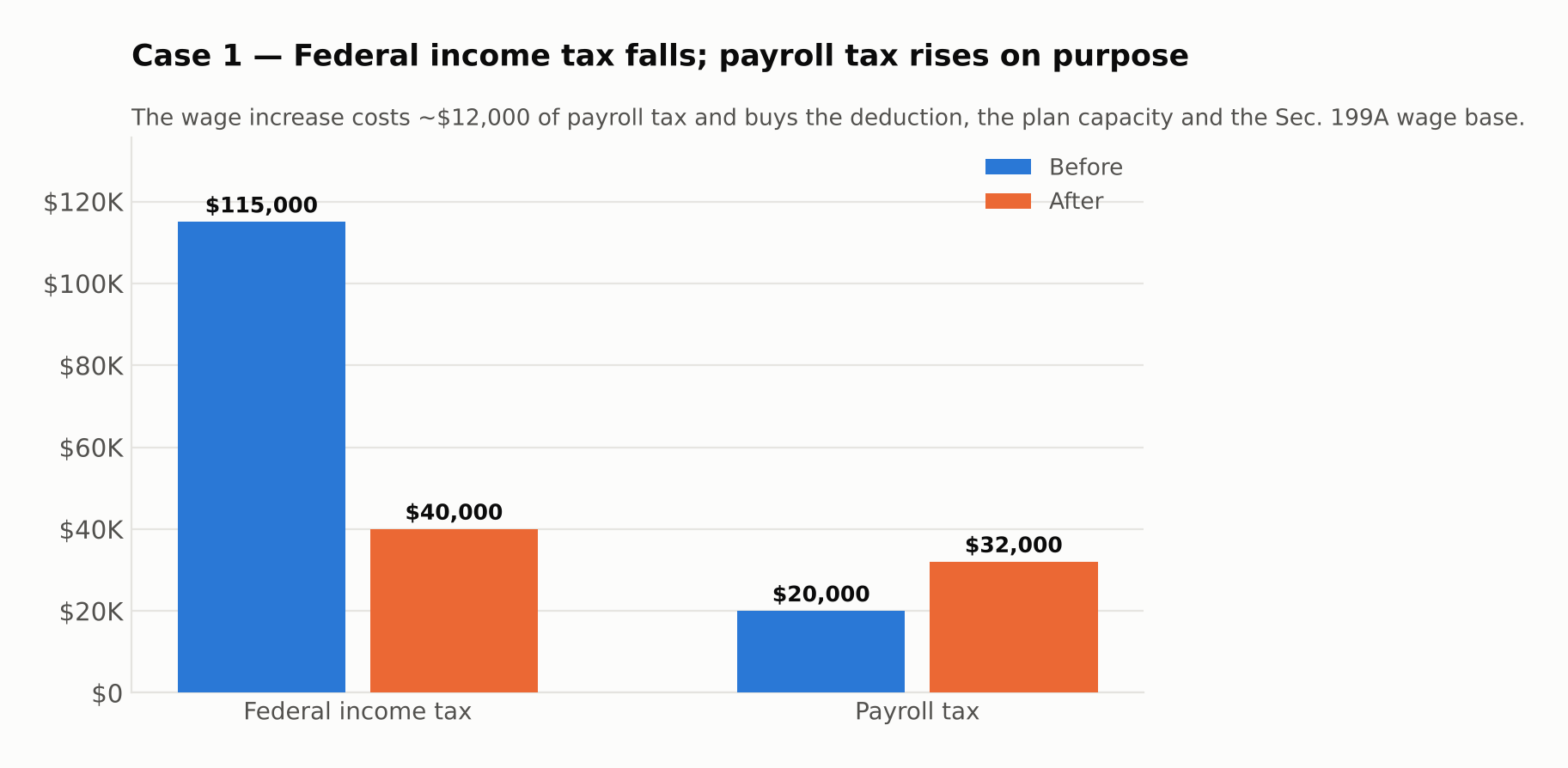
Roughly $75,000 of federal income tax a year, against about $12,000 of additional payroll tax, a net reduction near $63,000, plus $100,000 a year redirected into the owners’ retirement accounts. The wage increase is not a cost of the plan; it is the mechanism.
The Taxpayer
A married couple, filing jointly, who jointly own and operate a hospitality business, food service and lodging operations under one roof, through a limited liability company that has elected to be taxed as an S corporation for federal purposes. They are in their working years, materially participate in the business, and have limited retirement savings: individual retirement accounts only, with no meaningful employer-plan contributions to date.
The operating company is separated from the real estate. The real property on which the business operates is held in a second LLC, also taxed as an S corporation, which leases the property to the operating company for $10,000 per month. The couple controls both entities.
Each spouse draws $2,500 every two weeks, approximately $65,000 per year each, or roughly $130,000 combined, and historically they have taken substantial S corporation distributions when profits support them. In the most recent tax year the operating business generated approximately $600,000 of profit.
Outside the operating business they hold two investment rental properties: one acquired roughly four years ago for approximately $125,000 and occupied by a family member, and a second held for roughly twenty years, paid off, and not held in any entity. No cost segregation study has ever been performed on any property, including the lodging building.
They also acquired two passenger automobiles in recent years. Both are titled personally, and the couple has historically claimed business use through the standard mileage method rather than the actual-expense method with depreciation.
The Situation
The couple’s complaint was not that the business was unprofitable. It was that profitability was not reaching them. A $600,000 profit year produced neither a comparable improvement in personal cash flow nor any accumulation of retirement assets. They described three goals: increase personal after-tax income going forward, build long-term wealth, and reduce tax at both the business and personal levels while remaining fully compliant.
Two structural facts shaped the engagement. First, their compensation pattern, modest wages against large distributions in a highly profitable S corporation, created payroll-tax exposure that had never been documented or defended. Second, the fixed-asset side of the business was almost certainly under-deducted: the prior-year financial statements reflected depreciation expense low relative to the likely fixed-asset base of a food-service and lodging operation.
Overlaying both was a package of recently enacted federal changes (referred to in the engagement as the One Big Beautiful Bill Act, or “OBBBA”) that expanded several business deductions while tightening several individual ones. Some of the tightening landed directly on this couple’s historical return patterns.
The engagement date was January of the planning year: the prior tax year was closed as to transactions but open as to elections, and the current year was entirely open.
Issues Presented
- Accelerated depreciation planning. How can the couple use 100% bonus depreciation and expanded Sec. 179 expensing to reduce taxable income from the prior year forward, and should an accounting method change or cost segregation study be evaluated?
- Research-type cost deductions. Does the business incur qualifying research or experimental expenditures that can be immediately deducted under the new rules for domestic R&E costs?
- Business credits. Could enhanced credits for employer-provided child care and paid family and medical leave apply, and how would benefits need to be structured to qualify?
- Reasonable compensation compliance. Are the current S corporation wages defensible, and what wage strategy minimizes payroll-tax risk while supporting the wealth-building goal?
- Retirement plan implementation. What plan design creates meaningful deductions and long-term accumulation given the employee base?
- Individual itemized deductions. How does the increased state and local tax cap (subject to phase-down) change the picture, and how does the new charitable contribution floor affect the giving strategy?
- QBI deduction planning. How does the permanent extension and enhancement of the Sec. 199A deduction affect long-term planning, and how do the other planning moves interact with it?
- Wagering loss limitation. How does the new 90% limitation on wagering loss deductions affect projected exposure if the couple’s historical activity continues?
- Employment credit claim risk. How should the couple manage and defend a large employee retention credit receivable given heightened enforcement and an extended assessment period?
Out of scope: estate, gift, and succession planning; business valuation; and a full audit of the depreciation schedules, payroll records, or credit claim file. The analysis assumes material participation, so the pass-through income is non-passive.
Analysis
Bonus depreciation under Sec. 168(k)
Because the operating company is an S corporation, its deductions reduce the income that passes through to the shareholders on their Schedules K-1 and therefore reduce their taxable income directly. IRC Sec. 1366(a). Bonus depreciation under IRC Sec. 168(k) permits immediate expensing of the full cost of qualifying property in the year it is placed in service rather than recovery over the asset’s class life, and under the legislative changes applicable here, 100% bonus depreciation is available on a permanent basis for qualifying property acquired after January 19 of the prior year.
This is a direct fit. Food-service and lodging operations are tangible-property intensive: kitchen equipment, furniture, fixtures, tools, guest-room furnishings, and certain improvements, most carrying a recovery period of twenty years or less. Bonus depreciation is therefore the most immediate mechanism for converting business investment into current tax savings in a high-income year, and it works best when the spending is driven by genuine business need (replacing aging equipment, upgrading guest rooms, improving kitchen throughput) rather than by the deduction.
The vehicle limitation. Passenger automobiles are subject to annual depreciation ceilings under IRC Sec. 280F(a) unless they satisfy applicable weight and use tests. A vehicle may be eligible “property” under Sec. 168(k) and still have its first-year deduction capped by Sec. 280F. Both automobiles must be tested against the weight threshold before any depreciation projection is relied upon.
Enhanced Sec. 179 expensing
IRC Sec. 179 permits an election to expense qualifying property immediately, subject to an annual dollar limit and a phase-out threshold keyed to total qualifying property placed in service. Under the applicable changes, the maximum Sec. 179 expensing limit increased to $2.5 million with a phase-out threshold of $4 million for tax years beginning after December 31 of the year preceding the prior year. IRC Sec. 179(b)(1)–(2).
Sec. 179’s value here is control. Unlike bonus depreciation, which applies class-wide absent an election out, Sec. 179 is asset-by-asset and dollar-specific. That matters when the goal is to hit a taxable-income target rather than to maximize one year’s deduction, avoiding pushing income so low that it wastes other items, or preserving depreciation for a projected higher-income year. Given the current profit level and the desire for present cash flow, full expensing is generally favorable, but bonus depreciation, Sec. 179, and a blend should be modeled against the QBI and payroll consequences before electing.
Depreciation method review and the Form 3115 opportunity
The prior-year financial statements showed depreciation low relative to the probable fixed-asset base. Where assets were placed in service in earlier years but not depreciated correctly, wrong life, wrong convention, omitted assets, a missed election, the error can often be corrected through an automatic accounting method change producing a catch-up deduction via a Sec. 481(a) adjustment. Rev. Proc. 2015-13, 2015-5 I.R.B. 419.
This is the highest-leverage item in the engagement because it requires no new spending. A properly filed method change converts a prior understatement into a current deduction. The taxpayer is not taking an aggressive position; they are claiming what the law already permitted and the return failed to capture.
Cost segregation on the operating real estate
Cost segregation accelerates depreciation on a building by reclassifying components into shorter recovery periods, typically 5-, 7-, or 15-year property, which may then qualify for accelerated or bonus treatment. IRC Sec. 168(k); Rev. Proc. 2015-13.
Three candidate properties exist: the operating real estate in the second S corporation and the two residential rentals. The lodging property is ordinarily the highest-value candidate, both for scale and because lodging buildings carry a high proportion of short-life components, parking areas, signage, landscaping, security systems, specialty plumbing and electrical, interior finishes. Where the building is already in service, the reclassification is implemented through the same method-change machinery, generating the deduction in the year of change rather than by amended return.
The self-rental complication. A critical structural point is that the couple’s real estate entity leases to their operating entity and they control both. That relationship affects passive-activity characterization of the rental income and of any accelerated deductions. Before relying on a cost segregation deduction at the real estate entity, the self-rental rules and the grouping election must be evaluated against the couple’s actual participation, or the deduction may be generated in an entity where it cannot be used in the year claimed.
Research and experimental expenditures
Under the applicable legislative change, domestic research and experimental expenditures may be fully expensed in the year incurred for tax years beginning after December 31 of the year preceding the prior year, under new IRC Sec. 174A.
This business is not a research company, but the statute is activity-based, not industry-based. Qualifying costs can arise from developing new recipes, testing new preparation processes, implementing novel operational workflows, or designing customer-experience and efficiency initiatives, provided there is a genuine element of uncertainty and a process of experimentation.
The recommendation is deliberately modest: treat this as opportunistic. Track projects that plausibly qualify, document the uncertainty being resolved, and claim what is defensible. Do not reclassify ordinary operating expenses as R&E.
Employer-provided child care credit (Sec. 45F)
IRC Sec. 45F provides a credit for certain employer-provided child care expenditures. Under the applicable changes, the credit rate increases beginning in the year following the prior year, from 25% to 40%, with higher caps, and potentially higher rates for small businesses in certain structures.
Hospitality operations face chronic recruitment and retention pressure, and child care support is a non-wage benefit that addresses it while generating a credit. This is not purely a tax decision; the program must be operationally feasible, and if pursued it must be designed to satisfy the statutory requirements from the outset.
Paid family and medical leave credit (Sec. 45S)
IRC Sec. 45S provides an employer credit for wages paid during qualifying paid family and medical leave where policy requirements are met; under the applicable changes the credit is made permanent and expanded. Compliance detail is where this credit is won or lost: a written policy, defined eligibility, wage-replacement thresholds, and nondiscrimination requirements. Policy drafting and payroll tracking are foundational, because the credit is computed from wages that must be separately identified in the payroll records.
Reasonable compensation (payroll tax exposure)
As S corporation shareholder-employees performing services, both spouses must receive reasonable compensation as W-2 wages before taking the remaining profit as distributions. Treas. Reg. Sec. 31.3121(d)-1(b). Courts have sustained recharacterization of distributions as wages where salaries were unreasonably low relative to services performed. Radtke v. United States, 895 F.2d 1196 (7th Cir. 1990); Watson v. United States, 668 F.3d 1008 (8th Cir. 2012).
Approximately $65,000 each may be defensible in isolation depending on roles, hours, and comparable market pay. It is considerably less defensible against the scale and profitability of this business and the historical ratio of distributions to wages. Raising wages toward a market-aligned level accomplishes three things at once: it reduces reclassification risk, it expands the retirement plan contribution base (because employer contributions are computed on W-2 compensation), and it improves the overall compliance posture.
Higher wages cost real payroll tax. The judgment is that the cost is preferable to the uncertainty, interest, and penalties of an adjustment, and that it buys retirement-plan capacity that would not otherwise exist. The supporting file is what makes the position hold: documented job duties, hours including peak-season hours, decision authority, and five to ten comparable compensation data points per role, retained with the annual corporate records alongside an annual officer compensation resolution.
Retirement plan design
Retirement planning is the strategy most directly aligned with the couple’s goals, because it is the only one that simultaneously creates a current deduction, defers tax on growth, and converts business profit into protected personal assets rather than leaving it stranded in the business.
Given the income profile and the near-absence of existing retirement assets, a 401(k) with profit sharing, potentially with a safe harbor design, is the right vehicle. Design must account for the employee count and turnover characteristic of hospitality, because employer contributions may be required for eligible staff. The optimum balances maximizing owner contributions, keeping required employee contributions predictable, and limiting administrative complexity. A safe harbor design trades a mandatory employee contribution for relief from certain nondiscrimination testing, in a high-turnover workforce, frequently the better bargain.
Individual-level changes: the SALT cap
Under the applicable changes, the state and local tax deduction cap increases from $10,000 to $40,000 for joint filers, with a phase-down for higher-income taxpayers and a floor returning to $10,000. IRC Sec. 164(b)(6).
Historically this couple paid SALT well in excess of $10,000 and was limited to $10,000 on Schedule A. The higher cap increases itemized deductions and reduces taxable income, subject to the modified-AGI phase-down. The planning consequence is indirect but real: because the benefit phases down with MAGI, strategies that reduce AGI, retirement contributions above all, preserve SALT deductibility at the margin. The same contribution dollar therefore produces two benefits.
Sec. 199A after permanence
The qualified business income deduction permits up to a 20% deduction against qualified business income from pass-through businesses, subject to limitations and thresholds, and under the applicable changes becomes permanent and enhanced for tax years beginning after December 31 of the prior year. IRC Sec. 199A.
The operating business is not a specified service trade or business in the disfavored category, so at this income level the operative constraint is the W-2 wage and qualified property limitation. Because the business pays wages, to employees and owners, that limitation may well not bind, but it must be modeled.
The counseling point: QBI is computed on net business income after deductions and wages, so every other move in this plan reduces the QBI base. That is expected and should not be resisted. A dollar of real deduction at a 37% marginal rate saves more than the 20% QBI benefit it displaces.
Wagering loss limitation
Under the applicable changes, beginning in the year following the prior year, wagering loss deductions are limited to 90% of losses to the extent of gains. IRC Sec. 165(d). The arithmetic consequence is that a taxpayer who breaks even still reports taxable income equal to at least 10% of gross winnings.
This couple historically reported significant wagering winnings and offsetting losses that netted to approximately zero. Under the new rule the same activity at the same volume produces tax where previously there was none. The response is mechanical: project a minimum tax on the activity, tighten contemporaneous documentation of winnings and losses, fund the liability through estimates or withholding to avoid underpayment penalties, and recognize that reducing volume is the only lever that reduces the tax.
Employment credit claim exposure
The balance sheet from two years prior reflected a large receivable for an employee retention credit, indicating a claim filed or pending for prior payroll periods. Under the applicable changes, enforcement is heightened and the assessment period for certain such claims is extended to six years. IRC Sec. 6501.
The posture to adopt is that the claim is a probable examination focus, particularly if prepared by a third-party promoter. The defense file should be assembled now rather than in response to a notice: eligibility evidence under whichever path was used (gross receipts decline computations, or the governing orders with dates and a narrative of the more-than-nominal operational impact); payroll registers and allocation schedules; proof that wages were not double-counted against other wage-based benefits; signed amended employment tax returns with filing proof; and the third-party engagement contract and methodology.
If the refund has been received, a portion should be reserved in a segregated account pending the close of the risk window, 20% to 35% is a common planning range depending on documentation strength. If it has not been received, status should be confirmed and withdrawal or other corrective steps evaluated.
The Plan
| # | Action | Owner | Timing |
|---|---|---|---|
| 1 | Increase S corporation wages to a defensible level (target at least ~$100,000 each, subject to a compensation analysis); document duties, hours, and comparables | Taxpayers + payroll provider | Implement with current-year payroll immediately |
| 2 | Implement a business retirement plan; evaluate safe harbor 401(k) with profit sharing | Taxpayers + plan advisor / TPA | Design Q1–Q2; adopt no later than 12/31 |
| 3 | Build a capital investment plan aligned with 100% expensing; time purchases and placed-in-service dates | Taxpayers + CPA | Q1 planning meeting; execute through the year |
| 4 | Depreciation method review; evaluate Form 3115 catch-up opportunities | CPA | Q1–Q2 |
| 5 | Cost segregation study on the lodging property, subject to a go/no-go ROI test | Taxpayers + specialist | Engage in current year; implement with the return |
| 6 | Vehicle strategy: compare actual expense plus depreciation against mileage; substantiate business use; test weight threshold | Taxpayers + CPA | Q1 |
| 7 | Prepare for individual rule changes: charitable bunching against the AGI floor, wagering limitation planning, SALT timing and MAGI monitoring | Taxpayers + CPA | Mid-year |
| 8 | Assemble the employment credit defense file; reserve a portion of any refund received | Taxpayers + CPA | Complete by 3/31 |
Supporting documentation built in the same period: a fixed-asset register (description, purchase date, placed-in-service date, total cost including installation and freight, category, method and life, accumulated depreciation, bonus and Sec. 179 history, dispositions); an accountable plan policy so the operating company can reimburse personally paid business expenses without creating taxable income, supported by expense reports showing amount, date, place, and business purpose; contemporaneous mileage logs; and a capital expenditure tracker recording placed-in-service dates separately from purchase dates.
Projected Result
The following compares the status quo against the optimized strategy. The figures are planning estimates to be refined against the final financial statements and payroll records.
| Item | A. Status Quo (No Changes) | B. Optimized Strategy |
|---|---|---|
| Net business profit (before owner wages) | $600,000 | $600,000 |
| Owner W-2 wages (combined) | $130,000 | $200,000 (increase for reasonable comp) |
| Retirement plan contributions (employer) | $0 | $100,000 (deductible; wealth building) |
| New assets expensed via bonus depreciation | $0 | $100,000 (equipment, furniture, etc.) |
| Pass-through business income to the owners | $470,000 | $200,000 |
| Other income (rentals, etc., net) | $20,000 | $20,000 |
| Itemized/standard deduction impact (SALT and charity assumptions) | ~$40,000 | ~$45,000 |
| Approximate taxable income (MFJ) | $450,000 | $175,000 |
| Estimated federal income tax | ~$115,000 | ~$40,000 |
| Payroll tax cost (on wages) | ~$20,000 | ~$32,000 |
| After-tax cash flow impact | Baseline | Materially higher despite higher payroll tax, plus $100,000 added to retirement wealth |
How to read this. In the optimized scenario the taxpayers are not spending money to save tax. They are reallocating profit into deductible reinvestment and retirement wealth, with the tax savings helping finance both moves. Even with payroll tax rising by roughly $12,000, the net result is a lower overall tax bill and a materially better personal wealth trajectory.
A threshold clarification governs the modeling: it must first be established whether the $600,000 is K-1 ordinary business income already net of wages, depreciation, and rent, or an internal management profit figure stated before owner wages and certain non-cash items. The projection changes materially depending on the answer. Working the pre-wage version:
| Line item | Status Quo | Optimized |
|---|---|---|
| Profit before owner wages | $600,000 | $600,000 |
| Less owner wages (combined) | ($130,000) | ($200,000) |
| Less employer retirement contributions | $0 | ($100,000) |
| Less bonus depreciation on new assets | $0 | ($100,000) |
| K-1 ordinary income (approx.) | $470,000 | $200,000 |
| W-2 wages (combined) | $130,000 | $200,000 |
| Net rental income | $20,000 | $20,000 |
| AGI (illustrative) | $620,000 | $420,000 |
| Itemized deductions | ($40,000) | ($45,000) |
| Taxable income before QBI | $580,000 | $375,000 |
| QBI deduction (20% of K-1, subject to limits) | ($94,000) | ($40,000) |
| Taxable income after QBI (illustrative) | $486,000 | $335,000 |
A separate profit-to-cash bridge should be prepared to explain why taxable profit did not become owner cash: net profit, plus non-cash items, less increases in receivables, inventory, and prepaids, plus increases in payables, equals operating cash flow; then less capital expenditures, debt principal, owner distributions, and tax payments. In this kind of business the usual leaks are inventory build and debt principal, the latter consuming cash without reducing profit. That schedule, not the tax projection, usually identifies why profitability is not becoming wealth.
A payroll tax worksheet should accompany the wage increase: the portion below the Social Security wage base at a combined 12.4%, the full increase at a combined 2.9% Medicare rate, the employee-only additional Medicare tax where thresholds are crossed, and any state unemployment cost.