
Case study. Adapted from an actual engagement. All identifying details removed; all figures are the real figures.
The savings
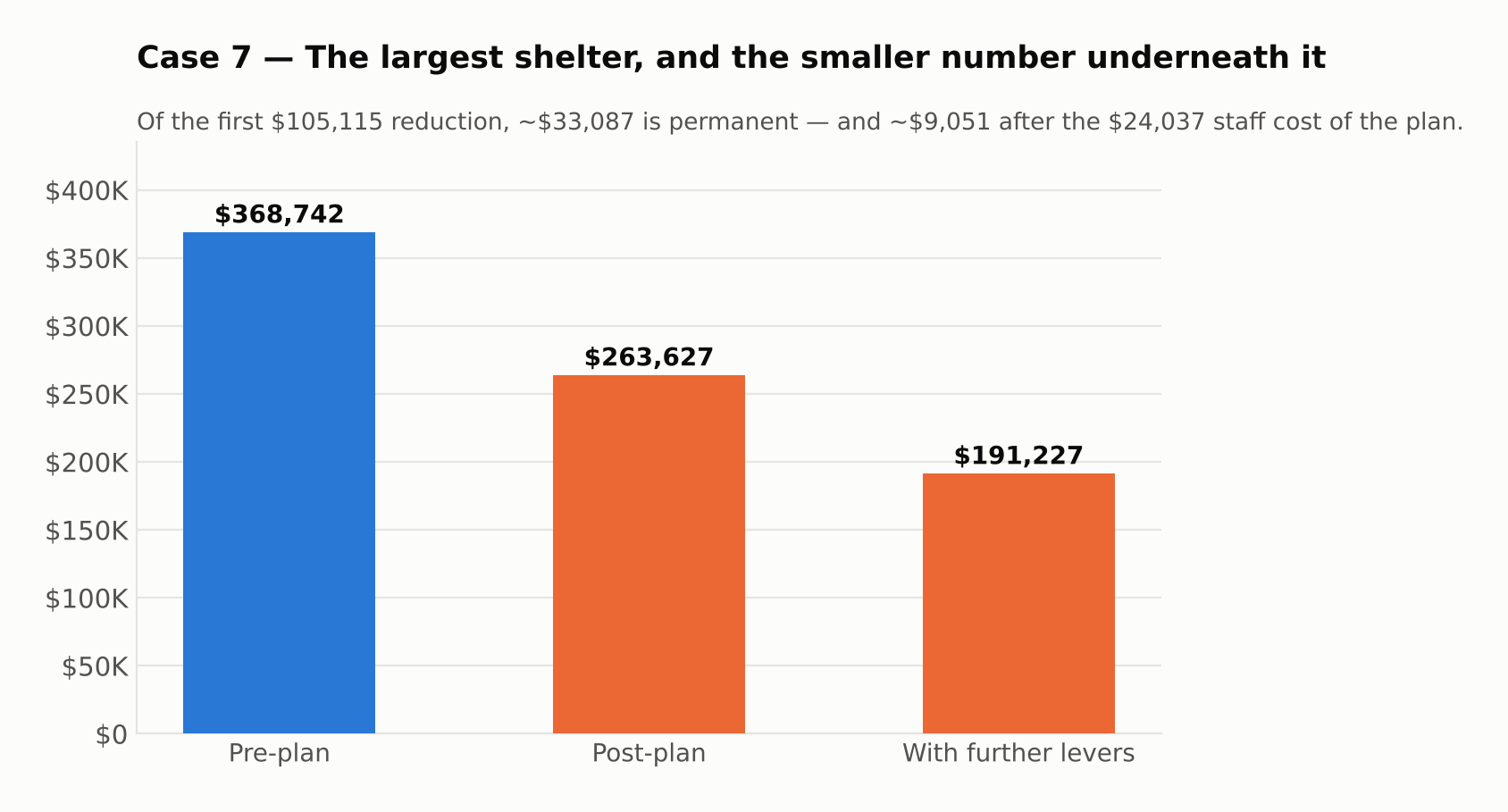
About $105,000 in the implementation year, with roughly another $72,400 recurring once the further levers stack on. But of that $105,115, only about $33,087 is permanent, and the plan covering the staff costs the owner roughly $24,037 a year, so permanent savings net of staff cost are about $9,051. All three figures are correct, and a client told only the first will feel misled later.
The Taxpayer
A married couple filing jointly, residing in a community property state that imposes a personal income tax and has enacted an elective entity-level tax (a pass-through entity tax, or PTET) as a workaround to the federal state and local tax deduction cap.
The principal taxpayer, in their mid-forties, is an equity owner in a licensed professional services firm, a regulated profession that the state requires be practiced through licensed individuals or a registered professional entity. The firm employs a small professional staff. The taxpayer holds the firm interest through a professional entity that has made an S election under I.R.C. Secs. 1361–1362 and of which the taxpayer is the sole employee. The spouse, of similar age, is self-employed in a service field and reports both wage and self-employment income. They have two minor children.
The household holds a long-term rental in another state, retirement balances, the equity value of the practice, a personal residence, and a foreign retirement account that is treated for U.S. purposes as a foreign grantor trust of which the principal taxpayer is the U.S. owner.
The Situation
The structure the clients brought to the engagement was competent as far as it went. The professional entity and its S election were in place. The state PTET election was in place. What was missing was everything else: there was no meaningful qualified retirement plan, no organized estate plan, no asset protection beyond the entity shell, no contemporaneous documentation of the compensation split, and no disciplined compliance file for the foreign trust.
Income, normalized to a 2026 rate basis from the most recent filed return (return line items rounded to the nearest $5,000):
| Income component | Amount (USD, approximate) | Character |
|---|---|---|
| Taxpayer W-2 (officer compensation) | 345,000 | Wages |
| Taxpayer Schedule K-1 (S corp ordinary) | 465,000 | Passthrough |
| Spouse income | 220,000 | Wages and self-employment |
| Investment income (interest, dividends, net capital) | 15,000 | Portfolio |
| Out-of-state rental (passive, losses suspended) | 0 | Passive |
| Total income | 1,045,000 | |
| Adjusted gross income | 1,000,000 |
Of that total, approximately $810,000 is sourced from the practice through wages and the distributive share.
Entity map, an operating partnership owned in equal shares by two professional entities, each wholly owned by one of the two principals:
| Entity | Form | Role in the structure |
|---|---|---|
| Operating firm | Operating partnership | The practice; a small professional staff |
| Taxpayer’s professional entity | Professional entity, S election | Holds 50 percent of the partnership; pays the taxpayer |
| Other owner’s professional entity | Professional entity | Holds the other 50 percent of the partnership |
Combined federal and state income tax on the household, on a normalized 2026 basis, approximates $368,742 per year, federal tax on ordinary income of approximately $278,742, a small net investment income tax component on portfolio income, and state tax modeled conservatively at approximately $90,000. For modeling purposes assume a 9% entity-level state tax rate; every state figure in this study is modeled on that assumption rather than drawn from the filed return. The effective combined rate on taxable income is roughly 38 percent.
Facts requiring confirmation before implementation, each treated conservatively in the model: a full net worth balance sheet (estimated in the workbook, sufficient only to confirm the household sits far below the federal estate tax exemption); the actual employee census (only aggregate staff payroll of approximately $1.53 million is known); the other owner’s agreement to a firm-wide qualified plan; and any existing estate instruments.
Issues Presented
- How much tax-deferred accumulation can a mid-forties professional-practice owner create, and what does the affiliated service group rule cost that owner in staff funding to get it?
- Is the existing PTET election capturing its available federal benefit, and how is that benefit quantified when the household is already at the SALT floor?
- How is the S corporation employment tax differential defended, and what compensation figure best serves both that defense and the retirement plan?
- What estate and asset protection architecture is justified when there is no transfer tax exposure at all?
- What does the foreign grantor trust require annually, and how is the passive foreign investment company (PFIC) exposure beneath it managed?
- Where else in the household, the spouse’s side, real estate, the Roth bucket, small entity-level items, and exit planning, can tax be reduced, and how much of the reduction is permanent rather than borrowed from the future?
Analysis
The organizing discipline of this engagement, and its most transferable lesson, is that permanent savings, timing deferral, tax-free Roth growth, and conditional event-driven benefits are four different kinds of dollars and are never summed into a single headline number. The plan does not manufacture large new permanent income tax reductions; the existing S corporation and PTET posture already captures the permanent reductions reasonably available at this income level.
Layer 1: Cash Balance Plan Paired with Safe-Harbor 401(k) and Cross-Tested Profit Sharing
A cash balance plan is a defined benefit plan that expresses each participant’s accrued benefit as a hypothetical account balance credited annually with a pay credit and an interest credit. I.R.C. Sec. 411(a)(13), (b)(5); Treas. Reg. Sec. 1.411(b)(5)-1 (statutory hybrid plan). Because the contribution to a defined benefit plan is actuarially determined rather than capped at the defined contribution dollar limit, a participant in their mid-forties can fund a far larger annual amount than a 401(k) alone permits.
For the taxpayer at age 44, a representative annual funding pattern is:
| Component | Annual amount | Governing limit |
|---|---|---|
| Cash balance pay credit | $160,000 | Sec. 415(b); Notice 2025-67 (2026 Sec. 415(b)(1)(A) limit $290,000) |
| 401(k) elective deferral | $24,500 | Sec. 402(g); Notice 2025-67 (no age-50 catch-up until the year age 50 is attained) |
| Profit-sharing allocation | $21,600 | Sec. 415(c) (2026 defined contribution additions limit $72,000) |
| Total annual tax-deferred funding | $206,100 |
The salary base from which these accruals are measured is itself capped, which is one reason the plan recommends setting W-2 compensation at the Sec. 401(a)(17) compensation limit.
The structural complication is that the plan cannot be run for the owner alone. The taxpayer’s professional entity, the operating partnership, and the other owner’s professional entity are almost certainly an affiliated service group, which the Code treats as a single employer for all qualified plan coverage and nondiscrimination purposes. I.R.C. Sec. 414(m); see Rev. Rul. 81-105, 1981-1 C.B. 256 (applying the rules to a professional corporation and its associated partnership). The plan must therefore be tested across the firm’s entire workforce, including the approximately $1.53 million of non-owner staff payroll.
Two consequences follow:
- To use the cross-tested design that directs the largest share to the owner, staff must receive a minimum allocation, the “gateway”, of 7.5 percent of compensation under the combined defined benefit and defined contribution testing rules. Treas. Reg. Sec. 1.401(a)(4)-9(b)(2)(v)(D); see also Treas. Reg. Sec. 1.401(a)(4)-8 (cross-testing on equivalent benefit accrual rates).
- Because the cash balance plan is not covered by Pension Benefit Guaranty Corporation insurance, the deductible employer profit-sharing contribution is limited to 6 percent of covered payroll, although 401(k) elective deferrals remain separately deductible and outside that limit. I.R.C. Sec. 404(a)(7)(C)(iv); Sec. 404(n).
The gateway funding of staff is a real cost:
| Item | Amount |
|---|---|
| Gross gateway funding at firm scale | $114,564 |
| Credit for existing plan contribution | ($66,491) |
| Incremental staff cost | $48,073 |
| Taxpayer’s economic share at 50 percent ownership | $24,037 |
The honest characterization matters. The $206,100 of annual funding is deferral, not permanent tax savings, the tax is paid later, at distribution. The permanent value of the plan lies in three quieter places: decades of tax-free internal compounding; the rate spread between today’s 37 percent top marginal bracket and the rate that will apply at withdrawal; and the creditor protection a qualified plan carries. The shelter-to-cost ratio is favorable, on the order of eight to one measured against the owner’s share of incremental staff funding. Final accrual sizing requires an enrolled actuary’s certification against the actual employee census.
One alternative was considered and rejected: a Sec. 831(b) micro-captive insurance arrangement. The case law has run consistently against taxpayers on risk distribution and bona fide insurance grounds, and the arrangement carries disclosure exposure as a transaction of interest. Avrahami v. Commissioner, 149 T.C. 144 (2017); Reserve Mechanical Corp. v. Commissioner, 34 F.4th 881 (10th Cir. 2022); Caylor Land & Dev., Inc. v. Commissioner, T.C. Memo. 2021-30; Treas. Reg. Sec. 1.6011-10 (2025), with disclosure obligations under Sec. 6011 and Form 8886.
Layer 2: Entity Posture and Current-Year Income Tax
The professional entity and its S election should be retained and documented rather than changed. They produce two recurring benefits.
First, the pass-through entity tax election. The regime is an elective entity-level tax that converts a non-deductible individual state tax into a deductible entity expense, with a corresponding credit against the individual return. The deductibility of an entity-level tax of this design is blessed federally by Notice 2020-75, 2020-49 I.R.B. 1453. Because this household is fully phased down to the $10,000 SALT floor at roughly one million dollars of modified AGI, the election preserves essentially the entire federal benefit of the state tax. The permanent federal benefit is approximately $15,000 to $17,000 per year. This is permanent savings, and it is already being substantially captured; the work is to confirm the election, optimize the base on which the entity tax is computed, and observe the estimated-payment requirements that accompany the election, whose terms must be checked against the governing state law before the election is relied upon.
Second, the employment tax differential. Holding the firm interest through an S corporation converts what would otherwise be a self-employment-taxed distributive share into wages plus a residual not subject to self-employment tax. The residual K-1 of approximately $450,000 thereby escapes the 2.9 percent Medicare and 0.9 percent additional Medicare components, an annual preservation of about $17,093. I.R.C. Secs. 1401(b), 3101(b)(2), 3121.
The protection is documentation. The exposure is reasonable compensation: the Service may recharacterize distributions as wages where officer compensation is unreasonably low. Watson v. United States, 668 F.3d 1008 (8th Cir. 2012); Spicer Accounting, Inc. v. United States, 918 F.2d 90 (9th Cir. 1990); Veterinary Surgical Consultants, P.C. v. Commissioner, 117 T.C. 141 (2001). The recommended response is a contemporaneous reasonable compensation study supporting a W-2 figure set at the qualified plan compensation limit of $360,000. I.R.C. Sec. 401(a)(17); Notice 2025-67. Raising compensation from $345,000 to $360,000 serves both the plan accrual base and the audit defense.
The contrary authority deserves a direct word, because it cuts in the taxpayer’s favor. The corporate form is more defensible than a direct limited partnership interest precisely because of the developing self-employment tax case law: the Tax Court has held that a state-law limited partner who functions as an active participant cannot exclude the distributive share from self-employment tax. Soroban Capital Partners LP v. Commissioner, 161 T.C. No. 12 (2023); Renkemeyer, Campbell & Weaver, LLP v. Commissioner, 136 T.C. 137 (2011); Denham Capital Mgmt. LP v. Commissioner, T.C. Memo. 2024-114. One court of appeals has rejected the functional-analysis approach, but the Tax Court position controls where it has not been displaced. The corporate form sidesteps the controversy entirely.
Layer 3: Estate, Probate, and Asset Protection Without a Transfer Tax Problem
There is no federal transfer tax problem to solve. Combined net worth is well below the $30 million federal exemption available to a married couple. I.R.C. Sec. 2010(c), as amended by the One Big Beautiful Bill Act, Pub. L. No. 119-21 (2025) (basic exclusion amount of $15,000,000 per individual for 2026, indexed). Candor about this is itself a deliverable: the estate recommendations are justified by probate avoidance, protection of minor children, asset protection, and basis planning, not by transfer tax savings.
The recommended core is a community property revocable trust. Holding community property in such a trust secures a full basis step-up on both halves of the community at the first spouse’s death, not merely the decedent’s half. I.R.C. Sec. 1014(b)(6). The trust is paired with pour-over wills, guardianship nominations for the two minor children, durable financial powers of attorney, advance health care directives, and authorizations under the federal health privacy rule and the state digital assets act.
Asset protection is built without reliance on a domestic asset protection trust. Where a self-settled spendthrift trust is not recognized, a settlor’s creditors may reach the maximum amount the trustee could distribute to the settlor, so the model assumes no DAPT protection is available and the plan does not depend on it. The protection toolkit is therefore the qualified plan, charging-order entities, insurance, and statutory exemptions:
- The qualified plan is the single strongest shield. Funds in an ERISA-qualified plan are excluded from the bankruptcy estate and protected by the plan’s anti-alienation provision. Patterson v. Shumate, 504 U.S. 753 (1992); ERISA Sec. 206(d)(1); I.R.C. Sec. 401(a)(13). State exemption statutes generally give separate protection to private retirement plans and, within limits, to self-employed plans.
- The out-of-state rental moves into a single-member limited liability company to isolate its liability and add a charging-order layer.
- An irrevocable life insurance trust holds the family’s permanent insurance so proceeds fall outside the taxable estate and outside the reach of personal creditors.
Continuity of the practice is addressed by a buy-sell agreement between the two owner entities, structured as a cross-purchase, not a corporate redemption funded by entity-owned insurance. Connelly v. United States, 602 U.S. 257 (2024), holds that life insurance proceeds a corporation receives to fund a redemption are a corporate asset that increases the value of the decedent’s shares, with no offset for the redemption obligation. A cross-purchase, in which the surviving owner rather than the entity holds the policy, avoids that valuation result. The buy-sell must also satisfy I.R.C. Sec. 2703 to fix value for transfer tax purposes.
One architectural question must be settled before the documents are drafted: if the surviving spouse is not a United States citizen, the marital deduction requires a qualified domestic trust, through which the marital share must pass to defer tax at the first death. I.R.C. Secs. 2056(d), 2056A (requiring at least one U.S. trustee with power to withhold tax on principal distributions and, for larger trusts, a domestic corporate trustee or bond). On the current net worth no tax is actually due at the first death in any event, but the architecture differs and should be set correctly from the outset.
Layer 4: Foreign Grantor Trust and PFIC Compliance
The foreign retirement account is a foreign grantor trust of which the taxpayer is treated as the U.S. owner. The obligations are not optional: the owner must file Form 3520-A as the foreign trust’s annual information return and Form 3520 to report ownership and transactions, and the foreign account must be reported on the FBAR and, if thresholds are met, on the foreign financial asset statement. I.R.C. Secs. 671–679 (grantor trust rules; Sec. 679 for a foreign trust with a U.S. grantor), Sec. 6048 (reporting), Sec. 6677 (penalties); 31 U.S.C. Sec. 5314 and 31 C.F.R. Sec. 1010.350 (FBAR); I.R.C. Sec. 6038D and Form 8938. The penalty regime is severe, which is what makes a disciplined standing annual file, rather than a year-to-year scramble, the actual deliverable.
Beneath the trust wrapper, the underlying investments are likely passive foreign investment companies carrying their own punitive default regime. The plan recommends evaluating a qualified electing fund election under Sec. 1295 (which requires an annual information statement from the fund) or a mark-to-market election under Sec. 1296 (available for marketable stock) against the default Sec. 1291 excess-distribution regime, which applies an interest charge and ordinary-income treatment. I.R.C. Secs. 1291–1298.
The treaty posture should not be overstated. Foreign retirement savings of this kind is generally not protected from current U.S. taxation by the pensions article of an applicable income tax treaty, and the Service has not conceded the point. The conservative course treats the fund as currently taxable to the owner under the grantor trust rules and manages the PFIC exposure accordingly.
Review One: The Spouse’s Side
The spouse’s income of approximately $220,000, reported on Schedule C, supports two levers the firm-centered plan does not reach.
Retirement shelter. Replacing the existing simplified employee pension with a solo 401(k) and a one-person cash balance plan raises deductible shelter from $46,000 to roughly $136,000, an incremental $90,000 deduction worth about $41,700 per year. I.R.C. Secs. 401(k), 402(g) (2026 elective deferral $24,500); 404(a)(3), 415(c) (2026 defined contribution additions limit $72,000). Because there are no employees, the plan is owner-only, with no gateway and no staff cost, which makes it far more efficient than the firm plan. A one-participant plan covering only the owner and spouse is exempt from the coverage and nondiscrimination testing that constrains the firm plan. This is deferral, and the accrual should be sized by an enrolled actuary against several years of demonstrated earnings.
Entity posture. Routing the income through an S corporation or partnership makes it eligible for the state PTET, which a sole proprietorship (and a disregarded single-member LLC) is not, and takes the residual outside the self-employment tax base, a combined permanent benefit of roughly $8,800 per year. I.R.C. Secs. 1401, 1402; cf. Watson, 668 F.3d 1008. The cost is a second entity, a payroll, and a reasonable-compensation study, so the lever is worth adopting only if the income is durable.
Review Two: The Real Estate Lever
The existing rental throws off roughly $55,994 of annual depreciation that is suspended, because AGI exceeds the Sec. 469(i) phase-out ceiling and neither spouse qualifies as a real estate professional. I.R.C. Sec. 469(c)(7), (i) (the $25,000 active-participation allowance fully phases out above $150,000 of modified AGI; real estate professional status requires more than one-half of personal services and more than 750 hours in real property trades or businesses, which full-time non-real-estate occupations preclude). Accelerating depreciation on that unit through cost segregation would not help, more passive loss only enlarges the suspended pile.
The lever is a new property. A rental whose average guest stay is seven days or fewer is not a rental activity for passive loss purposes, and if the taxpayer materially participates the activity is non-passive. Treas. Reg. Sec. 1.469-1T(e)(3)(ii)(A); material participation then tested under Treas. Reg. Sec. 1.469-5T (for example, more than 100 hours and not less than any other individual, or more than 500 hours). This path does not require real estate professional status. Its losses, including accelerated depreciation, offset active wage and passthrough income.
Pairing the acquisition with a cost segregation study reclassifies roughly a quarter of building basis into five, seven, and fifteen year property eligible for 100 percent bonus depreciation, permanently restored by I.R.C. Sec. 168(k) as amended by the One Big Beautiful Bill Act, Pub. L. No. 119-21 (2025), for qualified property with a recovery period of 20 years or fewer, including used property, acquired and placed in service after January 19, 2025. See Notice 2026-11 (interim guidance). On a representative $1,500,000 acquisition the first-year deduction is on the order of $300,000, worth roughly $140,000 of tax.
Two cautions are essential: the benefit is overwhelmingly deferral, because the depreciation reverses and is recaptured on sale; and the strategy requires genuine, contemporaneously documented material participation.
Separately, a fully taxable disposition of the existing rental to an unrelated party releases its accumulated suspended losses against income of any character. I.R.C. Sec. 469(g). A like-kind exchange under Sec. 1031 defers rather than releases them. The accumulated carryforward should be pulled from the current Form 8582 before any disposition is modeled, and any sale timed to a year that can absorb the release.
Review Three: Building a Tax-Free Bucket
Nearly everything else in the plan is pre-tax deferral. Three moves build a Roth bucket; none produces a current-year deduction, and the value is decades of tax-free growth:
- Mega-backdoor Roth. After-tax 401(k) contributions up to the Sec. 415(c) limit followed by an in-plan Roth conversion. I.R.C. Sec. 401(m) (actual contribution percentage test on after-tax employee contributions); Sec. 402A (in-plan Roth conversions). The constraint is the ACP test, which limits the owner’s after-tax room in a firm with non-contributing staff, tested across the affiliated service group.
- Backdoor Roth IRA. A nondeductible contribution and conversion places $7,000 per spouse into a Roth. The pro-rata rule is the trap. I.R.C. Sec. 408(d)(2) (aggregation of all traditional IRAs for the taxable portion of a conversion). The foreign retirement account is not a U.S. individual retirement account and does not taint the calculation; the spouse’s existing SEP-IRA does, so the clean path is to roll it into the solo 401(k) before converting.
- Children’s Roth IRAs. Reasonable wages for bona fide work give the children earned income to fund Roth accounts compounding over the longest horizon.
Roughly $38,000 per year of new Roth funding is available. It does not reduce current tax and is therefore excluded from the tax-reduction figures.
Review Four: Entity-Leak Plugs
Three small, clean, permanent items the S corporation currently leaves on the table. Each requires substantiation.
| Lever | Annual value | Authority and constraint |
|---|---|---|
| Residence rental to the corporation (“Augusta rule”) | $11,500 | Sec. 280A(g) (fewer than 15 days; rental income excluded). Corporate deduction must be ordinary and necessary at a defensible market rate with contemporaneous documentation of business purpose. Audit-sensitive; must not be inflated. |
| Accountable plan reimbursements (home office, telephone, internet, mileage) | $5,500 | Treas. Reg. Sec. 1.62-2; Sec. 62(a)(2)(A). The plan must require substantiation and return of excess advances. |
| Employing the children | $4,900 net | Sec. 3121(b)(3)(A) exempts wages paid by a parent’s sole proprietorship (or a partnership of both parents) to a child under 18 from FICA, but not wages paid by a corporation, so these wages bear payroll tax. A family management company organized as a sole proprietorship could restore the exemption, but the management fee must be reasonable. Cf. Aspro, Inc. v. Commissioner, 32 F.4th 673 (8th Cir. 2022). |
Review Five: Exit and Charitable Planning
The large events, a sale of the rental or a concentrated capital gain, turn on whether liquidity is needed and whether the family is charitably inclined (which the file does not yet confirm).
- Hold to the step-up. If liquidity is not needed, holding the appreciated rental until death eliminates the unrealized gain. I.R.C. Sec. 1014; for community property held in the community property revocable trust, Sec. 1014(b)(6) steps up both halves.
- Opportunity zone rollover. A gain reinvested in a qualified opportunity fund is deferred. I.R.C. Sec. 1400Z-2 as amended by Pub. L. No. 119-21 (2025): for investments made after December 31, 2026, a rolling five-year deferral, a 10 percent basis step-up at five years (30 percent for qualified rural funds), and exclusion of post-investment appreciation after a 10-year hold, capped at 30 years.
- Charitable remainder trust. Contributing the rental spreads the gain, produces an income stream, and yields a partial charitable deduction. I.R.C. Sec. 664.
- Donor-advised fund with appreciated stock. I.R.C. Sec. 170(b)(1)(A), (e) (fair-market-value deduction for long-term appreciated publicly traded stock, subject to the 30 percent of AGI ceiling). For 2026, Sec. 170 as amended imposes a 0.5 percent of AGI floor and caps the benefit of itemized deductions at roughly 35 percent, which favors bunching several years of giving.
Strategies Considered and Rejected
| Strategy | Why it does not work on these facts |
|---|---|
| Sec. 199A QBI deduction | The practice is a specified service trade or business and household income is far above the phase-out, so the deduction is zero and cannot be restored by aggregation. The retirement plan reduces taxable income but not below the threshold. |
| Cost segregation on the existing rental unit | More depreciation only enlarges the suspended passive loss; no current benefit on these facts. |
| Sec. 831(b) micro-captive | Case law runs consistently against taxpayers; reportable transaction of interest with disclosure exposure. |
| Conservation easement | Listed-transaction category with hostile case law; not defensible. |
| Incomplete-gift non-grantor trust | The structure is not reliable for a resident of an income tax state, and the household’s portfolio income is too small to justify it and its complexity. |
The Plan
Implementation runs in four phases over roughly twelve months. Sequencing matters: the retirement plan must be adopted by the employer’s fiscal deadline to count for the intended year, and the foreign trust filings run on the individual return cycle.
| Phase | Action | Timing | Dependency |
|---|---|---|---|
| 1 | Collect existing estate documents and full balance sheet; obtain actual employee census | Weeks 1–3 | None; gates everything |
| 1 | Reasonable compensation study supporting W-2 at the Sec. 401(a)(17) limit | Weeks 2–5 | Census |
| 1 | Secure the other owner’s agreement to a firm-wide plan at the group level | Weeks 1–4 | None; gates the plan |
| 2 | Engage enrolled actuary; design cash balance plus 401(k) and profit sharing; run gateway and nondiscrimination testing on the actual census | Weeks 4–9 | Census; co-owner consent |
| 2 | Adopt plan documents; raise officer compensation to $360,000; establish trust and custodial accounts | By fiscal year-end | Plan design; actuarial certification |
| 2 | Fund first-year contributions | By extended return due date | Plan adoption |
| 3 | Draft and execute community property revocable trust, pour-over wills, guardianship nominations, powers of attorney, health directives | Weeks 6–14 | Marital deduction architecture; balance sheet |
| 3 | Form single-member LLC for the rental; assign title; update insurance | Weeks 8–16 | Trust |
| 3 | Establish ILIT; place permanent life insurance; structure cross-purchase buy-sell between the owner entities | Weeks 10–20 | Trust; underwriting |
| 4 | Build foreign trust compliance file; prepare Forms 3520 and 3520-A; evaluate QEF or mark-to-market election; confirm FBAR and Form 8938 | Before next filing | None |
| 4 | Confirm PTET election and satisfy any required estimated payments | Per the governing state law | None |
Recurring maintenance: W-2 issuance and prior-year census in January; passthrough returns (Forms 1120-S and 1065) or extension in mid-March; individual return with Forms 3520 and 8938, plus the FBAR (automatically extended), in mid-April; Form 3520-A for a calendar-year trust in mid-April or extended on Form 7004; any PTET estimated payments on the schedule the governing state law requires; extended passthrough returns and contribution-funding status in mid-September; extended individual return and final plan funding deadline in mid-October. Annually: enrolled actuary certification (Schedule SB), nondiscrimination testing, and Form 5500; confirmation of the PTET base; ILIT premiums and Crummey notices. Every three years: refresh the compensation study, review estate documents, and revisit the QDOT posture.
Projected Result
| Metric (annual unless noted) | Pre-Plan | Post-Plan | Change |
|---|---|---|---|
| Adjusted gross income | approximately 1,000,000 | approximately 770,000 | approximately (230,000) |
| Federal income tax | 278,742 | 194,327 | (84,415) |
| State income tax (modeled at the assumed 9% rate) | 90,000 | 69,300 | (20,700) |
| Combined annual income tax | 368,742 | 263,627 | (105,115) |
| of which permanent (PTET + S corp) | (33,087) | ||
| of which timing deferral (plan) | (105,115) | ||
| Owner annual tax-deferred shelter | 0 | 206,100 | 206,100 |
| Federal estate tax at death | 0 | 0 | 0 |
| Assets behind a charging-order or ERISA shield | Low | High | Improved |
Net incremental staff retirement cost to the owner is approximately $24,037 per year, so permanent savings net of that cost are about $9,051. The retirement deferral should be weighed not against zero but against that staff cost and against the eventual tax at distribution.
The further levers stack onto the post-plan baseline rather than the current state, so already-realized permanent items are not counted twice. Against the post-plan combined tax of $263,627, the new recurring levers reduce the figure by roughly $72,400, about $30,700 permanent and about $41,700 spouse-side deferral, bringing recurring combined tax to approximately $191,227. A short-term rental acquisition can add a one-time first-year reduction on the order of $140,000, most of it deferral. The $38,000 of new Roth funding reduces no current tax and is excluded.
Sensitivity: under the base case the figures hold. Under an optimistic-growth case the deferred-account compounding advantage widens, increasing the plan’s permanent value without changing current-year deferral. Under a premature-death case within five years, the income tax deferral is largely unwound but the estate documents, insurance layer, probate avoidance, and asset protection are fully realized precisely when they matter most.