
Case study. Adapted from an actual engagement. All identifying details removed; all figures are the real figures.
The savings
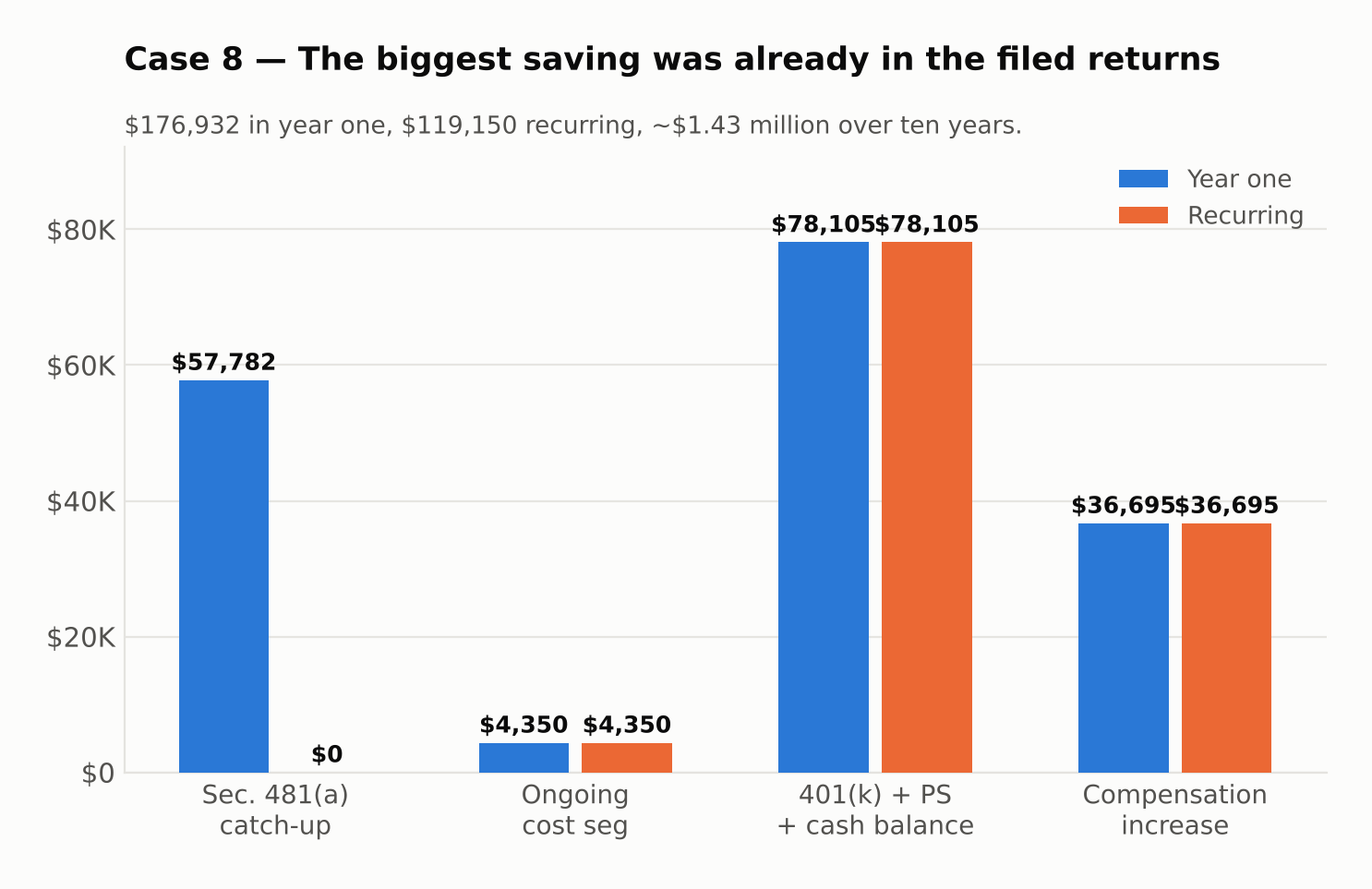
$176,932 in year one and $119,150 a year thereafter, the largest in the set, and about $1.43 million over ten years. The single biggest line, $57,782, required no new spending, no new entity and no new asset: depreciation had been understated on returns already filed, and an accounting method change claimed the whole cumulative shortfall in the year of change.
The Taxpayer
A married couple filing jointly in a state with its own individual income tax, who own and operate a group of four closely held entities. They have three children.
| Entity (as referred to here) | Tax classification | Ownership | Function |
|---|---|---|---|
| The Operating S Corporation | S corporation (S status elected roughly a decade before the engagement) | Taxpayer, 1,000 shares, 100 percent | Seasonal construction-services business |
| The Rental Partnership | LLC taxed as a partnership | Taxpayer and spouse approximately 50/50 | Residential and commercial rental real estate |
| The Second S Corporation | S corporation | Spouse, 100 percent | Operating business, first year in the earlier year examined |
| The Supply Activity | Single-member LLC on Schedule C | Taxpayer | Wholesale supply |
The partnership interests are split approximately 50/50 between the spouses, with a de minimis differential used to avoid deadlock on partnership decisions. That differential is the entire point of the split and carries no other planning significance.
The taxpayer devotes 95 percent of his time to the Operating S Corporation. The spouse’s primary occupation is outside the business; she is nonetheless on the Operating S Corporation payroll as an officer while owning none of its stock.
The Situation
This engagement is an addendum to a principal strategy memorandum. Counsel was asked to integrate two years of filed returns, a full federal and state individual package for the earlier year, and partnership and S corporation returns for the following year, plus management-prepared profit-and-loss statements for the next full year and year-to-date through mid-May of the current year, into a planning architecture already drafted on client representations. The question was not “what should they do”; it was “does what they actually filed support what we told them to do.”
It largely did not, without remediation first. Thirteen return-driven findings emerged from the two filed years, four more from the interim operating data. Four were classified Critical, meaning they block or substantially impair the planning sequence, and nine Material.
A note on method that is itself part of the lesson: the analysis rests solely on the returns as filed and the representations underlying them. No independent audit of the books was performed, and conclusions are expressly subject to revision on receipt of the Schedule L tie-out, the Sec. 752 liability-allocation worksheets, the outside-basis schedules, the Sec. 179 disposition computation on one equipment item, the Sec. 199A wage-determination worksheet, and any Treas. Reg. Sec. 1.469-4 grouping elections in effect. Both filed years were prepared by the same return preparer, which is what allows the Sec. 199A wage anomaly discussed below to be dated to the later cycle rather than the earlier one.
Issues Presented
- What does a two-year pattern of late filing and no estimated payments actually cost, and what estimated-tax architecture ends it?
- Both S corporation shareholders are at zero basis with suspended losses. What restores basis, and what traps lie in the existing shareholder loans?
- A $119,000 shareholder receivable grew $79,000 in one year while corporate cash fell $68,624. Loan or constructive distribution?
- The partnership K-1s report no Sec. 752 liability allocation against approximately $1,000,000 of nonrecourse mortgage debt. What cannot be computed until that is fixed?
- A commercial property owned by the partnership is leased to operating entities in which the taxpayer materially participates. How does the self-rental rule bite, and does a Sec. 1.469-4 grouping election fix it?
- Why was the Sec. 199A deduction $3,190 instead of $8,886, and why does one K-1 report $689,424 of W-2 wages against $171,873 actually paid?
- Four consecutive years of equipment dispositions have produced recurring Sec. 1245 recapture. What does that do to a planned Sec. 1031 exchange?
- A blanket Sec. 168(k)(7) bonus-depreciation opt-out is in effect. What does cost segregation plus a Form 3115 Sec. 481(a) catch-up produce once it is discontinued?
- What is the right officer compensation, and how much retirement plan capacity does the correct number unlock?
- The rental real estate is owned by a partnership, not by the individuals. How does that complicate a Sec. 1031 exchange and a SLAT?
Analysis
Compliance Posture and the Estimated-Tax Architecture
For the earlier year, an extension request was filed reporting a zero estimate of total liability and zero payment tendered. Actual federal liability was $57,314, of which only $8,167 had been withheld, leaving a true balance due of $49,147 at the original due date. The balance shown on the filed return was approximately $50,500, the difference being the Sec. 6654 underpayment addition.
| Penalty / interest category (rounded) | Federal | State | Total |
|---|---|---|---|
| Underpayment of estimated tax | ~$1,400 | ~$100 | ~$1,500 |
| Failure to pay (late payment) | ~$1,500 | ~$300 | ~$1,800 |
| Interest on underpayment | ~$2,000 | ~$400 | ~$2,400 |
| Subtotal | ~$4,900 | ~$800 | ~$5,700 |
See I.R.C. Sec. 6651(a)(2) (failure-to-pay penalty of 0.5 percent per month, capped at 25 percent); Sec. 6601 (interest at the federal short-term rate plus 3 percent); Sec. 6654. The roughly $1,500 late-payment penalty alone implies roughly six months of exposure on the $49,147 balance at 0.5 percent per month; the roughly $2,000 of interest is consistent with the 8 percent short-term rate plus 3 percent prevailing that year.
The package contains no reasonable-cause statement or abatement request. Given a substantial multi-entity business presence, an established preparer relationship, and liquidity available from the year’s equipment dispositions ($41,000 gross), reasonable cause would be difficult to establish on this record. I.R.C. Sec. 6651(a)(1); Crocker v. Commissioner, 92 T.C. 899, 913 (1989) (reasonable cause requires ordinary business care and prudence). Filing an extension with a zero balance estimate does not establish reasonable cause where actual liability differed materially. The recommendation is narrow: confirm whether first-time abatement was requested or remains available under IRM 20.1.1.3.6.1, and confirm the balance has been satisfied in full so as to permit that consideration.
Forward-looking, the facts trigger the high-income safe harbor, 110 percent of prior-year tax where prior-year AGI exceeds $150,000. I.R.C. Sec. 6654(d)(1)(B)(ii).
| Item | Amount |
|---|---|
| Prior-year total tax | $57,314 |
| 110 percent safe harbor threshold | $63,045 |
| Required quarterly estimate (÷ 4) | $15,761 |
| Less projected quarterly withholding ($8,167 ÷ 4) | ($2,042) |
| Net quarterly estimate required | $13,719 |
S Corporation Stock and Debt Basis, Two Separate Traps
The taxpayer’s interest in the Operating S Corporation. Form 7203 for the earlier year records the full erosion:
| Form 7203 line | Amount |
|---|---|
| Stock basis, beginning of year | $3,051 |
| Basis from capital contributions or additional stock | $21,109 |
| Ordinary business income | $26,447 |
| Interest income | $1,228 |
| Stock basis before distributions | $51,835 |
| Distributions | ($48,024) |
| Stock basis after distributions | $3,811 |
| Nondeductible expenses | ($2,035) |
| Allowable loss and deduction items used | ($1,776) |
| Stock basis at year-end | $0 |
| Suspended carryovers | $42,089 |
Composition of the $42,089: Sec. 179 deductions $36,860; charitable contributions $2,697; Sec. 1231 losses $2,532. These remain available against future stock or debt basis under I.R.C. Sec. 1366(d)(2).
The following year repeats the pattern and ends in the same place:
| Stock basis step | Amount |
|---|---|
| Beginning stock basis | $0 |
| Plus ordinary business income | $13,262 |
| Plus interest income | $1,879 |
| Plus Sec. 179 disposition gain (track loader recapture) | $28,000 |
| Stock basis before distributions | $43,141 |
| Less distributions | ($41,810) |
| Stock basis after distributions | $1,331 |
| Less nondeductible expenses (50 percent meals) | ($492) |
| Less charitable contributions allowed | ($839) |
| Ending stock basis | $0 |
| Suspended loss and deduction carryover | $42,640 |
| of which Sec. 179 carryover | $36,149 |
| of which charitable carryover | $4,008 |
| of which Sec. 1231 loss carryover | $2,483 |
| Debt basis available (no shareholder loans to the corporation) | $0 |
Under I.R.C. Sec. 1366(d)(1), a shareholder may deduct losses only to the extent of adjusted basis in stock plus adjusted basis in indebtedness of the corporation to the shareholder. With zero of each, and loans running in the opposite direction, the $42,640 of suspended deductions cannot be used until basis is restored. The Sec. 179 component is the largest piece and the most valuable per dollar of basis restored.
An unexplained capital gain. Schedule D and Form 8949 report a long-term gain of $21,019 attributed to the Operating S Corporation stock, acquired at the original incorporation date and “disposed of” at year-end, with $0 cost basis and $21,019 of proceeds (Box E, not reported to the Service). This is almost certainly Sec. 1368(b)(2) gain on distributions in excess of stock basis. But the Form 7203 arithmetic does not produce it: $48,024 of distributions against $51,835 of pre-distribution stock basis leaves $3,811, absorbed by the $2,035 of nondeductible expenses and the $1,776 of loss allowance. The $21,019 must therefore arise from a separate source, a deemed disposition of a portion of the stock, a redemption treated as a sale under Sec. 302, or a year-end distribution accounted for separately. It requires reconciliation with the preparer before the next return is filed. Together with the K-1 long-term gain of $97,318, it produced the Schedule D total of $118,337.
The spouse’s interest in the Second S Corporation, the debt-basis trap. First year of operations:
| Form 7203 line | Amount |
|---|---|
| Stock basis, beginning | $0 |
| Interest income from K-1 | $159 |
| Stock basis before distributions | $159 |
| Distributions | $0 |
| Nondeductible expenses | ($107) |
| Allowable loss | ($52) |
| Stock basis at year-end | $0 |
| Beginning debt basis | $7,584 |
| Additional loans during year | $16,838 |
| Debt basis before repayment | $24,422 |
| Allowable losses in excess of stock basis | ($24,422) |
| Debt basis at year-end | $0 |
| Suspended carryovers | $30,055 |
The corporation generated $54,529 of ordinary loss in its first year. Combined stock and debt basis allowed only $24,474 of it at the personal level ($24,422 + $52). The remaining $30,055 is suspended under Sec. 1366(d)(2).
The trap: if the corporation repays any portion of the $42,195 in shareholder loans before debt basis is restored above the loan principal, the repayment produces ordinary or capital gain to the extent it exceeds the tax basis in the debt, now $0. I.R.C. Sec. 1367(b)(2)(B); Treas. Reg. Sec. 1.1367-2(c). The recommendations are to freeze loan repayments until basis is restored through future income allocations; to consider converting some or all of the $42,195 to capital contributions, which converts loan-repayment risk into stock-basis exposure (still subject to Sec. 1368(b)(2) but cleaner), see Russell v. Commissioner, T.C. Memo. 2011-81 (capital contributions versus loans) and Estate of Leavitt v. Commissioner, 875 F.2d 420 (4th Cir. 1989) (back-to-back loans); and to document the loans with formal notes, stated interest, and amortization schedules to support bona fide indebtedness.
Basis trajectory across the two filed years:
| Shareholder / entity | End of year 1 | End of year 2 | End of year 3 |
|---|---|---|---|
| Taxpayer / Operating S Corp, stock basis | $3,051 | $0 | $0 |
| Taxpayer / Operating S Corp, suspended losses | n/a | $42,089 | $42,640 |
| Spouse / Second S Corp, stock basis | n/a (new) | $0 | pending |
| Spouse / Second S Corp, debt basis | $7,584 | $0 | pending |
| Spouse / Second S Corp, suspended losses | n/a | $30,055 | pending |
Aggregate suspended carryovers of $72,695 are locked at zero economic value pending basis restoration. Estimated cash required: $50,000 into the Operating S Corporation (to absorb projected distributions without recognition) and $35,000 into the Second S Corporation (to deploy the suspended ordinary losses against current income). Per-share, per-day allocation under Sec. 1366(a)(1) and Treas. Reg. Sec. 1.1366-1(a)(2) operates without regard to the timing of cash distributions. See generally Speca v. Commissioner, 630 F.2d 554 (7th Cir. 1980).
The $119,000 Shareholder Receivable
The Operating S Corporation’s Schedule L reports loans receivable from the shareholder of $40,000 at the beginning of the year and $119,000 at year-end, a $79,000 increase during a year in which cash declined from $79,403 to $10,779, a $68,624 decrease. Long-term liabilities rose from $146,362 to $197,797, a $51,435 increase. The cash trail is consistent with a meaningful operating cash distribution to the shareholder booked as a loan rather than as a Sec. 1368 distribution.
Two consequences follow.
Below-market loan. Under I.R.C. Sec. 7872, a corporation-to-shareholder loan not bearing interest at least at the applicable federal rate gives rise to imputed interest income to the corporation and a deemed distribution to the shareholder. The corporation reported $1,879 of interest income, which on an average balance of approximately $79,500 implies an effective rate of about 2.36 percent, well below the short-term AFR range of roughly 4.7 to 5.4 percent for the year.
Recharacterization. More significantly, if the advances are not bona fide indebtedness, lacking a written note, fixed maturity, security, and a realistic expectation of repayment, there is well-established authority to recharacterize them as constructive distributions under Sec. 1368 or as additional compensation under Sec. 61(a)(1). Commissioner v. Fender Sales, Inc., 338 F.2d 924 (9th Cir. 1964); Estate of Maxwell v. Commissioner, 3 F.3d 591 (2d Cir. 1993). Recharacterization would mean that distributions in excess of the $43,141 of stock basis available before any distributions, the $41,810 reported plus a deemed additional $79,000, total $120,810, would have produced roughly $77,669 of Sec. 1368(b)(2) gain, while the $42,640 of suspended losses would remain suspended for want of basis to absorb them.
This is a gating item. The strategy memorandum contemplates a holdings restructure and a contribution of S corporation stock to a spousal lifetime access trust. Both are significantly complicated, and arguably blocked, by an unresolved shareholder-loan position of this size.
The Sec. 752 Liability-Allocation Gap
| Item | Beginning of year | End of year |
|---|---|---|
| Partners’ capital accounts (tax basis) | $77,413 | ($61,001) |
| Taxpayer, capital account | $38,706 | ($30,501) |
| Spouse, capital account | $38,707 | ($30,500) |
| Long-term mortgages payable | approximately $900,000 | approximately $1,000,000 |
| Cash distributions | $113,091 (prior year) | $144,385 |
| Sec. 752 liability allocations on K-1 Item K | (blank) | (blank) |
Two problems. First, the partnership distributed $144,385 against net income of only $5,971, driving both partners’ tax-basis capital accounts negative. The distribution was funded substantially by a refinance during the year of the commercial property, which lifted long-term mortgage debt by approximately $100,000 and generated $2,880 of capitalized loan fees amortized over three years.
Second, and more troubling, both K-1s show blank entries in Item K despite approximately $1,000,000 of nonrecourse mortgage debt. Under Sec. 752(c) and the regulations, each partner is allocated a share of partnership liabilities based on the character of the debt and the partners’ interests in profits or capital. With no allocation reported, each partner’s outside basis, at-risk amount, and passive-loss capacity are all being computed without reference to a roughly $1 million liability pool, likely incorrectly.
Until a corrected allocation is in hand it cannot be determined (a) whether the taxpayer has sufficient outside basis to absorb his Form 7203 suspended losses; (b) whether the $144,385 distributed exceeded each partner’s outside basis under Sec. 731(a)(1), a literal reading of the capital accounts suggests it did, but the actual liability allocation may absorb it; or (c) whether the spouse is a bona fide partner under Sec. 704(e) and the principles of Commissioner v. Culbertson, 337 U.S. 733 (1949), or whether her interest is more properly a Sec. 704(e)(2) family partnership interest subject to challenge. Beginning capital of $38,707 against the taxpayer’s $38,706 suggests either joint contribution at formation or a family interest; documentation of her contribution is essential before any gifting of partnership interests on the basis of marketability or minority discounts.
Self-Rental and the Grouping Election
The commercial property is owned by the Rental Partnership, serves as the operating address of the Schedule C Supply Activity, and is leased to the Operating S Corporation for $18,707 of rent in the later year, with aggregate rents on that property of $49,914 (against $36,000 in the earlier year). The taxpayer materially participates in both the Schedule C activity and the S corporation.
Under Treas. Reg. Sec. 1.469-2(f)(6), rental income from property leased to a trade or business in which the taxpayer materially participates is recharacterized as nonpassive. The rule is asymmetric: net income is recharacterized, but a net loss from the same item of property remains passive. Mechanically, the property’s net rental income, $16,919 in the later year, of which the taxpayer’s share is roughly $8,460, is nonpassive and therefore cannot absorb passive losses from the other rentals or from any other passive activity.
The fix. Under Treas. Reg. Sec. 1.469-4(d)(1), a taxpayer may group a rental activity with a trade or business where the activities constitute an appropriate economic unit and the related-party constraints of Sec. 1.469-4(d)(5) are satisfied. Where the property is leased to the operating business and essentially dedicated to that use, grouping is generally available. The election is binding once made, with limited regrouping rights under Rev. Proc. 2010-13, 2010-4 I.R.B. 329, and must be disclosed on the first return for which it is in effect. The same grouping is also a permissible Sec. 199A aggregation under Treas. Reg. Sec. 1.199A-4 if the common-ownership and same-tax-year tests are met, so one election addresses both the self-rental recharacterization and the QBI aggregation.
The Passive Loss Phase-Out
Form 8582 reports modified AGI of $373,745 for active-participation purposes, $223,745 above the complete phase-out threshold. The $25,000 special allowance is phased out 50 cents per dollar of modified AGI above $100,000 and fully eliminated at $150,000. I.R.C. Sec. 469(i)(3). Result: zero special allowance, and all rental losses deferred under Sec. 469(b) and (g) until future passive income or a complete disposition releases them. The household paid full ordinary-income tax on $373,745 of modified AGI with no benefit from the rental portfolio’s suspended losses.
Sec. 199A, Two Separate Defects
Defect one: automatic loss aggregation. The Schedule C Supply Activity reported $129,399 of gross receipts against $131,343 of cost of goods sold, a negative $1,944 gross profit before operating expenses, producing a $28,477 Schedule C loss. COGS consisted of cost of labor $13,653 plus materials and supplies $117,690, with no beginning or ending inventory. That zero-inventory posture alongside the receipts-to-COGS mismatch suggests either a pass-through reseller model priced at or below cost, or supply purchases for related entities flowing through this Schedule C without intercompany markup.
Because the activity is a qualifying trade or business, its loss aggregated with the other passthrough activities:
| Entity | QBI / (loss) |
|---|---|
| Schedule C Supply Activity | ($28,477) |
| Rental Partnership (partner 1) | $3,919 |
| Rental Partnership (partner 2) | $3,920 |
| Operating S Corporation | $61,064 |
| Second S Corporation | ($24,474) |
| Aggregate QBI | $15,952 |
| Sec. 199A deduction (20 percent) | $3,190 |
Had the Schedule C activity been suspended or restructured into the S corporation chain so its losses were trapped at corporate-level basis, aggregate QBI would have been $44,429 and the deduction $8,886, a $5,696 deduction loss per equivalent loss year. The structural point is that at the simplified-computation level there was no election available: taxable income before QBI of $347,387 was below the MFJ threshold of $364,200, the simplified form was correctly used, and loss aggregation across all five activities is automatic. The income limitation ($45,810) was non-binding, and an aggregation election under Treas. Reg. Sec. 1.199A-4 could not have produced a different result. The fix is structural, not elective. (Note that restructuring the Schedule C into the S corporation chain does not change the self-employment tax outcome, Sec. 1402(a) already excludes an S corporation shareholder’s share, but it consolidates the QBI computation and removes the Schedule C audit flag.)
Defect two: an overstated W-2 wage base. The K-1 reports Sec. 199A W-2 wages of $689,424. Total W-2 wages actually paid by the corporation appear to be $171,873 ($130,000 officer compensation plus $41,873 non-officer salaries). The $689,424 reconciles only by adding the $517,551 of cost of labor reported on Form 1125-A.
Under Sec. 199A(b)(4)(A), “W-2 wages” means amounts described in Sec. 6051(a)(3) and (a)(8) paid by the qualified trade or business and properly reported on Forms W-2 filed with the Social Security Administration within 60 days after the due date. Treas. Reg. Sec. 1.199A-2(b)(1) is explicit that payments to independent contractors reported on Form 1099-NEC are not W-2 wages. If the $517,551 reflects subcontracted crew labor, the natural inference from a $168,007 year-over-year decline in W-2 payroll alongside a $278,797 increase in COGS, the wage base is overstated by approximately $517,551.
The practical impact on the filed individual return is zero: with true W-2 wages of $171,873 the wage limitation is $85,937 (50 percent), while the S corporation QBI of $41,262 yields a tentative deduction of $8,252, well below the corrected limit. The exposure is audit risk. If examined, the overstatement will draw scrutiny and may invite a broader worker-classification review under Rev. Rul. 87-41 and the Sec. 3121(d) common-law factors.
Recurring Sec. 1245 Recapture and the Sec. 1031 Problem
Form 4797 Part III for the earlier year reports four dispositions, listed as two pairs (the duplicates reflecting each spouse’s half interest):
| Asset | Holding period | Gross | Sec. 1245 recapture |
|---|---|---|---|
| Trailer (½) | acquired five years before disposition | $7,000 | $7,000 |
| Pickup truck (½) | acquired roughly three years before disposition | $34,000 | $29,279 |
| Trailer (½) | acquired five years before disposition | $7,000 | $7,000 |
| Pickup truck (½) | acquired roughly three years before disposition | $34,000 | $29,279 |
| Total | $82,000 | $72,558 |
The $72,558 rolls through Form 4797 to produce $72,451 of ordinary income after a ($107) Sec. 1231 loss flow-through, taxed at a 35 percent federal marginal rate plus the state’s individual income tax, roughly $29,000 to $31,000 of combined tax. I.R.C. Sec. 1245(a)(1) requires recapture as ordinary income of the lesser of recomputed basis less adjusted basis, or amount realized less adjusted basis.
The pattern is not anomalous. It is now four years deep:
| Year | Disposition recapture / loss on asset sales |
|---|---|
| Year 1 (trailer, pickup) | $72,558 |
| Year 2 (compact excavator $24,080 + track loader $28,000) | $52,080 |
| Year 3 (per P&L) | $32,668 |
| Year 4 year-to-date (per P&L) | $37,387 |
| Four-year cumulative | $194,693 |
Two consequences for the planned disposition pipeline. Sec. 1245 recapture is not deferrable in a Sec. 1031 exchange to the extent the relinquished property’s recapture exceeds depreciation taken on like-kind replacement property. Treas. Reg. Sec. 1.1245-4(d). And unplanned equipment dispositions create unhedged ordinary-income spikes. Every planned disposition must be modeled for recapture before any Sec. 1031 boot allocation is computed.
Confirmation is still needed on one item: the track loader recapture passed through at $28,000 against a tax basis of zero, the entire $41,345 cost having previously been Sec. 179-expensed, $28,000 sale price less $0 adjusted basis, separately reportable as ordinary income.
Net Investment Income Tax
| Form 8960 line | Amount |
|---|---|
| Taxable interest | $1,428 |
| Net rental / pass-through investment income | $6,690 |
| Net gain from disposition | $190,788 |
| Less gain not subject to NIIT | ($72,451) |
| Net investment-tax-applicable gain | $118,337 |
| Total investment income | $126,455 |
| State income tax allocable to investment income | ($4,153) |
| Net investment income | $122,302 |
| Modified AGI in excess of threshold ($381,584 − $250,000) | $131,584 |
| NIIT at 3.8 percent | $4,647 |
The $72,451 of Sec. 1245 ordinary income is properly excluded under Treas. Reg. Sec. 1.1411-4(d)(4) (gain treated as ordinary on disposition of property used in a trade or business). The exposure is therefore concentrated in the $97,318 K-1 long-term gain from passive S corporation activity, the $21,019 Sec. 1368(b)(2) gain, and the $1,428 of interest. Over a ten-year horizon this is approximately $46,470 of unmitigated tax.
Cost Segregation, the Sec. 168(k)(7) Opt-Out, and the Form 3115 Sec. 481(a) Catch-Up
Both the partnership and the S corporation have affirmative elections in effect under Sec. 168(k)(7) to opt out of bonus depreciation for “all eligible classes of property.” Such elections are made class-by-class and are revocable only with the Commissioner’s consent, Reg. Sec. 1.168(k)-2(f)(2), but they bind only the year made, the entity is free to make a different election (or none) in a later year. With 100 percent bonus depreciation permanently restored by the One Big Beautiful Bill Act of 2025 for property acquired and placed in service after January 19, 2025, the policy reason for opting out has largely disappeared.
The opt-out had no measurable cost in the year examined: the single placed-in-service item was a $7,023 improvement to a residential property (27.5-year), which would not have qualified for bonus in any event because Sec. 168(k) does not extend to Sec. 1250 real property other than qualified improvement property. The forward-looking concern is that the same blanket election language has been used historically and may have suppressed bonus on prior acquisitions and on personal-property components a cost segregation study would identify.
Partnership depreciable position. Buildings and other depreciable assets of $837,957 against accumulated depreciation of $99,551, leaving $738,406 of remaining basis; land of $199,666 carried separately; intangibles (new loan fees) of $2,560 net. Properties are on straight-line MACRS at 27.5-year residential and 39-year nonresidential rates. Total depreciation in the year examined: $29,561.
Property-level reclassification model. Commercial property carries a higher reclassification ratio (about 25 percent) than residential single-family rentals (about 18 percent), because of denser Sec. 1245 components (specialty plumbing and electrical, HVAC serving production equipment, removable interior finishes) and Sec. 1250 land improvements (parking, signage, landscaping, exterior lighting).
Modeled against a rounded total allocated depreciable basis of approximately $825,000 across the six properties, with the basis distributed by group rather than itemized per property:
| Property group | Type | Share of allocated basis | Reclass. % | 5-yr Sec. 1245 | 15-yr land improvements | Total reclass. |
|---|---|---|---|---|---|---|
| Five residential rentals | SFR | approximately 77% | 18% | $75,720 | $37,860 | $113,580 |
| One commercial property | Commercial | approximately 23% | 25% | $23,875 | $23,875 | $47,750 |
| Total | 100% | ~19.7% | $99,595 | $61,735 | $161,330 |
The approximately $825,000 of allocated depreciable basis differs from the $837,957 reported on the return by roughly $13,000, representing pure-land basis and other non-depreciable components; that reconciling item is to be confirmed against the property-level depreciation schedules.
Mechanics of the catch-up. A taxpayer depreciating property over a recovery period longer than the correct period is using an impermissible method of accounting. Reg. Sec. 1.446-1(e). The correction is a change in method of accounting on Form 3115 under automatic consent, Rev. Proc. 2019-43 (designated change number 7, cost segregation studies), and the Sec. 481(a) adjustment, the cumulative difference between depreciation as taken and as it should have been taken, is deducted entirely in the year of change.
| Item | Amount |
|---|---|
| Reclassified basis | $161,330 |
| Less depreciation already taken on those components | ($20,398) |
| Net Sec. 481(a) catch-up (one-time) | $140,932 |
| Regular depreciation on remaining $687,125 of Sec. 1250 basis | $29,561 |
| Total year-of-change deduction | $170,493 |
Against the status quo $29,561, that is a 476 percent increase. At the household’s blended 41 percent marginal rate, the catch-up is worth approximately $57,782.
Over a ten-year horizon the before-state line continues at roughly $29,561 per year, declining modestly; the after-state line spikes in the year of change and then runs at approximately $22,904 per year on the smaller remaining Sec. 1250 basis. Cumulative additional deductions reach approximately $105,907, worth approximately $43,422 of pure-timing benefit at 41 percent, of which the catch-up is the dominant piece.
The caveat that matters most. Because the rental activity is passive at the personal level (modified AGI fully phases out the special allowance), absorption of the $140,932 depends on offsetting passive income or a complete-disposition release under Sec. 469(g). The planned disposition pipeline is therefore not merely strategically aligned with the catch-up; it is essential to its current-year cash value. If dispositions slip a year, the basis advantage survives but the cash benefit defers. A real estate professional qualification analysis under Sec. 469(c)(7) and Sec. 1.469-9 is the alternative absorption path and should be evaluated in parallel.
Order of operations. Cost segregation must not precede remediation of the Sec. 752 allocations and the negative capital accounts, or it will compound inside/outside basis distortion: (a) correct K-1 Item K; (b) generate accurate outside-basis schedules; (c) then file Form 3115 and run the Sec. 481(a) adjustment.
Reasonable Compensation
| Item | Year examined | Prior year | Change |
|---|---|---|---|
| Gross receipts | $1,353,002 | $1,211,222 | +$141,780 |
| Cost of goods sold | $939,456 | $660,659 | +$278,797 |
| Gross profit | $413,546 | $550,563 | −$137,017 |
| Sec. 1245 gain on equipment sale | $24,080 | $5,244 | +$18,836 |
| Compensation of officers | $130,000 | $81,000 | +$49,000 |
| taxpayer (95 percent time) | $78,000 | n/a | |
| spouse (50 percent time, 0 percent stock) | $52,000 | n/a | |
| Salaries and wages (non-officer) | $41,873 | $209,880 | −$168,007 |
| Depreciation (regular MACRS, no bonus, no Sec. 179) | $54,620 | $39,937 | +$14,683 |
| Ordinary business income | $13,262 | $26,447 | −$13,185 |
| Distributions to shareholder | $41,810 | $48,024 | −$6,214 |
No Sec. 179 expense was elected despite a $1,220,000 dollar limitation and qualifying property placed in service.
The taxpayer’s $78,000. He works 95 percent of his time at a business generating $1,353,002 of gross receipts and receives $78,000 of W-2 wages plus $41,810 of distributions plus, on separate analysis, a $79,000 shareholder loan. The W-2-to-distribution ratio of roughly 65/35 is within the comfort range on its face, but the absolute dollar figure sits at the low end of what benchmarking would support for a working chief executive of a $1.4 million construction-services business; published comparables place owner-operator W-2 base in this revenue range at $115,000–$170,000. The recommendation is an increase to $140,000–$160,000, supported by a contemporaneous reasonable-compensation study dated within 60 days of the increase. I.R.C. Sec. 162(a)(1); Reg. Sec. 1.162-7(b)(3); Watson v. United States, 668 F.3d 1008 (8th Cir. 2012).
The spouse’s $52,000 is a different problem. She is reported as an officer at 50 percent time with 0.00 percent common and preferred stock. Reasonableness under Sec. 162(a)(1) and Reg. Sec. 1.162-7(b)(3) depends on services actually rendered; if her services are bookkeeping, administrative support, or marketing performed alongside her primary occupation, the payment may be defensible, but documentation is essential (job description, time logs, evidence of services, market benchmarking). Critically, because she owns no stock, this is not a Watson reasonable-compensation issue, which addresses payments from an S corporation to its shareholders. It is a Sec. 267 / Sec. 482 related-party and business-purpose issue, because the 100 percent shareholder is directing the company to pay his spouse. Unsupported, it could be recharacterized as a constructive distribution to him followed by a nondeductible spousal gift, or as wages paid for his benefit. Old Colony Trust Co. v. Commissioner, 279 U.S. 716 (1929). Two acceptable paths: document a defensible role and benchmark the pay to it (likely an administrative-coordinator or part-time bookkeeper range of $25,000–$35,000), or eliminate the payroll entirely and gross up the taxpayer’s compensation. The second is cleaner from an audit-risk perspective.
Interplay with QBI. Increasing W-2 wages reduces S corporation ordinary income passing through (decreasing QBI) while increasing the Sec. 199A wage limitation. The net deduction impact is approximately neutral; the benefits of the increase are audit defense, retirement-plan contribution capacity, and Social Security wage-base utilization.
Layered Retirement Plan Architecture
Install a three-tier program at the Operating S Corporation: a 401(k) with elective deferral and age-50 catch-up features under Secs. 401(k) and 414(v); a profit-sharing component layered onto it under Sec. 401(a); and a separately maintained cash balance defined benefit plan under Secs. 412(b) and 414(j).
Why three tiers: Sec. 415(c) caps aggregate defined-contribution allocations at the lesser of 100 percent of compensation or $70,000 for 2026. The elective deferral and the profit-sharing contribution both count against that limit, but the cash balance contribution is governed by the separately scaled Sec. 415(b) defined-benefit limit (effectively $275,000 per year of accrued benefit at age 62, present-valued back to the participant’s actual age). The combination of the two Sec. 415 limits is what produces the headline figure. The actuarial funding scale is the principal driver: at age 51, the cost of funding a defined-benefit promise is materially higher than at age 35, which is what makes the strategy valuable for participants from their late forties through mid-sixties.
| Plan component | Before (no plan, $78K W-2) | Interim (plan, $78K W-2) | After (plan, $150K W-2) |
|---|---|---|---|
| 401(k) elective deferral (Sec. 402(g), 2026 limit) | $0 | $23,500 | $23,500 |
| Age-50 catch-up (Sec. 414(v)) | $0 | $7,500 | $7,500 |
| Employer profit sharing (25 percent of W-2; Sec. 415 capped at $70,000 total DC) | $0 | $19,500 | $37,500 |
| Cash balance DB (Sec. 415(b) actuarial funding at age 51) | $0 | $140,000 | $235,000 |
| Total annual deductible contribution | $0 | $190,500 | $303,500 |
| Tax savings at 41 percent | $0 | $78,105 | $124,435 |
The incremental savings attributable to the compensation adjustment alone is $124,435 − $78,105 = $46,330 per year. Installing the plan without raising the salary captures only $190,500 of capacity and leaves $113,000 on the table.
At the household level, the status quo reflects officer compensation of $130,000 split $78,000/$52,000, no plan contributions, and a notional pass-through burden of approximately $143,500 on a representative $350,000 of S corporation ordinary income at 41 percent. The recommended scenario produces approximately $114,800 of annual tax savings. That figure is the gross deduction value at 41 percent on the increase in deductible compensation and contributions, less the $20,000 net increase in personal taxable wages (a $72,000 gross W-2 increase less the $52,000 of spousal compensation removed) net of $31,000 of pre-tax deferrals. It excludes payroll-tax effects and the Sec. 199A recalibration (approximately neutral at this income level). It is a planning estimate, not a return computation.
Raising W-2 wages by $72,000 creates approximately $5,508 of additional employer-side FICA and Medicare (7.65 percent, below the $176,100 Social Security wage base for 2026), comfortably outweighed by the $124,435 of contribution savings.
Over ten years, at an assumed 6 percent gross return inside the plan, cumulative tax savings approximate $1.32 million and the plan account balance approximates $4.43 million. That balance must be coordinated with the SLAT plan: qualified plan assets cannot be transferred to a SLAT during the participant’s lifetime without full income recognition under Secs. 401(a)(13) and 402, so the planning value runs through the SECURE Act ten-year payout rule for non-eligible designated beneficiaries at death. Beneficiary designations must be coordinated with the trust funding sequence.
Employer contributions are deemed made for the plan year if actually contributed by the extended filing deadline of the return for that year. Sec. 404(a)(6). Plan documents must be executed by December 31 of the intended plan year.
Sec. 1031 Into a Different Asset Class, Three Paths
The returns confirm the rental real estate is owned by the partnership, not by the individuals. A Sec. 1031 exchange of partnership-owned property followed by distribution of the replacement property (“swap and drop”), or the converse (“drop and swap”), are both heavily scrutinized and heavily litigated. The leading cases show how fact-sensitive the holding-period and step-transaction analysis is: Magneson v. Commissioner, 753 F.2d 1490 (9th Cir. 1985) (taxpayer-favorable on swap-and-drop facts); Bolker v. Commissioner, 760 F.2d 1039 (9th Cir. 1985) (taxpayer-favorable on drop-and-swap); Crenshaw v. United States, 450 F.2d 472 (5th Cir. 1971) (taxpayer loss). The Service’s longstanding position, in PLR 200807005 and Rev. Rul. 75-292, is that the partnership (or its partners) must hold the property for productive use in a trade or business or for investment both immediately before and after the exchange.
| Path | Mechanics | Assessment |
|---|---|---|
| Partnership-level exchange | The partnership exchanges directly and owns the replacement property | Acceptable as a pure tax move; misaligned with the recommended holding-company architecture and the SLAT funding plan |
| Pre-exchange liquidation (“drop”) | Properties distributed to the partners pro rata, partnership liquidates under Sec. 708(b)(1), partners exchange individually or through single-member LLCs | Consistent with the restructure, but requires analysis of gain under Sec. 731(a)(1) on cash distributions exceeding outside basis, an adequate holding period between distribution and exchange (the Service has informally suggested 12 months; no bright line), and Sec. 704(c) built-in gain layers given the contributing-partner question |
| Post-exchange liquidation (“swap and drop”) | Partnership exchanges, then distributes the replacement property | Least resistance on the relinquished side, maximum step-transaction exposure on the replacement side; generally not recommended |
Recommended sequence: the drop-then-individual-exchange path with a 9–15 month seasoning period, which requires beginning the restructure in the first quarter, distributing mid-year, and exchanging no earlier than the second quarter of the following year. If the contract closings are firm on the earlier timetable, that sequence does not work and the partnership-level exchange becomes the default, with restructuring on a separate track.
Trust Structure Must Accommodate S Corporation Stock
If S corporation stock is transferred to a spousal lifetime access trust, the trust must qualify as an eligible shareholder under Sec. 1361(c)(2):
- Qualified subchapter S trust under Sec. 1361(d): single beneficiary, all income distributed to the beneficiary, election made by the beneficiary. Simpler, less flexible.
- Electing small business trust under Sec. 1361(e): multiple beneficiaries permitted, income taxed at the trust’s highest marginal rate, election made by the trustee. More flexible for a trust with the spouse as lifetime beneficiary and the three children as remaindermen; preferred here.
Interim Operating Data, What Two More Years Showed
| Operating S Corporation | Filed return year | Following year (P&L) | Current year to date (mid-May) |
|---|---|---|---|
| Gross receipts | $1,353,002 | $1,382,667 | $190,621 |
| Cost of goods sold | $939,456 | $900,085 | $78,325 |
| Gross profit | $413,546 | $482,581 | $112,296 |
| Officer compensation | $130,000 | $130,000 | $47,500 |
| W-2 wages (non-officer) | $41,873 | $46,945 | $16,471 |
| Subcontractor / 1099 labor in COGS | $517,551 | $365,843 | $32,486 |
| Total operating expenses | n/a | $415,561 | $141,164 |
| Net operating income | $13,262 | $67,021 | ($28,869) |
| Gain/(loss) on asset sales | $24,080 | ($32,668) | ($37,387) |
| Depreciation (book) | $54,620 | $34,860 | (partial) |
| Net income (book) | $13,262 | $65,055 | $6,172 |
| Rental Partnership | Filed return year | Following year (P&L) | Current year to date (mid-May) |
|---|---|---|---|
| Gross rents | $165,610 | $157,436 | $60,156 |
| Other fee income | n/a | $2,935 | n/a |
| Total income | $165,610 | $160,371 | $60,156 |
| Cost of goods sold (R&M, supplies, subs) | $159,671 (incl. depr.) | $17,465 | $107,712 |
| Mortgage interest | (included above) | $53,275 | $24,899 |
| Property taxes | n/a | $21,499 | n/a |
| Insurance | n/a | $10,299 | $3,455 |
| Total expenses | n/a | $108,706 | $38,266 |
| Net operating income | $5,939 | $34,200 | ($85,822) |
| Book depreciation / amortization | $29,561 | $30,574 | n/a |
| Uncategorized expense account | n/a | n/a | $34,463 |
| Net income | n/a | $11,595 | ($119,546) |
Five observations follow. (1) The compensation gap persists: officer compensation held at $130,000 while gross receipts rose to $1,382,667, so the recommendation is now overdue rather than prospective. (2) The worker-classification pattern continues: $365,843 of subcontractor labor against $46,945 of non-officer W-2 wages, an 88/12 mix, with the same pattern in the current year to date, sustaining the Sec. 199A wage-base finding and keeping Rev. Rul. 87-41 and the Sec. 3121(d) factors live. (3) The disposition pattern is confirmed four years deep at $194,693 cumulative. (4) Book depreciation of $30,574 confirms no cost segregation has been performed, consistent with the opt-out election remaining in effect. (5) Current-year operational distress at the partnership: an $85,822 operating loss on $60,156 of rents, a 143 percent expense-to-revenue ratio, driven by cost of goods sold of $107,712 versus $17,465 for the whole prior year, concentrated in three properties ($24,544, $27,416 including $10,100 of subcontractor cost, and $16,471) that are the same three identified as sale candidates. That is a defensible pre-sale make-ready pattern with two tax consequences: a capitalization-versus-expense analysis under Reg. Secs. 1.162-4 and 1.263(a)-3 (betterment, restoration, or adaptation items under Reg. Sec. 1.263(a)-3(d) must be capitalized; the partnership has elected the de minimis safe harbor under Reg. Sec. 1.263(a)-1(f), permitting expensing up to $2,500 per invoice or item with a written policy), and suspension of the resulting passive loss absent Sec. 469 reform.
The uncategorized-expense balance is a critical reconciliation item. The partnership’s current-year-to-date statements carry $34,463 in a bookkeeping “unclassified” account, 22 percent of year-to-date cost of goods sold, with a further $2,419 on the operating company. This must be fully reconciled before any cost segregation study is run or any Sec. 1031 closing is initiated, because misclassified items flow into the property-level basis schedules that drive both the reclassification and the boot calculation.
Portfolio composition has also shifted: one property appears in the current year that was absent from the earlier Form 8825, and one property with $23,880 of gross rents has dropped out, suggesting a disposition or a transfer out of the partnership. Several properties named in the strategy memorandum never appeared on the return at all. Titling for each must be reconciled with the clients.
Two Procedural Items
A Sec. 163(j) informational entry of $33,337/$33,338 appears on the partner K-1s. Small business taxpayers under the Sec. 448(c) gross receipts threshold ($30 million) are exempt from the limitation unless they are a tax shelter under Sec. 448(d)(3). The partnership clearly qualifies; the reporting should be removed or recharacterized.
No Sec. 754 election is in effect, which matters for basis adjustments on transfers at death and should be revisited as part of the estate plan.
Schedule A for the earlier year reports $34,197 of itemized deductions (SALT capped at $10,000, mortgage interest $6,813, charitable contributions $17,384) against a $27,700 MFJ standard deduction. The charitable total warrants substantiation review under Sec. 170(f)(8) and Treas. Reg. Sec. 1.170A-13, a contemporaneous written acknowledgment for every gift of $250 or more, stating the amount or description, whether goods or services were provided, and a good-faith estimate of any such goods or services; Form 8283 for any noncash gift over $500. Clean substantiation infrastructure matters before any donor-advised fund or charitable remainder trust is funded.
The Plan
Priority Action Matrix
| # | Priority | Action | Authority |
|---|---|---|---|
| R-01 | Immediate | Confirm whether first-time abatement was requested for the roughly $1,500 failure-to-pay penalty; if not, prepare and file the abatement request | Sec. 6651; IRM 20.1.1.3.6.1 |
| R-02 | Immediate | Reconcile the $21,019 Form 8949 Box E entry against Form 7203 Part I, Lines 5/6/7, the gain is not explained on the face of the return | Sec. 1368(b)(2); Treas. Reg. Sec. 1.1368-1 |
| R-03 | Immediate | Resolve the $119,000 shareholder receivable: repay (preferred), or paper with note, AFR interest, fixed maturity and security, accruing past-due interest as imputed income | Sec. 7872; Fender Sales; Maxwell |
| R-04 | Immediate | Obtain corrected K-1s with proper Sec. 752 allocations on Item K; recompute outside basis for both partners | Sec. 752; Reg. Sec. 1.752-1 |
| R-05 | 30 days | Establish the 110 percent safe-harbor estimated-tax architecture (~$15,761/quarter federal, ~$2,576/quarter state), automated from a dedicated tax-reserve account | Sec. 6654(d)(1)(B)(ii); state estimated-tax statute |
| R-06 | 30 days | File the Sec. 1.469-4 grouping election covering the commercial property and the operating S corporations as one appropriate economic unit; consider amending the earlier year | Treas. Reg. Sec. 1.469-4; Rev. Proc. 2010-13 |
| R-07 | 30 days | Discontinue the blanket Sec. 168(k)(7) opt-out prospectively; confirm the election language does not appear on the next returns | Sec. 168(k)(7); Reg. Sec. 1.168(k)-2(f) |
| R-08 | Near term | Restore stock basis in the Operating S Corporation via a ~$50,000 capital contribution to absorb projected distributions and access the $42,640 of carryovers (especially the $36,149 Sec. 179 piece) | Secs. 1366(d), 1367(a)(1)(A) |
| R-09 | Near term | Restore basis in the Second S Corporation via a ~$35,000 capital contribution in lieu of further loans, so the $30,055 of suspended ordinary losses can be deployed | Sec. 1367; Reg. Sec. 1.1367-2(c); Russell |
| R-10 | Near term | Freeze repayments on the $42,195 of shareholder loans until debt basis is restored or the loans are converted to capital | Sec. 1367(b)(2)(B); Reg. Sec. 1.1367-2(c) |
| R-11 | Near term | Increase the taxpayer’s W-2 base to $140,000–$160,000 effective the first available pay period; procure a benchmarking study within 60 days; document or eliminate the spouse’s $52,000 | Sec. 162(a)(1); Reg. Sec. 1.162-7(b)(3); Watson |
| R-12 | Next quarter | Engage a cost-segregation provider; scope all six rentals and the S corporation’s depreciable assets; coordinate Form 3115 for the Sec. 481(a) catch-up | Rev. Proc. 2019-43; Reg. Sec. 1.446-1(e) |
| R-13 | Following year | Restructure the Schedule C Supply Activity: absorb it into the S corporation chain so the loss is captured at corporate level, or discontinue it. The Schedule C structure costs $5,696 of QBI deduction per equivalent loss year | Secs. 199A, 1361, 351 |
| R-14 | Following year | Pre-model all Sec. 1245 recapture on operating-asset transitions before any Sec. 1031 boot allocation | Treas. Reg. Sec. 1.1245-4(d); Sec. 1031 |
| R-15 | Ongoing | Confirm Sec. 170(f)(8) acknowledgments for the $17,384 of charitable contributions; build substantiation discipline ahead of any DAF or CRT funding | Sec. 170(f)(8); Reg. Sec. 1.170A-13 |
Documents to Request from the Return Preparer
Critical: the Sec. 752 worksheets and outside-basis schedules reconciled to capital accounts; the Sec. 179 disposition computation on the track loader; the journal entries supporting the $79,000 increase in shareholder loans receivable, with any notes, security agreements, repayment schedules, or interest records. Material: the Sec. 199A wage worksheet reconciling $689,424 to $171,873; the 1099-NEC vendor listing with amounts and contract terms; the grouping election history; any prior cost-segregation reports. Procedural: justification for the Sec. 163(j) entries.
Coordinated Implementation Calendar
| Quarter | Cost segregation workstream | Retirement plan workstream |
|---|---|---|
| Q1 | Remediate Sec. 752 K-1 allocations; obtain the preparer’s worksheets; reconcile the $34,463 uncategorized balance | Raise W-2 to $150,000 effective the first pay period; procure the benchmarking study; restructure or eliminate the $52,000 |
| Q2 | Confirm the Sec. 168(k)(7) opt-out is absent from the next returns; scope providers on engineering credentials and Audit Techniques Guide compliance | Engage a third-party administrator for the 401(k)/profit-sharing plan and an actuary for the cash balance plan; draft adoption agreements; obtain the ERISA fidelity bond |
| Q3 | Engineering site visits; component identification; preliminary reclassification report; coordinate with disposition closings for passive-loss absorption | Execute plan documents; open trust accounts; begin deferrals through payroll; project employer funding levels |
| Q4 | Final report; Form 3115 prepared for filing with the partnership return; catch-up calculation finalized | Year-end nondiscrimination testing; profit-sharing allocation; cash balance actuarial valuation; participant statements |
| Q1 following | File the partnership return with Form 3115; K-1s reflect the catch-up on Line 2 and flow to the personal returns | Fund employer contributions before the extended corporate deadline; file Form 5500 |
Projected Result
| Strategy component | Year of implementation | Recurring annual thereafter | Type |
|---|---|---|---|
| Cost segregation, Sec. 481(a) catch-up | $57,782 | $0 | One-time |
| Cost segregation, ongoing timing benefit | $4,350 | $4,350 avg. | Annual |
| 401(k) + profit sharing + cash balance at $78K W-2 | $78,105 | $78,105 | Annual |
| Compensation increase to $150K, incremental capacity | $36,695 | $36,695 | Annual |
| Combined | $176,932 | $119,150 | |
| Ten-year cumulative | approx. $1.43M |
Revised against the original strategy memorandum’s estimates:
| Strategy | Original estimate | Revised estimate | Delta |
|---|---|---|---|
| Cost segregation, prospective | $45K–$80K | $45K–$80K | $0 |
| Form 3115 Sec. 481(a) catch-up (one-time) | not modeled | $50K–$60K | +$50K–$60K |
| Short-term rental acquisitions | $80K–$150K | $80K–$150K | $0 |
| Sec. 1031 into a new asset class (deferral, not absolute savings) | $60K–$120K | $60K–$120K | $0 |
| Reasonable comp + DB plan integration | $30K–$40K | $46K | +$6K–$16K |
| Trust estate-tax savings (present value over horizon) | $1.2M–$2.0M | $1.2M–$2.0M | $0 |
| Annual recurring income-tax savings (excl. one-time) | $215K–$390K | $231K–$406K | +$16K |
| Plus one-time Sec. 481(a) catch-up | n/a | $50K–$60K | +$50K–$60K |