
Case study. Adapted from an actual engagement. All identifying details removed; all figures are the real figures.
The savings
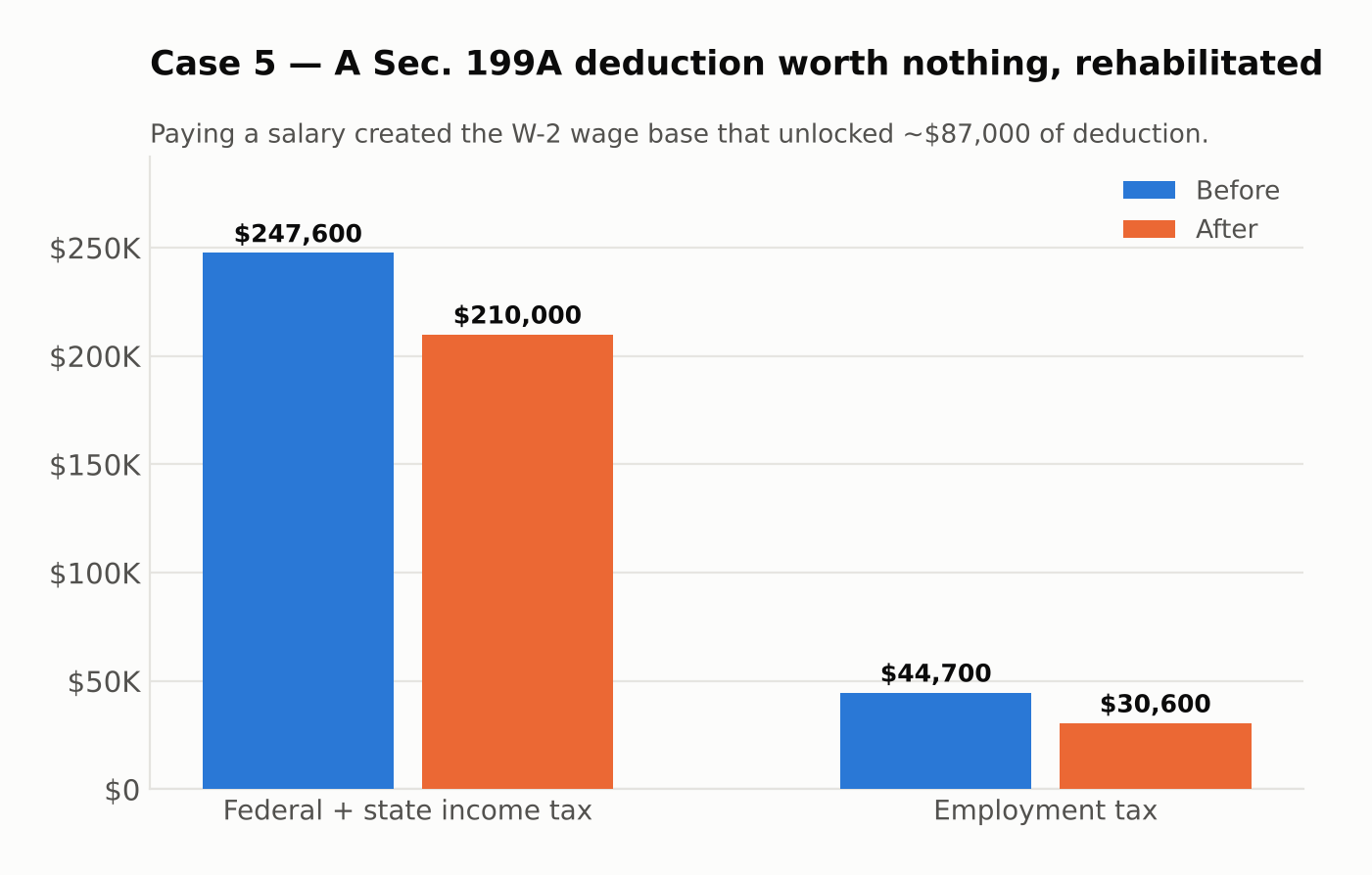
Roughly $50,000 a year, communicated to the client conservatively as $40,000–$50,000. The Sec. 199A deduction had been zero, above the thresholds it is limited by reference to W-2 wages paid, and a sole proprietor pays himself none. Paying a salary created the wage base that unlocked about $87,000 of deduction.
The Taxpayer
A single-member limited liability company, disregarded for federal tax purposes, operating a digital media and online content business. The owner is the sole worker; no employees and no W-2 wages were paid. The owner is treated as single with no dependents for projection purposes.
For the most recent completed tax year the business reported:
| Amount | |
|---|---|
| Gross revenue | $1,000,000 |
| Vendor and direct expenses | $300,000 |
| Net profit (Schedule C) | ~$700,000 |
A home office is maintained in the owner’s personally owned condominium unit. No S corporation election had been made. An extension had been filed for the completed year, leaving an extended filing deadline in October of the following year.
The business operates from a high-tax state.
The Situation
Delivered in April of the year following the reporting year, with the extended return still unfiled. That timing created a two-part mandate: what can still be changed for a closed year not yet reported, and what should be restructured prospectively.
The structural problem is simple. A disregarded single-member LLC exposes the entire $700,000 of net profit to self-employment tax on Schedule C, and because no W-2 wages are paid while net income far exceeds the applicable thresholds, the Sec. 199A deduction is unavailable. The taxpayer is paying the maximum on both axes, employment tax on every dollar of profit, and income tax with no pass-through deduction.
Issues Presented
- What deductions and elections remain available for the closed year where an extension has been filed but the return has not?
- Can a retirement plan be adopted and funded retroactively for the closed year, and at what limits?
- Is a retroactive S corporation election for the closed year advisable, and what are its costs and risks?
- Should the LLC elect S corporation status prospectively, and does the state’s entity-level charge structure argue for converting the LLC into a corporation rather than electing on top of the LLC?
- How is a defensible reasonable compensation figure determined, and how does the Social Security wage base change the optimal salary/distribution split?
- How does paying W-2 wages rehabilitate a Sec. 199A deduction that is otherwise zero?
- How is the home office deduction preserved after converting to S corporation form, when the owner becomes an employee and unreimbursed employee expenses are disallowed?
- Can an elective pass-through entity tax be used to restore a federal deduction for state income tax otherwise capped?
- What real estate strategies can shelter active business income notwithstanding the passive loss rules?
Analysis
Part One, Retroactive Planning for the Closed Year
Retirement Contributions Funded by the Extended Due Date
Because an extension was filed, a SEP-IRA may still be adopted and funded for the closed year up to the extended due date. On $700,000 of net profit the maximum SEP contribution is approximately $66,00025% of net self-employment earnings as limited by the statutory dollar ceiling, a $66,000 reduction to a year already closed.
A solo 401(k) can likewise be adopted after year end under the post-SECURE Act retroactive adoption rule, supporting a profit-sharing contribution of similar magnitude (~$66,000). But the employee elective deferral generally had to be elected by the last day of the plan year, so that layer is not retroactively available absent a specific exception. For a closed year the two vehicles therefore produce substantially the same deduction, and the SEP is administratively simpler.
Defined Benefit Plan Adopted Retroactively
A more aggressive version of the same idea: a defined benefit plan adopted by the extended due date and funded before filing supports a contribution set by actuarial calculation rather than a dollar cap. At this income level the memorandum models a potential $200,000 contribution for the closed year. It requires actuarial determination, cash to fund before filing, and a multi-year funding commitment, raised as a live option because the income level justifies the complexity.
Home Office, Including the Depreciation Component
The deduction is available on Schedule C for the portion of the residence used regularly and exclusively as the principal place of business, including where the qualifying use is conducting the business’s administrative and management activities with no other fixed location for them.
The deductible share covers a proportionate allocation of mortgage interest, property taxes, homeowners association dues, utilities, insurance, and, most frequently omitted, depreciation on the basis allocable to the office space. On a 15% square-footage allocation, 15% of each is deductible.
Two refinements. Where home office depreciation was omitted in prior years, the omission is a change in method of accounting correctable by a Form 3115 adjustment rather than by amending each prior return. And the post-2017 suspension of the deduction for unreimbursed employee business expenses does not reach a sole proprietor’s Schedule C home office deduction, a distinction that becomes critical in Part Two.
Sweep of Ordinary and Necessary Expenses
The closed-year return should be built from a full-year review of card statements and receipts, because expenses paid personally rather than from business accounts remain deductible on Schedule C. Categories commonly incomplete in a business of this type:
- Equipment, cameras, lighting, computers, phones, limited to the business-use portion
- Software subscriptions and web hosting
- Advertising and promotion, including paid social advertising
- Business travel, including conferences and location shoots
- Contract labor and professional fees
- Self-employed health insurance premiums, deductible above the line where paid personally
Cost Recovery and the Federal/State Conformity Split
For equipment placed in service in the closed year, Sec. 179 expensing and bonus depreciation accelerate the deduction. The federal Sec. 179 ceiling was $1,160,000 for the earlier year and $1,200,000+ for the year at issue, with 80% bonus depreciation available federally.
The state does not conform to federal cost recovery: its expensing ceiling sits far below the federal figure and federal acceleration is not followed. Federal expensing above the state cap is added back on the state return and recovered over the asset’s ordinary life for state purposes. Take the full federal acceleration regardless, the federal benefit is immediate and the state effect is timing, not permanent disallowance. A $5,000 equipment purchase late in the closed year placed on a regular depreciation schedule is a candidate for a Sec. 179 election on the extended return. Where any vehicle was used in the business, the passenger automobile limitations must be observed.
Sec. 199A for the Closed Year, Why It Is Zero
The 20% qualified business income deduction is subject to a taxable-income threshold above which the deduction for a specified service trade or business phases out entirely, a range running from approximately $220,050 to $270,050 for a single filer for the year at issue, and above which the deduction for a non-specified business is limited to the greater of 50% of W-2 wages or 25% of W-2 wages plus 2.5% of unadjusted basis in qualified property, fully phased in above approximately $364,200 for a single filer.
At roughly $700,000 of income with zero W-2 wages the taxpayer fails on both routes: above the SSTB phase-out if the activity is a specified service trade or business, and limited to zero by the wage test if it is not, because a disregarded single-member LLC pays its owner no wages. Wages to employees, including a spouse, had there been one, would have supported some deduction. Retroactive owner wages are impossible in a sole proprietorship; only a corporate classification can characterize owner compensation as wages. The closed-year deduction is therefore $0, which is the strongest single argument for the restructuring in Part Two.
State Tax Deduction and the Absence of a Pass-Through Entity Tax Election
The state’s individual income tax is largely non-deductible federally because of the $10,000 limitation on the state and local tax deduction. The elective pass-through entity tax that works around it is available only to entities treated as partnerships or S corporations, not to a disregarded single-member LLC, and there is no retroactive cure other than the retroactive S election discussed next.
The one available step is to ensure the $10,000 cap is consumed: paying the condominium property tax bill within the closed year rather than deferring it.
The Retroactive S Election, Analyzed and Not Recommended
Relief for a late S election is available under Rev. Proc. 2013-30 where the entity intended S status, failed to file a timely Form 2553, acts within 3 years and 75 days of the intended effective date, and establishes reasonable cause. Applied here, the LLC would file Form 1120-S for the closed year and reconstruct owner compensation after the fact.
The upside is large: reclassifying a portion of $700,000 of profit from self-employment income to distributions not subject to employment tax is worth on the order of $50,000 for the closed year if executed perfectly.
The downside is why it was declined. Reconstructing a year of payroll means late deposits with penalties and interest, late information returns, amended filings, and a reasonable cause showing that must actually be true rather than asserted. The recommendation was to accept the closed year as filed on extension and direct the restructuring at the open year, where it can be done cleanly. The option is preserved in the file as a considered alternative.
Summary of Closed-Year Recovery
| Item | Reduction to taxable income |
|---|---|
| SEP-IRA contribution | $66,000 |
| Home office allocation | $15,000 |
| Miscellaneous overlooked expenses | $10,000 |
| Total | ~$91,000 |
At a ~35% federal marginal rate that is in excess of $30,000 of federal tax, plus approximately $9,000 of state tax at a ~10% rate, recovered after the year was already over.
Part Two, Prospective Restructuring
The S Corporation Election
As a disregarded entity, 100% of the $700,000 net profit bears self-employment tax at 15.3% (subject to the wage base on the Social Security component) in addition to income tax. As an S corporation, profit splits between a reasonable W-2 salary and distributions, and only the salary bears Social Security and Medicare tax.
Form 2553 elects S status, ordinarily due by the 15th day of the third month of the tax year for which it is effective. Where that date has passed, the taxpayer seeks late election relief or targets the following January 1. The LLC remains the legal entity; the change is one of federal tax classification, and the owner becomes a shareholder-employee.
Entity Form in a State That Charges Both
Easy to miss and expensive to get wrong. In the subject jurisdiction:
- An LLC, even one classified as an S corporation federally, remains in the LLC regime: a flat annual franchise tax plus a revenue-based fee, which at approximately $1,000,000 of revenue falls in one of the higher fee tiers.
- A corporation with an S election pays a net-income-based franchise tax, subject to the same flat minimum, roughly $10,000 to $11,000 at this level of profit.
An LLC that merely elects S status federally can therefore owe both the revenue-based LLC fee and the net-income-based franchise tax, a wholly avoidable duplication. The recommendation was to convert the LLC into a corporation by statutory conversion, or form a new corporation, so only the net-income-based charge applies, itself deductible federally as a business expense. The general lesson: where a state imposes distinct entity-level charges on LLCs and corporations, a federal classification election made without changing state entity form can stack both.
Reasonable Compensation
An S corporation shareholder-employee must be paid reasonable compensation for services actually rendered, a facts-and-circumstances standard asking what it would cost to hire someone to do the owner’s work, weighing duties, hours, experience, industry comparables, and the extent to which profit derives from personal services as against capital and the efforts of others.
Here, a $200,000 salary against $700,000 of net profit, leaving approximately $500,000 as distributions, is defensible, roughly a 30/70 split. Courts have sustained lower ratios on particular facts, but a conservative target is 30% to 50% of profits as wages, justified by reference to actual duties (production, marketing, management) and comparable-role compensation. Substantially underpaying salary is the most common trigger for recharacterization.
Employment Tax Comparison
| Sole proprietor | S corporation | |
|---|---|---|
| Income subject to employment tax | $700,000 | $200,000 (salary only) |
| Employment tax | ~$44,700 | ~$30,600 |
| Annual savings | n/a | ~$14,000 |
The composition matters. Social Security tax is 12.4% up to the wage base (approximately $160,200) and Medicare is 2.9%, plus the 0.9% additional Medicare tax on high earners. Because the Social Security component stops at the wage base, the marginal benefit of shifting dollars from salary to distribution collapses once salary passes it, above the base only Medicare is at stake. That argues for a salary near the wage base where defensible. But defensibility governs: if profit grew to $2,000,000, a salary at the wage base would likely be unreasonably low, while $300,000 could be supported and still leave the bulk as distributions. Revisit the ratio annually, and whenever the owner’s role changes in character, for instance from performing the revenue-generating work to managing others who perform it.
Note the tension with retirement funding: employer profit-sharing contributions are a percentage of W-2 wages, so compressing salary to minimize employment tax also compresses the retirement contribution ceiling. The optimum is not the lowest defensible salary.
Sec. 199A Rehabilitated
Paying W-2 wages moves Sec. 199A from zero to substantial. With $500,000 of pass-through profit after a $200,000 salary, the wage limitation is satisfied: 50% of $200,000 equals $100,000, supporting a deduction of approximately $100,000 (20% of $500,000). The alternative prong, 25% of wages plus 2.5% of the unadjusted basis of qualified property, is available where capital assets are significant.
That is roughly $100,000 of income removed from federal tax, worth approximately $24,000 at the top bracket, achieved by the act of running payroll. In the projection table the deduction is computed on qualified business income net of the other above-the-line adjustments, producing approximately $87,00020% of $437,000, rather than the illustrative $100,000. Both figures are retained because each answers a different question.
Administration and Cost
An S corporation adds a separate return, payroll processing (on the order of $1,000 per year), and the state’s net-income-based entity tax of roughly $10,000 to $11,000, which is largely offset by the employment tax saved and is deductible federally. Separate books must be maintained and corporate formalities respected; day-to-day operations do not change.
Accountable Plan, Preserving the Home Office After Conversion
Conversion creates a trap. Once the owner is an employee rather than a proprietor, business expenses cannot be deducted on Schedule C, and the deduction for unreimbursed employee business expenses is suspended. A home office deduction worth $15,000 as a proprietor becomes worth nothing if the structure changes and nothing else is done.
The cure is an accountable plan under Treas. Reg. Sec. 1.62-2, a written arrangement, typically adopted in corporate minutes, under which the corporation reimburses substantiated expenses incurred on its behalf. Conforming reimbursements are deductible by the corporation and excluded from the employee’s income; they are not wages, so they bear no employment tax and do not count as compensation for retirement plan purposes. The plan must require a business connection, substantiation within a reasonable period, and return of excess advances.
What runs through the plan:
- Home office. On a 15% allocation: 15% of mortgage interest, property taxes, utilities, association dues, insurance, and depreciation on the basis allocable to the office space, submitted on a monthly or quarterly expense report. The square-footage computation is documented annually and retained in the tax file.
- Vehicle and travel. Business mileage at the standard rate, 65.5 cents per mile for the earlier year, approximately 68 cents for the year at issue, plus airfare and lodging paid personally.
- Cell phone and internet. The business-use portion on substantiation. At 80% business use, 80% of the monthly bill.
Every S corporation whose owner incurs business costs personally should have one. Without it, those dollars are simply lost.
Pass-Through Entity Tax, Restoring the State Tax Deduction
The individual deduction for state and local taxes is capped at $10,000. An elective entity-level tax converts state income tax on business income into a deductible business expense at the entity level, with a corresponding credit against the owner’s personal state liability.
Here the electing entity pays the state’s elective entity-level tax on qualified net income, roughly $45,000 to $50,000. The owner’s personal state tax of approximately $61,000 is offset by an equal credit, leaving roughly $11,000 to $16,000 due personally.
State revenue collected is unchanged; the federal characterization is what moves. The entity-level tax becomes a deductible entity-level expense instead of a personal itemized deduction capped at $10,000, approximately $17,000 of additional federal tax saved at a 37% rate, and much of the federal reduction in the optimized column below. The election is available only to entities treated as partnerships or S corporations, a further argument for the conversion.
Real Estate, Sheltering Active Income Despite the Passive Loss Rules
Conventional rentals. Depreciation offsets rental income, but rental activity is presumptively passive and losses cannot offset active business income unless the taxpayer qualifies as a real estate professional, unrealistic for someone working full time in this business, or another exception applies.
The short-term rental exception. A rental is excluded from the definition of “rental activity” where the average period of customer use is seven days or less. Such an activity is not automatically passive; if the owner materially participates, losses are non-passive and available against other income. Material participation can be established by more than 100 hours and more than any other individual, among other tests.
The illustration: acquire a short-term rental for $500,000; through cost segregation and bonus depreciation at the 60% rate applicable in the planning year, generate a first-year paper loss of approximately $150,000; if the average-stay and material participation requirements are met, that $150,000 offsets $150,000 of S corporation income, worth approximately $50,000 in tax, while the property may be cash-flow positive or near break-even. This requires rigorous hour logs and genuine personal management.
Sec. 280A(g), renting the residence to the business. Where the residence is rented to the business for fewer than 15 days in the year, the rental income is excluded from the owner’s gross income entirely while the business deducts the rent. On 10 days at a documented market rate of $500 per day, the corporation deducts $5,000 and the owner receives $5,000 tax free, well suited to a business that genuinely films or hosts at the residence. Requirements: a fair rate supported by comparable venue quotes, an invoice or rental agreement for the specific dates, a genuine business purpose for each day, and strict observance of the day limit, which if exceeded forfeits the exclusion in full.
Relocation. Given the state’s rate structure, relocating to a no-income-tax state is the largest available lever on the state component. It is a life decision, not a tax decision, and was presented as such.
Industry-Specific Planning for a Digital Content Business
- Cost of content. Production inputs acquired primarily for business use; marketing costs; paid advertising; bandwidth and production software; outsourced editing and assistant costs. The standard is ordinary and necessary; the substantiation is a receipt with a contemporaneous note tying it to the specific business use.
- Non-cash compensation is income. Products and services received in exchange for content are taxable at fair market value whether or not cash changes hands and whether or not an information return issues. A $2,000 item received for use in production is $2,000 of gross income, and the costs of producing the content around it are deductible. Maintain a log of significant in-kind compensation for the return preparer.
- Entity as contracting party and IP holder. Having the corporation sign commercial agreements and hold trademarks and brand assets provides liability separation and reinforces that the activity is a trade or business rather than a hobby, tax-neutral as to character, useful on audit.
- Education. Courses and materials maintaining or improving skills required in the existing business are deductible; expenses qualifying the taxpayer for a new trade or business are not. Industry conferences are deductible travel.
- Insurance and professional fees. Production liability coverage, contract review and entity formation costs are deductible.
- Estimated taxes. Salary withholding covers part of the liability and can be increased to cover tax on distributions, which is often simpler than separate quarterly estimates. Either way, quarterly discipline avoids underpayment penalties.
The Plan
| Step | Action | Timing |
|---|---|---|
| 1 | Adopt and fund SEP-IRA (~$66,000) for the closed year | Before the extended due date |
| 2 | Evaluate retroactive defined benefit plan (~$200,000) if cash is available to fund before filing | Before the extended due date |
| 3 | Compute and claim the full home office allocation including depreciation; Form 3115 for prior omitted depreciation | On the extended return |
| 4 | Sweep personal card statements and receipts for unrecorded business expenses | Before filing |
| 5 | Elect Sec. 179 on closed-year equipment; accept state add-back | On the extended return |
| 6 | Accept the closed year without a retroactive S election; document the decision | n/a |
| 7 | Convert the LLC to a corporation and elect S status, effective January 1 of the open year (or obtain late election relief) | Immediately |
| 8 | Obtain a new EIN if required; establish payroll with first run in Q2 and Q1 retroactive if permitted under late election relief | Q2 of the open year |
| 9 | Set salary at $200,000; document the reasonable compensation rationale in the corporate file | At payroll setup |
| 10 | Adopt a written accountable plan; begin monthly or quarterly expense reports for home office, mileage, phone and internet | At payroll setup |
| 11 | Establish a solo 401(k) under the corporation; fund $22,500 deferral plus ~$50,000 employer contribution | Open year |
| 12 | Make the elective pass-through entity tax election and fund it at the entity level | Per state election deadlines |
| 13 | Evaluate layering a cash balance plan after one to two years of S corporation results | Year 2–3 |
| 14 | If real estate is desired, acquire a short-term rental with cost segregation and maintain material participation logs | As opportunity arises |
| 15 | Adopt Sec. 280A(g) residence rental documentation if the residence is genuinely used for business events | Open year |
| 16 | Reset quarterly estimates to reflect the new structure | Q3 of the open year |
Projected Result
Projection for the open year, assuming income and expenses materially unchanged, gross $1,000,000, net $700,000, and a single filer with no dependents. All figures approximate.
| Item | Current structure (LLC as sole proprietorship) | Optimized structure (S corporation plus strategies) |
|---|---|---|
| Business net income | $700,000 (Schedule C) | $700,000 (S corp profit before salaries) |
| Owner W-2 salary | N/A (no wages paid to self) | $200,000 (reasonable salary via W-2) |
| Pass-through profit | N/A (all income on Schedule C) | ~$500,000 (S corp net after salary) |
| Retirement contributions | $66,000 SEP-IRA deduction | $72,500 solo 401(k) ($22,500 deferral + $50,000 employer) |
| Self-employment / payroll taxes | ~$44,700 (15.3% on $700,000, net of adjustment) | ~$30,600 (FICA on $200,000 salary) |
| Federal taxable income after above-the-line deductions | ~$612,000 (after SEP and one-half SE tax adjustment) | ~$542,000 (after 401(k) and payroll adjustments) |
| Sec. 199A deduction | $0 (no wages; deduction limited out) | ~$87,000 (20% of $437,000 QBI, supported by wages) |
| Federal income tax | ~$179,000 | ~$149,000 (after Sec. 199A) |
| State taxable income (no state QBI or SEP above-the-line conformity) | ~$700,000 | ~$637,000 (wages plus pass-through; 401(k) reduces wages) |
| State income tax (personal) | ~$68,600 | ~$61,000 |
| State entity taxes | Flat LLC franchise tax + revenue-based LLC fee | Net-income-based franchise tax of roughly $10,000 to $11,000 (flat minimum if lower) |
| Elective pass-through entity tax | Not available | Entity-level tax of roughly $45,000 to $50,000, yielding an equal personal credit |
| Total federal + state income tax | ~$247,600 ($179,000 + $68,600; SALT deduction capped at $10,000) | ~$210,000 ($149,000 + $61,000; PTET shifts state tax to the deductible entity level) |
| Employment tax | $44,700 (Schedule SE) | $30,600 (FICA, employer and employee shares) |
| Effective income tax rate on $700,000 | ~35% federal, state tax in the high single digits | ~25% federal, state tax in the high single digits |
Reading the table:
- Federal taxable income falls on three mechanisms: the larger retirement deduction, the rehabilitated Sec. 199A deduction, and the pass-through entity tax deduction that removes the entity-level state tax from the SALT cap.
- The owner’s personal state tax of approximately $61,000 is offset by an equal credit, leaving roughly $11,000 to $16,000 due personally. Net state collections are unchanged; the federal characterization moved, worth approximately $17,000 at a 37% rate.
- Employment tax savings of approximately $14,000 do not appear in the income tax lines and are additive.
- Taking income tax, state tax and employment tax together, the optimized structure saves roughly $50,000 or more per year, communicated to the client conservatively as $40,000–$50,000 annually. The result scales with income, because the value of the salary/distribution split and the Sec. 199A deduction both grow with profit.