
Case study. Adapted from an actual engagement. All identifying details removed; all figures are the real figures.
The savings
Roughly $50,000 of federal tax, plus about $7,000 of credits in year one and $13,900 reaching the owner tax free. In total, in excess of $100,000 that would have been tax or idle cash was redirected into retirement investments, debt reduction, business assets and real property equity.
The Taxpayer
A licensed professional in the mid-thirties operating a solely owned professional services practice, a specified service trade or business for purposes of Sec. 199A, organized as an S corporation.
| Amount | |
|---|---|
| Gross revenue | Over $1,000,000 annually |
| Owner’s W-2 salary | $100,000 |
| Employee 1 salary | $60,000 |
| Employee 2 salary | $50,000 |
| Total headcount including owner | 3 |
| Owner’s residential rent | $2,300 per month |
| Office rent paid to an unrelated landlord | $18,000 per year |
| Student loan balance (graduate-professional degree loan) | ~$160,000 |
| Existing retirement plan | None |
The practice operates in a state with no individual income tax, which removes state income tax planning from the analysis and concentrates the engagement entirely on federal provisions. A heavy sport utility vehicle was acquired in the prior year and is represented as used 100% for business.
The Situation
A high-margin owner-operated professional practice with substantial free cash flow, no retirement plan, significant non-deductible personal debt service, office space leased from an unrelated landlord, and an owner’s salary low relative to practice profitability. Every one of those facts is a planning opportunity, and one of them, the salary, is also the engagement’s principal exposure.
The owner’s objectives were tax reduction, wealth accumulation and asset creation. The report accordingly organized around four strategies, each of which converts dollars that would have gone to tax into an asset the owner retains: retirement account balances, reduced debt principal, depreciable business property, and real property equity.
Delivered as a written planning report in May, covering the prior completed year and the current year.
Issues Presented
- Can the S corporation pay the owner’s student loans with pre-tax corporate dollars, and what plan requirements apply?
- How are the owner’s personal expenditures for business purposes, home office, phone, mileage, made deductible now that an owner-employee cannot deduct unreimbursed employee expenses?
- What cost recovery is available on a heavy sport utility vehicle used entirely for business, and why do the passenger automobile limitations not apply?
- What credits are available for establishing a first retirement plan for a practice with three participants, and how do the startup credit and the employer contribution credit interact?
- Is the owner’s $100,000 salary defensible against revenue exceeding $1,000,000, and what is the consequence if it is not?
- Can the practice’s rent payments be redirected to property the owner holds, and how does the self-rental rule affect the character of that rental income?
- Is any portion of the Sec. 199A deduction recoverable given that the practice is a specified service trade or business?
Analysis
Strategy One: Sec. 127 Educational Assistance Program for Student Loan Repayment
Under Sec. 127, an employer may provide up to $5,250 per employee per year of educational assistance excluded from the employee’s gross income. The CARES Act expansion extended the definition of qualified educational assistance to include payments of principal or interest on the employee’s qualified education loans, a treatment available through 2025 under the legislation in force at the time of the engagement.
Applied here, the S corporation adopts a written educational assistance program and pays $5,000 per year toward the owner’s ~$160,000 student loan balance. The payment is deductible by the corporation as an ordinary and necessary business expense under Sec. 162, and excluded from the owner’s wages for both income tax and employment tax purposes. Pre-tax corporate dollars retire personal debt.
The arithmetic is the whole point. To pay $5,000 of loan principal personally, the owner must first earn approximately $7,937 pre-tax and pay roughly 37% in federal tax on it. Routing the same payment through a conforming Sec. 127 program eliminates that wedge entirely:
| Corporate payment under Sec. 127 | Personal after-tax payment | |
|---|---|---|
| Amount applied to loan | $5,000 | $5,000 |
| Pre-tax earnings required | $5,000 | ~$7,937 |
| Deductible to the business | Yes (Sec. 162) | No |
| Taxable to the recipient | No (Sec. 127) | Already taxed |
| Tax cost of delivering $5,000 | $0 | ~$2,937 |
Plan requirements. The program must be a separate written plan for the exclusive benefit of employees and must not discriminate in favor of highly compensated employees. Because the owner is the most highly compensated employee, nondiscrimination is the operative constraint: the same benefit, up to $5,250, must be available to both employees for qualifying tuition or loans. Publication 15-B and Publication 970 set out the requirements. Because $5,000 is below the $5,250 ceiling the full amount is excludable; assistance above $5,250 in a year is taxable compensation to the recipient.
Risk posture. The statutory basis is express and the administrative guidance affirmative. There is no contrary case law, largely because the loan repayment expansion is recent. The risk is plan administration, an unwritten or discriminatory program, rather than substantive entitlement.
Strategy Two: Maximizing Business Deductions
Accountable Plan for Home Office and Mixed-Use Personal Assets
An S corporation owner is an employee, and since the 2017 Act an employee’s unreimbursed business expenses are not deductible at all. An owner who pays business costs personally and does nothing further simply loses the deduction.
The cure is an accountable plan satisfying Treas. Reg. Sec. 1.62-2: a written arrangement under which the corporation reimburses substantiated expenses bearing a business connection, with excess advances returned. Conforming reimbursements are deductible to the corporation and excluded from the employee’s income, and they are not wages, so they bear no employment tax.
Where the home office satisfies Sec. 280A(c), regular and exclusive business use, the corporation reimburses a prorated share. On a 25% allocation: 25% of $2,300 monthly rent is approximately $575 per month, or approximately $6,900 per year. The owner receives $6,900 tax free; the corporation deducts $6,900. Utilities and renter’s insurance follow the same allocation.
The plan should also carry mileage at the standard rate, the business-use share of cell phone and internet, and out-of-pocket travel, approximately $7,000 of additional reimbursements beyond the home office.
Heavy Vehicle Cost Recovery
The vehicle acquired in the prior year has a gross vehicle weight rating exceeding 6,000 pounds and is represented as used 100% for business. The weight rating matters because the passenger automobile depreciation limitations of Sec. 280F apply only at or below that threshold; a heavier vehicle sits outside the luxury auto caps.
Cost recovery available on an $80,000 vehicle:
| Component | Computation | Deduction |
|---|---|---|
| Sec. 179 expensing (SUV sub-limit) | Statutory SUV cap, inflation-indexed | $25,000 |
| Bonus depreciation on remaining basis | 60% of $55,000 | $33,000 |
| First-year total (before regular MACRS on the balance) | n/a | ~$58,000 |
| Federal tax saved at 37% | $58,000 × 37% | ~$21,000 |
The remaining basis is recovered under the ordinary MACRS schedule.
Two conditions govern. Sec. 179 expensing requires business use exceeding 50% and is limited to the taxable income of the trade or business. More important here, Sec. 274(d) imposes strict substantiation requirements on listed property: the date placed in service and a mileage log establishing business use. A 100% business use representation is exactly the position an examiner tests, and it cannot be sustained by assertion. Contemporaneous logs are the entire defense.
Additional Deduction Opportunities
Health coverage. Premiums paid by the corporation for the owner and employees are deductible. For a more-than-2% shareholder, premiums are includible in W-2 wages and then deducted on the owner’s return under Sec. 162(l), reaching a comparable pre-tax result. Establishing a plan also aids retention and may qualify the practice for the small employer health care tax credit.
Sec. 280A(g), renting the residence to the practice. Where a residence is rented fewer than 15 days in the year, the rental income is excluded from the owner’s income in full while the corporation deducts the rent. On 10 days at a documented market rate of $500 per day, the corporation deducts $5,000 and the owner receives $5,000 tax free. Requirements: a genuine business purpose for each day (off-site meetings, client receptions), a rate supported by comparable venue costs, an invoice from the owner, and strict observance of the day limit.
Prepaying and bunching. In a high-income year, prepaying office rent, insurance premiums and marketing costs before year end accelerates deductions, subject to the economic performance rules and the 12-month rule safe harbor. The accounting method must be applied consistently.
Routine deductions. Office supplies, local business travel, industry subscriptions, licensing dues and professional development, all ordinary and necessary under Sec. 162(a).
Modeled savings from this strategy group:
| Deduction | Tax saved |
|---|---|
| Home office reimbursement | ~$2,500 |
| Vehicle depreciation | ~$18,500 |
| Sec. 280A(g) residence rental | ~$2,600 |
The Reasonable Compensation Constraint
This is the engagement’s central exposure, and it limits everything above.
An S corporation owner-employee must receive reasonable compensation for services rendered, and the Service may recharacterize distributions as wages where salary is unreasonably low. A $100,000 salary against revenue exceeding $1,000,000, generated by a practice in which the owner is the sole licensed professional producing the revenue, is on the low side.
Watson v. United States, 668 F.3d 1008 (8th Cir. 2012), is the controlling illustration: an accountant operating through an S corporation paid himself a $24,000 salary against roughly $200,000 of profits, and the court sustained recharacterization of a substantial portion of the distributions as wages with back employment taxes. The standard is facts and circumstances, duties performed, training and experience, time devoted, comparable compensation, and the relative contribution of personal services as against capital and the services of others.
The recommendations were to consider increasing the W-2 wage if profits remain at this level and, in any event, to document contemporaneously why $100,000 is reasonable, for instance by reference to the rent, staff compensation and marketing costs the practice bears, which reduce the profit attributable to the owner’s services. A higher salary also enlarges the retirement contribution base under Strategy Three, so the two pull in the same direction. Distributions above a defensible salary remain free of employment tax; the objective is a salary high enough to survive scrutiny, not the lowest number that can be argued.
Strategy Three: Credits and Retirement Plans
The practice has no retirement plan. Establishing one produces three benefits: credits covering the cost of setup, annual deductions for contributions, and tax-deferred accumulation of the owner’s wealth.
Sec. 45E Small Employer Pension Plan Startup Credit
A small employer establishing a new qualified plan may claim a credit for qualified startup costs of 50% to 100%, up to $5,000 per year for each of the first three plan years. For an employer with 50 or fewer employees, this practice has 3 including the owner, the credit is 100% of plan setup and administration costs up to $5,000 annually.
If setup and advisory costs are $4,000, the credit is $4,000: the cost of establishing the plan is fully offset. Across three years, where costs reach the cap, the credit totals $12,000 to $15,000.
SECURE 2.0 Employer Contribution Credit
SECURE 2.0 added a separate credit for employer contributions for employees earning under $100,000, available for the first five plan years, capped at $1,000 per employee and phased down by plan year:
| Plan year | Credit percentage of employer contributions |
|---|---|
| 1 | 100% |
| 2 | 100% |
| 3 | 75% |
| 4 | 50% |
| 5 | 25% |
Both employees earn under $100,000. A $3,000 contribution for each would nominally support a $6,000 credit, subject to the $1,000 per-employee cap. Taken conservatively at the cap, the credit is $2,000.
First-Year Credit Total
| Credit | Amount |
|---|---|
| Sec. 45E startup credit | up to $5,000 |
| SECURE 2.0 employer contribution credit (2 employees at the cap) | ~$2,000 |
| First-year total | ~$7,000 |
Plan Design and Contribution Capacity
A 401(k) with profit sharing offers the most contribution room and the most design flexibility; a SEP or SIMPLE IRA would be simpler but lower-capacity.
| Component | Limit | On a $100,000 salary |
|---|---|---|
| Employee elective deferral | $23,000 | $23,000 |
| Employer profit-sharing contribution | Up to 25% of compensation | $25,000 |
| Overall annual additions ceiling (under age 50) | $69,000 | n/a |
| Realistic total at current salary | n/a | ~$48,000 |
The owner cannot reach the $69,000 ceiling on a $100,000 salary without raising the salary, the same conclusion the reasonable compensation analysis reaches from the other direction.
Employee contributions are required to satisfy nondiscrimination testing or a safe harbor design. A safe harbor 401(k) with a 3% nonelective contribution produces approximately $1,800 for one employee and $1,500 for the other; both are deductible, and in plan year one both are fully offset by the SECURE 2.0 contribution credit.
Every dollar contributed reduces the corporation’s pass-through profit and therefore the owner’s taxable income, while accumulating tax-deferred and generally enjoying creditor protection.
Other Credits Evaluated
- Employee Retention Credit. A retroactive refundable payroll tax credit for employers that retained employees during the pandemic-era disruptions, available where the employer sustained a significant decline in gross receipts or was subject to a governmental order limiting operations, up to $5,000 per employee for 2020 and up to $7,000 per employee per quarter for the first three quarters of 2021. Claiming requires amending quarterly employment tax returns, and the limitations period on the earlier year was closing. Many professional practices that continued operating remotely do not qualify, so eligibility must be confirmed rather than assumed.
- Work Opportunity Tax Credit. Up to $2,400 against first-year wages for a qualified new hire from a targeted group, on timely pre-screening certification.
- Sec. 45S paid family and medical leave credit. Extended through 2025. Where the employer offers at least two weeks of paid leave at 50% or more of normal wages to all qualifying employees under a written policy, the credit is 12.5% to 25% of wages paid during leave. On $2,500 of wages paid during a four-week leave at half pay, the credit is approximately $312 to $625.
- State incentives. The state imposes no individual income tax, so there are no state income tax credits. Local or enterprise-zone incentives could apply to a qualifying capital investment but are not implicated here.
Sec. 199A, Why It Is Not Pursued
The practice is a specified service trade or business, and for an SSTB the Sec. 199A deduction phases out entirely once taxable income exceeds the applicable threshold, approximately $220,000 for a single filer. At a seven-figure gross, the deduction is unavailable.
The strategies above reduce taxable income materially but not to the SSTB threshold, and closing a gap of that size would require changes far beyond what is contemplated here. The correct conclusion is to stop chasing Sec. 199A and concentrate on direct deductions and credits. If taxable income ever fell within the phase-in range, a partial deduction would be an incidental bonus rather than an objective.
Strategy Four: Real Estate, Self-Rental and Investment Property
Acquiring the Practice’s Offices
The practice pays approximately $18,000 per year in rent to an unrelated landlord. Those payments are deductible but build nothing; redirecting them to property the owner holds converts an expense into equity while preserving the deduction. Two structures:
- The corporation purchases the property, deducting mortgage interest, property taxes, maintenance and depreciation on the building, 39-year straight line for nonresidential real property under Sec. 168.
- The owner purchases personally or through an LLC and leases to the corporation. The corporation deducts the rent under Sec. 162(a); on the owner’s side, rental income is reduced by mortgage interest, taxes, operating costs and depreciation.
The second is generally preferred, because it keeps appreciating real property outside the operating entity, insulating it from practice liabilities and avoiding the complications of distributing appreciated property out of a corporation later.
Illustrative economics of the self-rental:
| Item | Amount |
|---|---|
| Annual rent received from the practice | $12,000 |
| Mortgage interest and property taxes | ($8,000) |
| Depreciation (on a ~$300,000 property, with cost segregation accelerating components) | ($10,000) |
| Net taxable rental result | Paper loss |
The self-rental rule. Treas. Reg. Sec. 1.469-2(f)(6) recharacterizes as non-passive any rental income received from an activity in which the taxpayer materially participates. The practical consequences cut both ways and must be understood before the structure is adopted:
- Net rental income from leasing to the owner’s own practice is non-passive. It cannot be sheltered by unrelated passive losses from other investments.
- The rule recharacterizes income, not loss. A net rental loss from the self-rental generally remains passive and subject to the Sec. 469 limitations, so it does not freely offset the practice income.
The planning implication is to set the lease at a rate where the property roughly breaks even after depreciation, producing little or no net taxable rental income while the corporation deducts the full rent. Functionally the owner occupies the space rent-free in tax terms, while the mortgage amortizes into equity.
Rate setting and documentation. The rent must be fair market rent. Rent above market invites recharacterization of the excess as a non-deductible constructive distribution, and the related-party pricing authority of Sec. 482 is available to the Service. The lease should be documented as any arm’s-length lease would be, with an appraisal or market comparables retained in the file.
Cost segregation and improvements. Identifying shorter-lived components, lighting, flooring, site improvements, landscaping, accelerates depreciation into early years, with bonus depreciation available on qualifying components while the phase-down permits. Energy-efficient improvements can generate the Sec. 48 investment credit for qualifying property and accelerated deductions for qualifying commercial building improvements.
Investment Rental Property
Surplus earnings can also be deployed into residential or commercial rental property. Depreciation, 27.5 years for residential rental property, commonly reduces taxable rental income well below cash flow, and cost segregation compounds that in early years.
The constraint is Sec. 469. As a high-income taxpayer working full time in the practice, the owner cannot use passive rental losses against practice income; real estate professional status requires more than half of all personal services in real property trades or businesses, which is not achievable alongside a full-time professional practice. Suspended losses are not lost, they accumulate and become available against future rental income or on disposition.
The realistic exception is the short-term rental. Where the average period of customer use is seven days or less the activity is excluded from the definition of rental activity, and if the owner materially participates, losses are non-passive and available against other income. A genuine option, but one demanding real personal management and contemporaneous hour logs.
Disposition, Deferral and Conversion
- Appreciation is untaxed until realized, and a Sec. 1031 like-kind exchange defers gain on reinvestment into replacement real property.
- Long-term gain is taxed at preferential rates, except that depreciation previously taken on real property is recaptured under Sec. 1250 at a maximum 25% rate. That is the cost of the annual depreciation benefit and a favorable trade, deferral at ordinary rates for a capped rate later.
- Holding until death eliminates the recapture entirely through the basis step-up. That estate planning interaction is the strongest argument for holding rather than selling.
- Rental income may qualify for the Sec. 199A deduction where the activity rises to a trade or business, the Notice 2019-07 safe harbor provides one route, because rental real estate is not itself a specified service trade or business even though the practice is. The owner’s income level limits the benefit, but the structural point stands: not all of this taxpayer’s income is SSTB income.
- Opportunity zones. Capital gain reinvested in a qualified opportunity fund under Sec. 1400Z-2 obtains deferral and, on a long enough hold, partial exclusion. Relevant only on realization of a substantial capital gain.
- Rehabilitation credit. A 20% credit is available for certified rehabilitation of a historic structure, applicable if the office property acquired were a qualifying building.
Personal Residence
As a general financial matter rather than a business deduction: with rent at $2,300 per month, purchasing a residence at a comparable payment builds personal equity, allows deduction of qualified mortgage interest and property taxes within the $10,000 state and local tax limitation, and preserves the Sec. 121 exclusion of up to $250,000 of gain for an unmarried seller.
The Plan
| Step | Action |
|---|---|
| 1 | Adopt a written, nondiscriminatory Sec. 127 educational assistance program; offer up to $5,250 to all three employees; pay $5,000 annually toward the owner’s student loans |
| 2 | Adopt a written accountable plan by corporate resolution; begin monthly expense reports |
| 3 | Document the 25% home office allocation; reimburse ~$575 per month (~$6,900 per year) plus utilities and insurance share |
| 4 | Reimburse mileage at the standard rate, and the business-use share of phone and internet (~$7,000 in aggregate) |
| 5 | Elect Sec. 179 expensing of $25,000 on the heavy SUV plus 60% bonus depreciation on the remaining $55,000; establish and maintain a contemporaneous mileage log substantiating 100% business use |
| 6 | Establish a safe harbor 401(k) with profit sharing; claim the Sec. 45E startup credit (up to $5,000 per year for three years) |
| 7 | Fund the owner’s $23,000 deferral plus a $25,000 employer contribution; fund the 3% safe harbor for employees (~$1,800 and ~$1,500); claim the SECURE 2.0 contribution credit |
| 8 | Re-examine the owner’s $100,000 salary; raise it if profits remain at this level, and in any event document the reasonableness rationale in the corporate minutes |
| 9 | Adopt a written paid family and medical leave policy meeting the Sec. 45S requirements if consistent with practice needs |
| 10 | Confirm or rule out Employee Retention Credit eligibility before the limitations period closes; do not file a claim without a documented basis |
| 11 | Adopt Sec. 280A(g) documentation, business purpose, market comparables, invoices, for up to 14 days of residence use annually |
| 12 | Identify an office property for acquisition; purchase through an owner-held LLC and lease to the practice at documented fair market rent with a written lease |
| 13 | Commission a cost segregation study at acquisition of any real property |
| 14 | Evaluate investment rental property, including the short-term rental exception, with hour logs from the first day if that route is taken |
| 15 | Consider purchasing a personal residence at a payment comparable to current rent |
Projected Result
The integrated illustration assumes gross revenue of $1,000,000 and, before planning, approximately $800,000 of net income after salaries and basic expenses, all of which passes through and is taxable to the owner, with federal tax potentially exceeding $300,000.
| Strategy | Deduction or credit | Tax effect | Asset created |
|---|---|---|---|
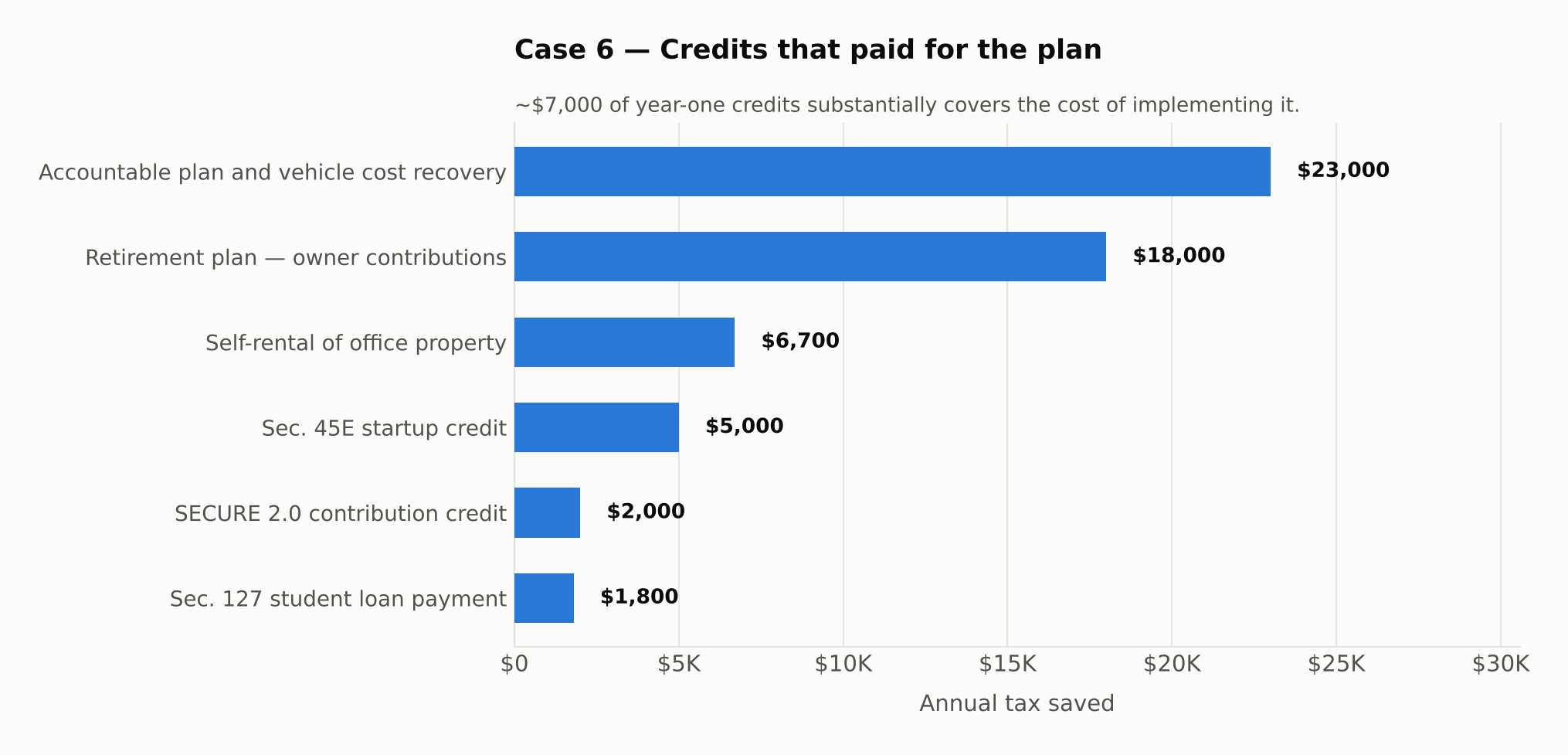
| Retirement plan, owner’s contributions | ~$50,000 | ~$18,000 federal tax saved | $50,000 in the owner’s retirement account |
| Retirement plan, employee contributions | ~$10,000 | Deductible; offset by credit in year 1 | Employee retention and goodwill |
| Sec. 45E startup credit | $5,000 credit | $5,000 direct offset | n/a |
| SECURE 2.0 contribution credit | ~$2,000 credit | $2,000 direct offset | n/a |
| Sec. 127 student loan payment | $5,000 | ~$1,800 federal tax saved | $5,000 of loan principal retired with pre-tax dollars |
| Accountable plan, home office | $6,900 | Included below | $6,900 received tax free |
| Accountable plan, other reimbursements | ~$7,000 | Included below | ~$7,000 received tax free |
| Vehicle accelerated depreciation | ~$50,000 | Combined with above: ~$23,000 federal tax saved | Depreciable business asset |
| Self-rental of office property | $18,000 rent redirected | ~$6,700 federal tax saved | Real property equity; rental income largely sheltered by depreciation |
Aggregate effect:
- Combined additional deductions from the accountable plan and vehicle cost recovery total approximately $63,000, worth roughly $23,000 of federal tax.
- Approximately $13,900 of cash reaches the owner tax free through accountable plan reimbursements, which can itself fund the elective deferral in step 7.
- The $18,000 of rent formerly paid to third parties is still deducted by the practice, but now builds the owner’s equity, with the rental income on the owner’s side largely offset by depreciation.
- Credits total approximately $7,000 in year one, which substantially covers the cost of implementing the plan.
- Taken together, the pass-through income flowing to the owner is reduced by hundreds of thousands of dollars, the effective rate falls, and in excess of $100,000 that would otherwise have been tax or idle cash is redirected into retirement investments, debt reduction, business assets and real property equity.
The implementation costs are modest and largely self-funding: plan setup is covered by the Sec. 45E credit; employer contributions are offset by the SECURE 2.0 credit and deductible besides; mortgage interest on any acquired property is deductible and the principal portion builds equity. The strategies also reinforce one another, the tax saved on vehicle cost recovery funds the retirement contributions, and the accountable plan reimbursements supply the cash for the elective deferral.