
Case study. Adapted from an actual engagement. All identifying details removed; all figures are the real figures.
The savings
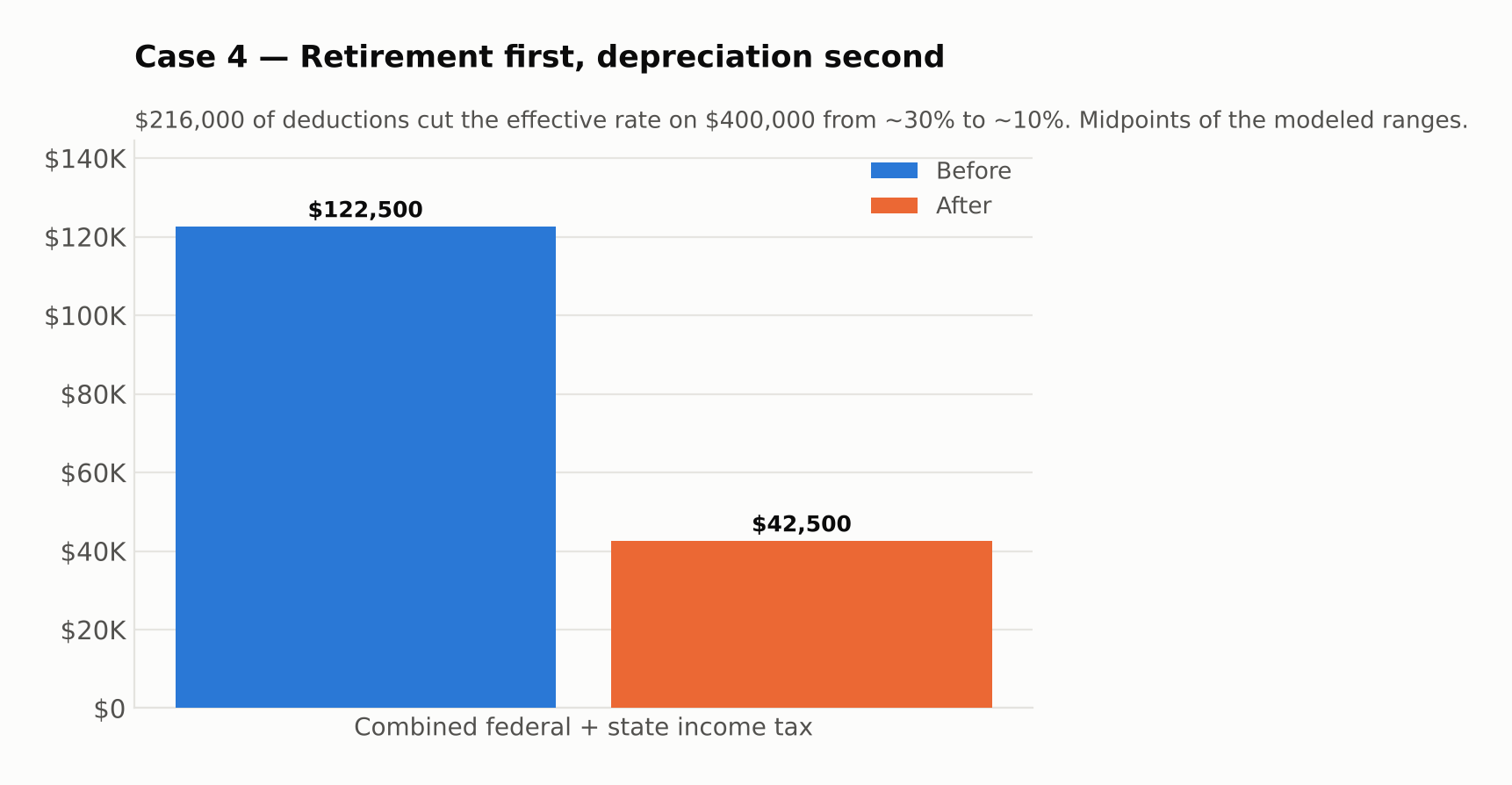
$75,000 to $85,000 a year, the taxpayer moves from writing a $125,000 cheque to writing a $40,000 one, a reduction of more than 65%, and the effective rate on $400,000 falls from about 30% to about 10%.
The Taxpayer
A self-employed professional operating an unincorporated practice with no full-time employees other than the owner. The practice is the taxpayer’s sole source of earned income. The taxpayer files as an unmarried individual and claims one dependent. The actuarial discussion below assumes a participant in the 40s or 50s range, which is the input that drives defined benefit funding.
For the most recent completed year the taxpayer paid over $60,000 in combined federal and state income tax. The planning illustration that closes this case models a $400,000 taxable-income year.
The taxpayer came to the engagement with no qualified retirement plan, no real estate, no disability coverage, no life insurance, and no health savings account. Every recommendation is a first-time implementation.
The Situation
A self-employed professional earning in the high six figures with no retirement plan and no depreciable assets has essentially no deductions beyond the standard deduction and ordinary practice expenses. All net profit is exposed to the top marginal brackets and to self-employment tax. The taxpayer’s goals were to cut the current tax bill, build retirement wealth, protect the income stream funding everything else, and evaluate the “infinite banking” concept, about which the taxpayer asked specifically.
Delivered as a written planning report in November 2025 covering four domains: retirement plan selection and layering, real estate acquisition and loss utilization, insurance (income protection, death benefit, cash value), and health coverage structured to enable HSA funding.
Issues Presented
- Which self-employed retirement vehicle, Solo 401(k), SEP IRA, or a defined benefit plan, produces the largest deductible contribution at this income level, and can they be layered?
- How can real estate depreciation be used to shelter income, and under what circumstances can rental losses offset the taxpayer’s active practice income rather than being suspended?
- What is the tax and economic difference between participating in a real estate partnership as a limited partner versus a general partner, and how does that choice affect loss character?
- How should income protection and death benefit coverage be structured, and does an overfunded participating whole life policy (“infinite banking”) have a legitimate place in the plan?
- How should health coverage be selected so that the taxpayer captures both the above-the-line self-employed health insurance deduction and the triple tax benefit of an HSA?
- What is the aggregate before-and-after tax outcome if all of the above are implemented in a single year?
Analysis
Solo 401(k) as the Primary Deferral Vehicle
A one-participant 401(k) is available because the practice has no full-time employees other than the owner. It permits two distinct contributions, and this two-part structure is the whole reason it beats a SEP at most income levels.
The first is the employee elective deferral: $22,500 for the earlier year at issue, rising to $23,000 for the following year, plus a $7,500 catch-up for a participant age 50 or older. The second is the employer nonelective contribution of up to 25% of net self-employment income. The two together are bounded by the overall annual additions limit of $69,000 for the later year, plus catch-up where applicable.
At this taxpayer’s profit level the full $69,000 is reachable. At an assumed 35% marginal federal rate, a maxed contribution is worth approximately $24,000 in federal tax alone, before state savings. The plan also permits designating the employee portion as Roth while still taking the employer portion as a deduction, which gives the taxpayer a dial to blend current deduction against future tax-free growth.
SEP IRA, Why It Was Rejected as the Primary Plan
A SEP permits only employer contributions, capped at 25% of net self-employment earnings and subject to the same dollar ceiling, approximately $66,000 for the earlier year, $69,000 for the later year.
At a maxed-out income level the deduction is roughly equivalent. The Solo 401(k) wins on three margins:
| Feature | Solo 401(k) | SEP IRA |
|---|---|---|
| Employee elective deferral | Yes, $22,500 / $23,000 (+$7,500 catch-up) | No |
| Employer contribution | Up to 25% of net SE income | Up to 25% of net SE income |
| Combined ceiling | $69,000 (plus catch-up) | ~$66,000 / $69,000 |
| Contribution in a low-profit year | Meaningful via deferral even if 25% of profit is small | Strictly a percentage of profit |
| Roth component | Yes (employee portion) | No |
| Participant loans | Permitted | Not permitted |
| Administrative burden | Higher | Lower |
The decisive point is the low-profit year. A SEP’s contribution is purely a function of profit percentage; the Solo 401(k) floor is the elective deferral, which survives a bad year. The taxpayer should use one or the other, not both, and the Solo 401(k) is the correct primary vehicle. A prior-year SEP contribution, if any, is left undisturbed.
Defined Benefit Plan Overlay
Where the Solo 401(k) ceiling is a fixed dollar amount, a defined benefit plan’s deductible contribution is the output of an actuarial calculation driven by participant age, the targeted retirement benefit, and compensation. For a high earner in the 40s or 50s, annual contributions “well into six figures” are routine. The memorandum models $100,000 per year, which at a 35% federal rate is approximately $35,000 of federal tax saved annually, state savings excluded.
The plan may be layered on top of the Solo 401(k) in the same year, so the aggregate deferral is the sum of both, the single largest lever available to a self-employed taxpayer at this income.
The costs are real and must be disclosed to the client:
- Mandatory funding. The contribution is a funding obligation tied to a promised benefit, not a discretionary election. There is some flexibility within an actuarial range, but it is not the on-off switch a defined contribution plan is.
- Permanence. A plan terminated after a short life invites a challenge that it was never established with the requisite intent of permanence, with penalty exposure.
- Actuarial and administrative cost. An enrolled actuary must certify the funding calculation annually.
- Income stability requirement. The strategy is only prudent where earnings are consistently high and cash flow can service the commitment through a down year.
The recommendation was to obtain a plan design proposal from an administrator showing contribution and tax savings across several benefit targets before committing.
Real Estate: Direct Ownership and Cost Segregation
Direct ownership of rental property supplies depreciation, which is the mechanism that converts positive cash flow into reported losses. Annual depreciation is a deduction against rental income; a cost segregation study reallocates basis from the long-lived building shell to shorter-lived components, appliances, flooring, site improvements, landscaping, accelerating deductions into the early ownership years.
Where depreciation and operating expenses exceed rent, the result is a net rental loss. Unused losses are not forfeited: they carry forward and may be used against future passive income or against gain on disposition.
Direct ownership also gives full control over the levers that matter for tax, the decision to commission a cost segregation study, the financing structure, the timing of disposition, at the cost of active management burden. A property manager’s fee is itself deductible and does not by itself destroy any tax position discussed here.
The illustration contemplates acquisition of a duplex or small multi-unit building to begin, with a larger cost-segregated property added.
Real Estate: Syndications and the Character of Syndicated Losses
Passive participation through a syndication or private real estate fund suits a taxpayer whose professional practice consumes available time. Capital is pooled, a sponsor manages, and the investor receives a Schedule K-1 reporting a share of income or loss.
Because sponsors commonly combine cost segregation with bonus depreciation, a first-year K-1 frequently reports a loss even where the property is cash-flow positive. The memorandum’s example: a $50,000 investment producing a $40,000 reported first-year loss.
That loss is passive. Absent a qualifying exception it offsets only passive income, other rentals, other partnerships, and otherwise suspends and carries forward, available against future passive income or against gain on sale. Where the taxpayer qualifies as a real estate professional, the same loss becomes available against active practice income.
Real Estate Professional Status and the Passive Loss Barrier
This is the hinge on which the real estate portion of the plan turns. Rental activity is per se passive unless the taxpayer qualifies as a real estate professional. The test has two prongs, both of which must be satisfied:
- More than 750 hours of service during the year in real property trades or businesses in which the taxpayer materially participates; and
- More than half of the taxpayer’s total personal services in all trades or businesses for the year performed in real property trades or businesses.
The second prong is the obstacle. A taxpayer working full time in an unrelated professional practice cannot satisfy a “more than half of all working time” test without materially scaling back that practice. The honest advice was that this status is not available in the near term, and that it becomes available only if the taxpayer deliberately restructures how working time is allocated, or, should filing status change, if a spouse can satisfy the test while the taxpayer continues generating the practice income.
The value if achieved is direct: a $40,000 loss that would otherwise suspend instead offsets $40,000 of practice income, worth roughly $14,000 or more at a 35% marginal rate in the year claimed. Contemporaneous time logs are the evidentiary foundation and must be maintained from the first year of any attempt, whether or not the test is met, because the record cannot be reconstructed later.
Limited Partner Versus General Partner
| Limited Partner | General Partner / Sponsor | |
|---|---|---|
| Capital contributed | The investment amount | Often less cash; sometimes sweat equity |
| Management role | None | Sponsorship, acquisition, capital raise, operations |
| Liability | Limited to the invested amount | Materially greater; mitigated by entity structure |
| Economics | Pro rata share | Fees plus carried interest in the upside |
| Character of income/loss | Passive | Non-passive where materially participating |
The tax consequence of the distinction is the character of the resulting loss. A materially participating general partner’s loss from that activity is non-passive and available against other active income on a deal-by-deal basis, without needing real estate professional status across the whole portfolio. The practical consequence is that a general partner role is a second job. It should not be undertaken for the tax result alone. The recommendation was limited partner positions in syndications, with active ownership only in directly held property.
Income Protection: Long-Term Disability
The taxpayer’s earning capacity funds every other element of this plan. A disability that halts the practice halts all of it, so coverage is the predicate to the plan rather than an afterthought. Specifications recommended:
- Benefit amount sized to actual need; carriers will write monthly benefits in the five figures for high earners, typically replacing 60–70% of usual income.
- “Own occupation” definition of disability, the policy pays if the insured cannot perform the specific occupation, regardless of theoretical capacity to do other work. The most important term in the contract, and the one most often compromised to reduce premium.
- Cost-of-living adjustment rider, so a long-duration claim is not eroded by inflation.
- Residual/partial disability rider, paying proportionately where part-time work is possible but full-time is not.
Death Benefit: Term as the Baseline
Because the taxpayer supports a dependent, a death benefit is required. Level term is the efficient baseline: a 20- or 30-year term with a $1,000,000 to $2,000,000 death benefit. Sizing is driven by income replacement years, debt retirement, and future obligations including the dependent’s education; a common heuristic is roughly 10 times annual income, tailored rather than applied mechanically.
Overfunded Participating Whole Life (“Infinite Banking”)
The taxpayer asked about this specifically, so it is addressed on the merits.
The mechanics: purchase a participating whole life policy structured for cash accumulation rather than maximum death benefit, typically with paid-up additions riders, and deliberately overfund it up to, but not past, the limits that would classify it as a modified endowment contract. Cash value accumulates without current taxation. Once cash value exists, the policyowner borrows against it using the policy as collateral. Loan interest is paid to the insurer, which credits the policy’s account less a spread, and, the feature that drives the strategy, the full cash value continues to earn dividends as though no loan were outstanding, because from the carrier’s perspective the loan is secured by the death benefit. Repayment is on the owner’s schedule.
The costs, stated honestly: acquisition costs and commissions consume a substantial portion of early premiums, so the strategy generally does not demonstrate its advantage until 5 to 10 years of consistent funding, and premiums must continue to keep the policy in force. A conventionally designed whole life policy will not perform this way; the design must come from an advisor who specializes in these structures.
The benefits are a controlled, tax-advantaged pool of capital, a permanent death benefit with estate planning utility, and liquidity by contract rather than by underwriting. The intended use here is funding the real estate acquisitions above, borrow for a down payment or syndication subscription, repay from the investment’s returns. Sequencing matters: this is positioned after the Solo 401(k) and HSA are maximized.
Health Coverage and HSA Stacking
Two separate benefits were being missed.
Above-the-line premium deduction. A self-employed taxpayer not eligible for subsidized coverage through any employer may deduct premiums for medical, dental, and qualifying long-term care coverage for the taxpayer and dependents as an adjustment to income on Schedule 1, without itemizing. On a $5,000 annual premium, that is $5,000 off the top of AGI.
HDHP plus HSA. A high-deductible health plan trades a higher deductible for lower premium and eligibility to fund an HSA. HSA treatment is triple-advantaged: contributions deductible without itemizing, growth untaxed, and distributions for qualified medical expenses untaxed.
| Self-only | Family | |
|---|---|---|
| Earlier year limit | $3,850 | $7,750 |
| Later year limit | $4,150 | $8,300 |
| Age 55+ catch-up | +$1,000 | +$1,000 |
Because the taxpayer covers a dependent, family-tier limits apply on a plan covering both. Funding $8,300 at an assumed combined federal and state rate of 30–35% is worth roughly $2,500 to $3,000 per year.
Reimbursement account versus long-term investment account. The HSA can be run two ways, and the choice is a planning decision rather than a mechanical one. Run as a reimbursement account, contributions in and qualified distributions out make current medical costs effectively pre-tax. Run as an investment account, the taxpayer contributes the maximum, pays current medical costs from other funds, and leaves the balance invested to compound. The second approach is superior for a taxpayer with the cash flow to support it, because there is no deadline connecting an expense to its reimbursement: a qualified expense incurred after the HSA is established may be reimbursed from the account years or decades later, on receipts retained in the interim. That makes the account a deferred-reimbursement reserve the taxpayer controls the timing of. After age 65 a non-medical withdrawal is taxed as ordinary income without penalty, so the account functions as a supplemental retirement vehicle in the worst case. Receipt retention is the operative discipline.
The Plan
| Step | Action | Timing |
|---|---|---|
| 1 | Establish Solo 401(k); fund employee deferral and 25% employer contribution to the annual additions limit | Immediately; fund throughout the year or before the filing deadline |
| 2 | Obtain defined benefit plan design proposals across several benefit targets; adopt if cash flow supports a multi-year commitment | Next 1–2 quarters |
| 3 | Obtain long-term disability quotes; bind an own-occupation policy with COLA and residual riders | Within 1–3 months |
| 4 | Bind level term life coverage sized to the dependent’s needs | Within 1–3 months |
| 5 | Identify first direct rental acquisition (duplex or small multi-unit); commission cost segregation at acquisition | Next 12–24 months |
| 6 | Evaluate limited partner positions in sponsored syndications for diversification and K-1 depreciation | Concurrent |
| 7 | Begin contemporaneous real estate time logs regardless of whether REPS is achievable this year | Immediately |
| 8 | At next renewal or open enrollment, price HDHP against traditional coverage; if HDHP, open and max the HSA | Next enrollment period |
| 9 | Educate on and obtain illustrations for an overfunded participating whole life design, after steps 1 and 8 are funded | After other vehicles maxed |
| 10 | Update quarterly estimated tax projections to reflect the new deductions so estimates are not overpaid | Ongoing |
Projected Result
The integrated illustration, modeled on a $400,000 taxable-income year:
| Before (no strategies) | After (fully implemented) | |
|---|---|---|
| Taxable income before planning | $400,000 | $400,000 |
| Solo 401(k) contribution | n/a | ($66,000) |
| Defined benefit plan contribution | n/a | ($100,000) |
| Subtotal, retirement deductions | n/a | ($166,000) |
| Real estate depreciation utilized | n/a | ($50,000) |
| Total deductions applied | n/a | ($216,000) |
| Resulting taxable income | $400,000 | ~$184,000 |
| Federal income tax | n/a | ~$37,000–$40,000 |
| Combined federal + state income tax | ~$120,000–$125,000 | ~$40,000–$45,000 |
| Annual tax reduction | n/a | ~$75,000–$85,000 |
| Effective rate on $400,000 | ~30% | ~10% |
The real estate deduction assumes $50,000 of the available depreciation losses are usable against other income in the modeled year, the optimal case, which requires real estate professional status or another exception. Where the losses suspend instead, taxable income is correspondingly higher and the benefit is deferral rather than current reduction. The depreciation in the illustration comes from the duplex, the syndication K-1, and in particular a cost-segregated 8-unit property.
Reading the two columns together: the taxpayer moves from writing a roughly $125,000 check to writing one of roughly $40,000, retaining in excess of $80,000, a reduction of over 65%.
The mechanism is worth stating plainly because it is the transferable lesson. The retirement contributions strip income out of the highest marginal bracket at a known, guaranteed rate. The real estate deductions then work on what remains, and because brackets are progressive, each successive dollar of deduction is worth slightly less than the one before, which is why the deferral-first, depreciation-second ordering matters.