
Case study. Adapted from an actual engagement. All identifying details removed; all figures are the real figures.
The savings
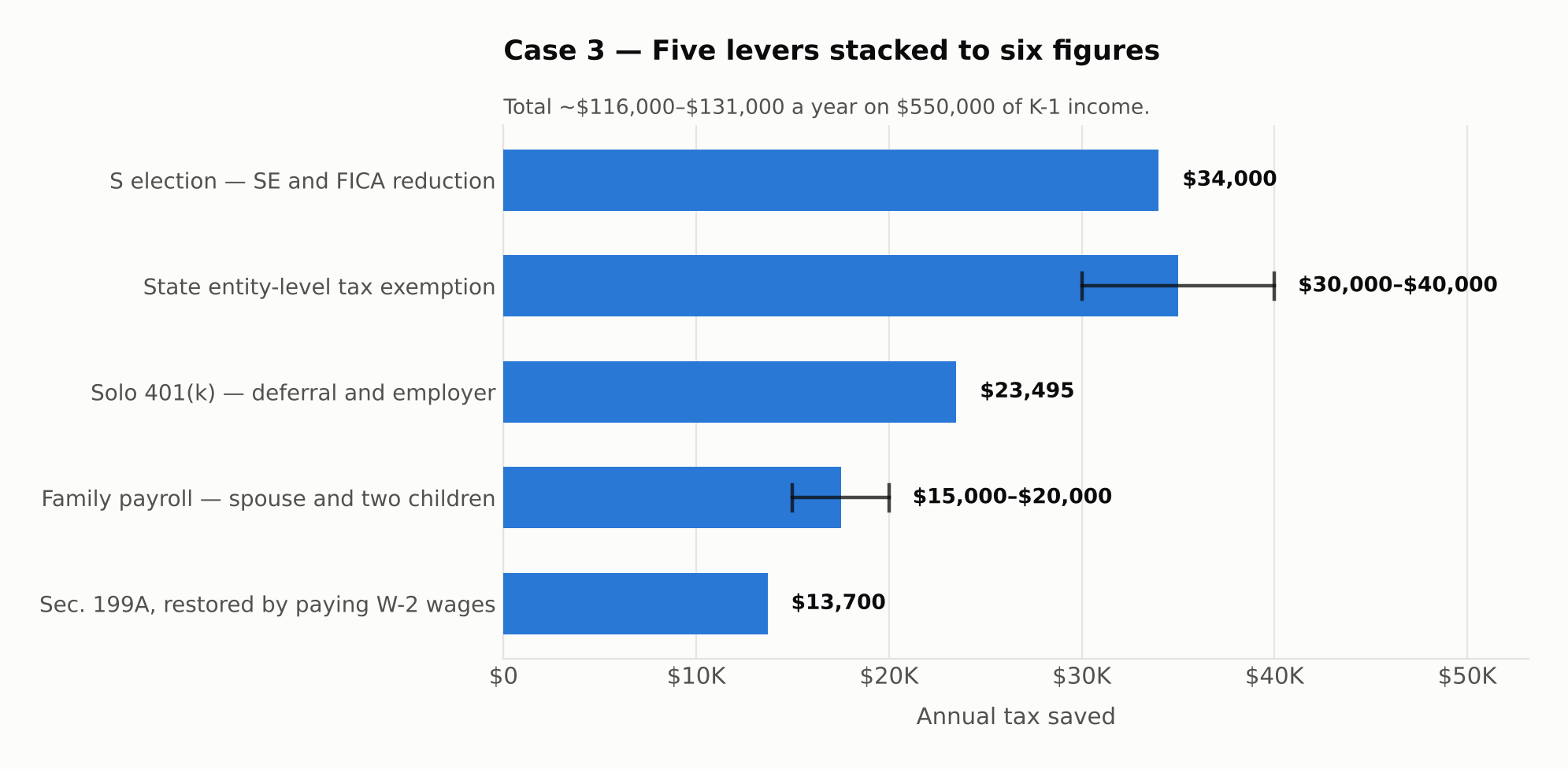
$116,000 to $131,000 a year, moving the federal effective rate from about 24.9% of gross income to about 17.2%, with entity-level state exposure reduced to zero. The figure excludes what happens to the $63,500 a year going into pre-tax retirement accounts, roughly $2.0 million in fifteen years at a 7% assumed return.
The Taxpayer
An individual in his mid-forties, married and filing jointly, with two dependent children under age 18. He is an equity partner in a professional-services firm, receiving approximately $550,000 annually in partnership K-1 distributions. His practice constitutes a specified service trade or business (“SSTB”) under IRC Sec. 199A(d)(1)(A), which drives much of the analysis below.
He holds no entity structure of any kind. Partnership distributions flow directly to him as an individual and are reported on his Form 1040. He also has real estate investment activities outside the practice.
He is domiciled in a state that imposes no individual income tax but does impose a low-rate net-worth-based franchise tax and a mid-single-digit entity-level income tax on business entities doing business in the state. That combination, no personal income tax but a meaningful entity-level tax, is the single most important state-law fact in the engagement, because it means the obvious federal move (forming an entity) carries a state-level cost unless a specific statutory exemption is elected.
His stated goals: reduce his effective tax rate, accelerate wealth accumulation, and achieve compliance efficiency.
The Situation
The taxpayer earned a high income in the most tax-inefficient possible form. Partnership distributive income received directly by an individual partner is subject to self-employment tax on the full amount up to and beyond the wage base, is reported without the benefit of any entity-level deduction planning, and provides no access to employer-side retirement contributions.
Four problems compounded:
Self-employment tax on the whole amount. With no entity, the full $550,000 of distributive income runs through the self-employment tax computation. There is no distribution component to shelter from FICA because there is no corporation to make distributions.
No employer retirement capacity. Without W-2 compensation from an entity he controls, the taxpayer’s retirement options were limited to vehicles keyed to individual contribution limits. He had no mechanism for employer contributions, which is where the large deductible dollars live.
Sec. 199A squarely in the SSTB phase-out corridor. At $550,000 of joint income, and with a practice that is an SSTB, the taxpayer sat above the phase-out range entirely. The qualified business income deduction was being lost, not reduced, lost, because of where his taxable income fell relative to the thresholds. This is one of the few situations where reducing taxable income produces a double benefit: the direct benefit of the deduction, plus the restoration of a deduction that disappears above a threshold.
An entity-level state tax waiting on the other side. Forming an entity to solve the federal problems would ordinarily expose the taxpayer to a low-rate net-worth-based franchise tax and a mid-single-digit entity-level income tax on net earnings apportioned to the state. On $550,000 of net earnings that combination is in the range of $30,000 to $40,000 annually, enough to swallow a large share of the federal savings.
Recently enacted federal legislation (referred to in the engagement as the One Big Beautiful Bill Act, or “OBBBA”) changed several of the relevant parameters, generally favorably, and made permanent a provision that was otherwise set to sunset.
Issues Presented
- Entity structure. Should the taxpayer form a single-member LLC to receive his partnership distributions, and should that LLC elect S corporation status?
- Reasonable compensation. If the S election is made, what W-2 salary is defensible against recharacterization, and how is it documented?
- Retirement vehicle selection. Which retirement vehicle is optimal for this income profile, and which are affirmatively wrong?
- Family employment. Can a spouse and two minor children be employed in the entity to shift income into lower brackets, and what is the actual FICA treatment of children’s wages paid by an S corporation?
- State entity-level tax. Can the entity-level state tax exposure created by the new entity be eliminated?
- Sec. 199A interaction. How do the above moves affect the SSTB phase-out computation?
- OBBBA parameters. Which newly enacted or newly permanent provisions change the analysis?
Analysis
Relevant OBBBA provisions
Permanent Sec. 199A deduction. The qualified business income deduction was scheduled to expire after December 31, 2025. The legislation made it permanent and increased the phase-in threshold for SSTBs. For tax years beginning after 2025, the SSTB income phase-out range begins at $400,000 (MFJ) with complete phase-out at $500,000 (MFJ).
This is the critical planning note. At $550,000 the taxpayer is above the complete phase-out. Every dollar by which the strategy reduces his taxable income moves him back toward the corridor, and within the corridor each dollar of reduction restores a proportionate share of the deduction. Pre-tax retirement contributions and family payroll deductions are therefore doing two jobs at once.
Permanent 100% bonus depreciation. IRC Sec. 168(k) bonus depreciation at 100% was restored and made permanent for qualified property placed in service after January 19, 2025. This is directly relevant to the taxpayer’s real estate investment activities and is also available if the new S corporation acquires depreciable personal property for legitimate business use.
Expanded Sec. 1202 QSBS exclusion. Exclusion rates for qualified small business stock were expanded to 50% for stock held more than three years, 75% for more than four, and 100% for more than five, and the per-taxpayer gain exclusion cap was raised to $15,000,000 from $10,000,000. This is not available to an S corporation, which cannot issue QSBS, but it is relevant to future C corporation investment planning.
Permanent estate and gift exemption increase. The federal estate and gift tax exemption was permanently set at $15,000,000 per individual, $30,000,000 for a married couple, indexed, removing the sunset, materially widening the wealth transfer window for a taxpayer about to begin accumulating significant assets.
Retirement contribution enhancements. The catch-up limit for individuals aged 60 to 63 was increased to $11,250, indexed. Solo 401(k) limits for 2025 remain $23,500 of employee deferral under age 50, plus employer contributions of up to 25% of W-2 compensation, subject to a $70,000 total.
Formation of the single-member LLC
Form a single-member LLC to receive the partnership distributions. By default it is a disregarded entity under Treas. Reg. Sec. 301.7701-3, so income continues to flow to the Form 1040 as though the LLC did not exist. The baseline provides liability separation and establishes the vehicle capable of making the S election. It is a platform, not a strategy.
The S corporation election
The LLC should file Form 2553 to elect S corporation status under IRC Sec. 1362(a). Once accepted it is treated as an S corporation for federal income tax purposes while retaining single-member LLC status under state law, a structure widely used by professional service providers.
The mechanical benefit: only the shareholder-employee’s reasonable W-2 salary bears FICA and payroll tax. The remainder, distributed as S corporation distributions, is not subject to self-employment tax under IRC Sec. 1402 or to FICA under IRC Secs. 3101–3121. The Service requires reasonable compensation before distributions. Rev. Rul. 74-44; Watson v. Commissioner, 668 F.3d 1008 (8th Cir. 2012).
Reasonable compensation
A defensible salary is the single most critical element of S corporation planning, because it is the Service’s primary attack vector. The Service has successfully recharacterized distributions as wages where compensation was disproportionately low relative to services rendered. Relevant factors: (1) training and experience; (2) duties and responsibilities; (3) time and effort devoted to the business; (4) payments to non-shareholder employees in comparable roles; and (5) what comparable firms would pay for similar services.
For a professional-services partner with extensive transactional experience generating $550,000 of income, the recommended W-2 salary range is $155,000 to $175,000. This analysis uses $160,000 as the baseline. The figure should be documented annually with a formal compensation study or published occupational wage data, and the conclusion recorded in corporate minutes or a resolution.
Note the interaction with retirement planning, which argues against the bottom of the range. The employer contribution to a solo 401(k) is capped at 25% of W-2 compensation, at $160,000, that is $40,000. A lower salary reduces payroll tax but also reduces retirement capacity, so the optimum is not the minimum.
Status quo versus S election
| STATUS QUO: NO ENTITY | |||
|---|---|---|---|
| Income component | Amount | Tax rate | Tax owed |
| Gross K-1 / partnership income | $550,000 | n/a | n/a |
| Self-employment tax (92.35% base) | $508,425 | 15.3% / 2.9% | $21,239 |
| Federal income tax (MFJ, 37% bracket) | ~$414,000 taxable | 10%–37% | ~$120,000 |
| QBI deduction (Sec. 199A) | ($110,000) | 20% of QBI | ~($14,800) savings |
| Net investment income tax (Sec. 1411) | N/A (active) | 3.8% | $0 |
| State individual income tax | $550,000 | 0% | $0 |
| Estimated total annual tax burden | $550,000 | ~24.9% | ~$126,439 |
| PROPOSED: SMLLC + S CORP ELECTION | |||
|---|---|---|---|
| Item | Amount | SE / FICA rate | Tax impact |
| Reasonable W-2 salary | $160,000 | 15.3% | $24,480 |
| S corp distribution (avoids SE/FICA) | $390,000 | 0% | $0 |
| SE tax savings vs. status quo | n/a | n/a | ~$34,000 saved |
| Solo 401(k), employee deferral | $23,500 | Pre-tax | ($8,695) savings |
| Solo 401(k), employer match (25% of W-2) | $40,000 | Pre-tax | ($14,800) savings |
| Total 401(k) contribution (2025 limit) | $63,500 | n/a | ~$23,495 tax saved |
| QBI deduction (Sec. 199A, permanent) | ~$100,000 | 20% | ~$13,700 saved |
| Estimated total annual tax burden | $550,000 | ~17.2% | ~$94,600 |
| Estimated annual tax savings | ~$31,800+ |
The S election alone generates estimated FICA and self-employment tax savings of approximately $34,000 annually on the distribution component, before accounting for retirement contributions, family payroll, or state tax savings.
Retirement vehicle analysis
The S corporation structure unlocks access to the solo 401(k), which is the superior vehicle for this income profile.
| Vehicle | 2025 limit | Tax deductible? | Roth option? | Best for | Recommendation |
|---|---|---|---|---|---|
| Traditional IRA | $7,000 | Phased out at income | No (backdoor) | Supplemental savings | Low priority |
| Roth IRA | $7,000 | No (after-tax) | Yes | Tax-free growth | Backdoor only |
| SEP-IRA | $70,000 | Yes (25% of W-2) | No | Simple, high limit | Inferior to solo 401(k) |
| Solo 401(k) | $70,000 (+$7,500 catch-up) | Yes, employee + employer | Yes (Roth sub-account) | Maximum deferral | Primary |
| Defined benefit | Up to ~$280,000 | Yes, actuarial | No | Age 50+ / high income | Layer on later |
Solo 401(k), primary recommendation. Establish a solo 401(k) through the S corporation. It offers the highest contribution limits, maximum flexibility, and a Roth sub-account.
- Employee deferral: $23,500 for 2025 (under age 50); $31,000 if the participant were age 60 to 63 under the enhanced catch-up provision
- Employer contribution: up to 25% of W-2 compensation, at a $160,000 salary, $40,000
- Total 2025 contribution: $63,500 (up to $70,000 with catch-up)
- Tax savings at a 37% marginal rate: $63,500 × 37% = $23,495 of federal income tax savings
- Roth sub-account: employee deferrals may be designated Roth, tax-free growth with no required minimum distributions
The plan also permits participant loans of up to 50% of the vested balance, not to exceed $50,000, emergency liquidity without a taxable distribution.
Defined benefit or cash balance plan, secondary. To defer beyond the solo 401(k) limits, particularly as income grows or as he approaches his mid-fifties, a defined benefit or cash balance plan can be layered on top. Under IRC Sec. 415(b) the maximum defined benefit payout is $280,000 for 2025, indexed. A cash balance plan can generate annual contributions of $150,000 to $280,000 or more depending on actuarial assumptions, age, and income. The strategy is most powerful with a ten to fifteen year runway before retirement, precisely this taxpayer’s position, which is why it is sequenced as a later layer rather than discarded.
Backdoor Roth, supplemental. Income exceeds the Roth IRA direct contribution limit ($240,000 MFJ for 2025). A $7,000 non-deductible traditional IRA contribution followed by immediate conversion is permissible under IRC Secs. 408(d)(3) and 408A and is not prohibited by the step transaction doctrine; see Notice 2014-54. The pro-rata rule under IRC Sec. 408(d)(2) must be checked before the first conversion if any pre-tax IRA assets exist. The spouse may execute a separate $7,000 backdoor Roth as a spousal IRA under IRC Sec. 219(c), for $14,000 combined annually.
SEP-IRA, not recommended. A SEP permits up to $70,000 or 25% of net self-employment income, but offers no Roth option, no loans, and, decisively here, requires proportional contributions for all eligible employees. Because this S corporation will employ family members, a SEP creates mandatory contributions for them and is materially less efficient than the solo 401(k).
Family employment strategy
Employing bona fide family members in the S corporation shifts income into lower brackets while generating legitimate business deductions.
The Sec. 3121(b)(3) question, stated carefully. For children under age 18 employed by a partnership or sole proprietorship owned by a parent, wages are exempt from Social Security and Medicare tax under IRC Sec. 3121(b)(3).
Important caveat, and it is the crux of this section. That exemption applies by its terms to partnerships and sole proprietorships owned by the parents, not to S corporations. Payments by an S corporation to the owner’s children are generally subject to FICA, because the corporation, not the parent, is the employer, and the exemption is keyed to the parent-employer relationship. Counsel should therefore consider whether to retain the LLC’s disregarded-entity status for employment tax purposes, or whether a separate family management entity should employ the children. The tables below present the FICA-exempt scenario, with the distinction flagged for resolution before the children are added to payroll.
Spouse employment. The spouse may be employed in a legitimate, documented capacity, office management, client relations, marketing, bookkeeping, at a salary reflecting fair market value for services actually rendered. At a $28,000 salary the income is largely offset by the standard deduction ($14,600 for 2025, single filer), producing a combined family rate on that tranche of roughly 10% to 12% rather than the taxpayer’s marginal 37%, and effective savings of approximately $7,000 or more annually. The spouse may also fund a separate solo 401(k) if earned income supports it, and a spousal IRA.
Children’s employment. Children may be employed for genuine services, filing, data entry, social media, administrative support, at compensation reasonable for the work actually performed. The 2025 standard deduction for a dependent with earned income is $14,600, so the first $14,600 of wages is effectively free of federal income tax. IRA or Roth IRA contributions may then be made up to the child’s earned income.
| Family member | W-2 salary | Std deduction | Fed tax | FICA (S corp) | Net take-home |
|---|---|---|---|---|---|
| Principal | $160,000 | $30,000 (MFJ) | ~$24,600 | $24,480 | ~$110,920 |
| Spouse (legitimate business role) | $28,000 | $14,600 (single) | ~$1,540 | $2,142 | ~$24,318 |
| Child #1 (under 18, bona fide work) | $14,600 | $14,600 (single) | $0 | $0 (exempt) | $14,600 |
| Child #2 (under 18, bona fide work) | $14,600 | $14,600 (single) | $0 | $0 (exempt) | $14,600 |
| S corp distribution to principal | $332,800 | n/a | ~$84,000 | $0 (no SE) | ~$248,800 |
| Family total take-home (after all taxes) | ~$550,000 | n/a | ~$110,140 | ~$26,622 | ~$413,238 |
The family payroll strategy removes approximately $57,200 from the 37% marginal bracket (spouse plus two children), generating estimated federal income tax savings of $15,000 to $20,000 annually, and relocates those wages into brackets of 0% to 12%, a permanent arbitrage of the rate differential rather than a deferral.
Documentation requirements are non-negotiable: (1) bona fide employment agreements; (2) timesheets or contemporaneous records of services rendered; (3) payroll run through a legitimate processor; (4) Forms W-2 issued at year end; and (5) consistent payment at fair market rates.
The entity-level state tax exemption
The exposure. The state of domicile imposes a low-rate net-worth-based franchise tax and a mid-single-digit entity-level income tax on net earnings apportioned to the state. Without planning, the new LLC or S corporation would be subject to both, producing a combined estimated liability in the range of $30,000 to $40,000 annually. That is not a rounding error against $31,800 of federal savings, it would reverse the entire plan.
The personal-liability exemption. The state’s entity-level tax statute provides a statutory exemption available where the entity’s members accept personal liability for all entity obligations. That is the natural condition of a single-member LLC whose sole member personally guarantees, or is jointly and severally liable for, the entity’s obligations.
By filing the state’s exemption election with the state revenue department, the LLC affirmatively elects that status and is exempted from both entity-level taxes entirely. The election is perpetual unless voluntarily revoked or the entity ceases to qualify.
Independence from the federal S election. The exemption election is made at the state LLC level and is independent of the federal S corporation election. The S election is filed with the Service for federal income tax purposes; the exemption election is filed with the state revenue department for state tax purposes. The two are fully compatible and do not conflict.
| Item | Without the election | With the election | Annual savings |
|---|---|---|---|
| Entity type | SMLLC (standard) | SMLLC (exemption elected) | n/a |
| Net-worth-based franchise tax | Up to $2,500+ | $0 (exempt) | $2,500+ |
| Entity-level income tax on net earnings | In the range of $30,000 to $40,000 | $0 (exempt) | In the range of $30,000 to $40,000 |
| Filing requirement | Annual entity return | One-time exemption election | n/a |
| Compliance burden | Annual filing + CPA cost | Minimal ongoing | CPA time savings |
| Total estimated state tax saved annually | In the range of $30,000 to $40,000/yr exposure | $0 owed | In the range of $30,000 to $40,000/yr |
Note the sequencing consequence: because the exposure accrues from the moment the entity begins doing business, the exemption election must be filed contemporaneously with formation, not at the first annual filing.
Sec. 199A interaction
The practice is a specified service trade or business for Sec. 199A purposes. At $550,000 of joint income the taxpayer sits above the complete SSTB phase-out. The combination of pre-tax retirement contributions ($63,500) and family payroll deductions (~$57,200) reduces taxable income by well over $100,000, moving him back into, and potentially through, the $400,000 to $500,000 corridor, restoring a partial or full QBI deduction. The modeling above assumes a restored deduction of approximately $100,000 of qualified business income, worth roughly $13,700.
This computation must be run annually. It is sensitive to income level, to the exact contribution amounts, and to the indexed thresholds, and it is the one element of the plan whose value changes most from year to year.
The Plan
Step 1, Entity formation (weeks 1–2). File articles of organization for the new single-member LLC with the state. Obtain an EIN on Form SS-4. Draft and execute an operating agreement consistent with S corporation requirements. Open a dedicated business bank account in the LLC’s name.
Step 2, S corporation election (weeks 2–3). File Form 2553 within two months and fifteen days of the beginning of the tax year for current-year effectiveness. Confirm eligibility: a single class of stock, domestic entity, eligible shareholders, fewer than 100 shareholders. Establish a payroll system and begin W-2 salary payments.
Step 3, State exemption election (weeks 3–4). File the state’s personal-liability exemption election with the state revenue department. Confirm that all members accept personal liability for all of the LLC’s obligations. Retain the election confirmation in the compliance file.
Step 4, Retirement accounts (weeks 4–6). Establish the solo 401(k) plan document with a custodian or third-party administrator. Adopt the written plan document and summary plan description. Designate the Roth sub-account if desired for employee deferrals. Establish the spousal IRA and initiate backdoor Roth conversions after confirming no pre-tax IRA balances trigger the pro-rata rule.
Step 5, Family employment (weeks 6–8). Resolve the Sec. 3121(b)(3) structuring question first. Then draft employment agreements for the spouse and each child, establish timekeeping and documentation protocols, add family members to payroll, and document job descriptions and compensation justification.
Step 6, Ongoing compliance. File quarterly employment tax returns (Form 941). File the annual Form 1120-S. Issue Forms W-2 by January 31. Conduct and contemporaneously document the annual reasonable compensation review. Monitor Treasury guidance implementing the new legislation.
Projected Result
| Strategy lever | Estimated annual savings | Notes |
|---|---|---|
| S corp election (SE/FICA reduction) | ~$34,000 | Distribution vs. salary split |
| Solo 401(k), pre-tax deferrals | ~$23,495 | Employee + employer |
| QBI deduction (Sec. 199A, permanent) | ~$13,700 | 20% of QBI |
| Family payroll income shifting | ~$15,000–$20,000 | Spouse + two children |
| State entity-level tax exemption via the election | In the range of $30,000 to $40,000 | Both entity-level taxes |
| Total estimated annual savings | ~$116,000–$131,000 | Conservative estimate |
The $116,000 to $131,000 figure deliberately excludes the compounding effect of $63,500 or more invested annually in pre-tax retirement accounts. At $63,500 per year and a 7% assumed growth rate, the retirement accounts accumulate to approximately $2.0 million in 15 years and $2.8 million in 20 years. The annual tax saving is the headline; the accumulation is the actual result.
Effective rate movement: from approximately 24.9% of gross income to approximately 17.2% at the federal level, with state entity-level exposure, in the range of $30,000 to $40,000, reduced to zero.